



S02E08 – Heather Barnett – B2B Marketers: Off The Record
In this episode, Freya Ward interviews Heather Barnett, a seasoned B2B copywriter and content creator,…
"You’ve actually got to earn the trust of the board to demonstrate that the scary things you’re going to tell them later on down the line are worth taking a risk in because they believe in you."
— Joel Harrison, Joel Harrison B2B
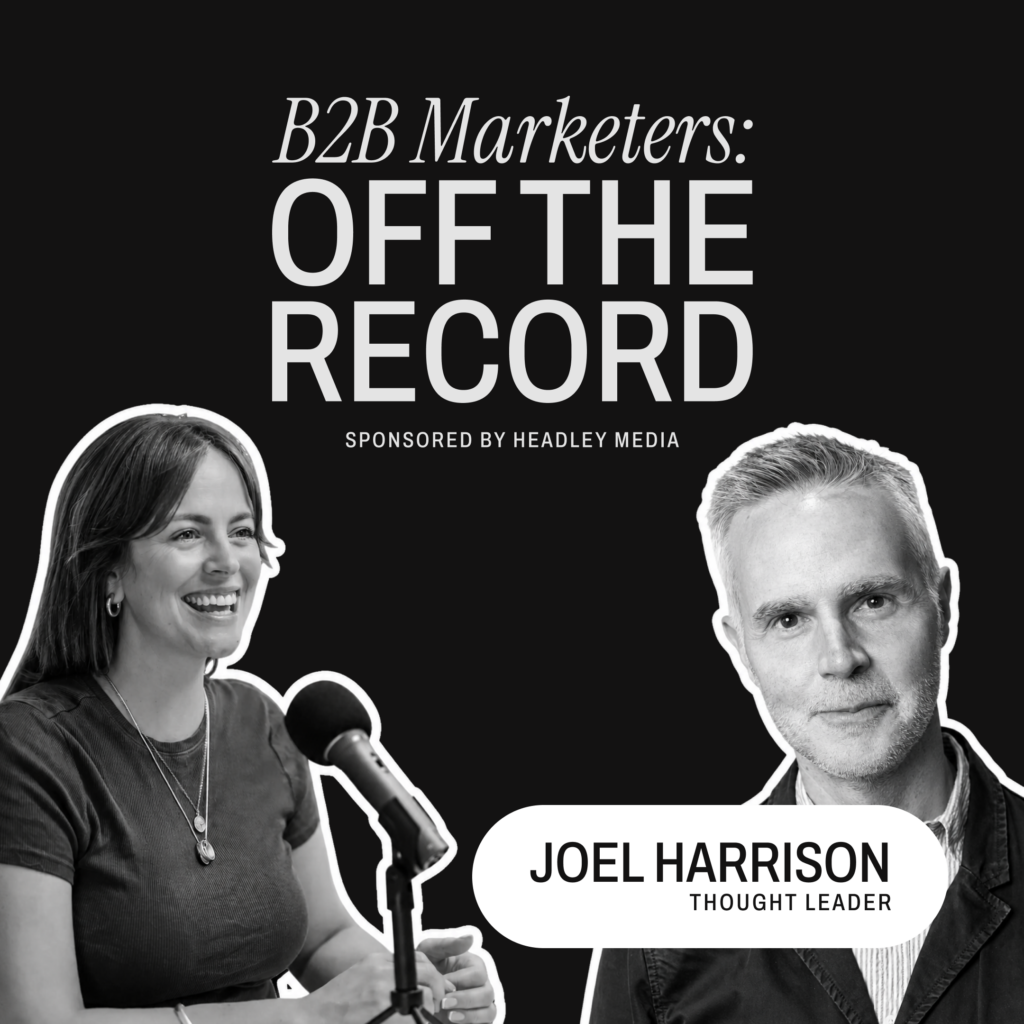
In this episode of B2B Marketers Off the Record, Joel Harrison shares his journey in the B2B marketing space, discussing the evolution of marketing strategies, and the importance of trust and influence. In this conversation, Joel and Freya focus on the limitations of traditional metrics like MQLs and the importance of strategic marketing that aligns with business goals. They emphasize the need for marketers to communicate effectively with stakeholders and advocate for a long-term approach to thought leadership and brand strategy.
Takeaways

Freya Ward (01:11)
Welcome to another episode of B2B Marketers Off the Record. I am joined by Joel Harrison, who is a thought leader in the B2B marketing space and is also the host of Trust and Influence podcast. Joel, would you like to introduce yourself?
Joel (01:27)
I’ll certainly give it a go. So yeah, so I’ve been in B2B for 20, nearly 23 years. We launched the B2B Marketing Magazine in 2004 when there wasn’t really anything going on in B2B. If you read the marketing press, it was all about consumer. And so I kind of put a big bet on B2B and I’ve been doing it ever since. It’s kind of been my life’s work really.
And the magazine doesn’t exist anymore, the company still does. I’m still one of the owners of that business. But these days I kind of operate under my own brand and I do my own content creation and public speaking, bit of advisory work as well. You know, I use the word thought leader. It’s very, very strange to describe yourself as a thought leader. think almost someone else to describe you as that, but it’s certainly an aspirational statement. And I’m someone who’s been visible in the market and I’m really trying to become an honest broker and talk and provide people with a kind of…
an insight about how I’m seeing the world and being just a candid, trusted voice, as well as talking about trust. So that’s bit meta, isn’t it? But I’m just someone who’s trying to be out and about and B2B and well-known and visible and trusted, if not liked, as well.
Freya Ward (02:29)
Joel and I can definitely I see you everywhere you’re all over LinkedIn you’re all the events and you’re speaking in all the right places for sure and you’ve always got something interesting to say m definitely
Joel (02:41)
Thank you.
Freya Ward (02:42)
backed by your experience as well. To take us back to when you first started in B2B in the B2B space you’ve mentioned you were a pioneer a leader when it came to backing B2B and introducing m
the brand, publication and everything else. But yeah, how did you get into the space in the first place?
Joel (03:00)
Well, so way back, right, my dad was in marketing, right? My dad worked at direct marketing firms, right? So marketing was always kind of there in my life. know, we always used to, you know, we would watch the commercial breaks in the eighties and there would always be some commentary about that. know, so marketing is always a thing. So it was tuned into that. I wanted to be, I kind of fell in love with journalism really, the idea of being a journalist. When I was in school, ran a satirical publication.
university I was editor of the student newspaper which was fantastic it was just like one of those school programs those children’s CV programs about running a newspaper you know and all the everyone doing it in their spare time and kind of making up to go along and in jokes and stuff and I thought this is fantastic that’s what I want to do for my life and so I am I got into publishing and I didn’t have the the ambition or the English degree to go and work for a newspaper at the time so I kind of and I’m actually I’m a geek so I love
technical stuff. I was like, actually quite happy to go and work for a specialist magazine of some kind and what could I write about? And my first choice, to be quite honest, was architecture because that’s kind of what I’ve studied. But I’m kind of glad that I didn’t get into that. I’d still love it. It’s fascinating and cities are fascinating, but marketing was not my second choice because it was in my background. So I got into writing about marketing and then I did a couple of applications and then talking to a friend of mine from university who thinks he’s a marketer, but he’s actually a salesman.
He
was like, yeah, let’s launch a newspaper. And I said, that’s a stupid idea. Do know how much money it takes to launch a newspaper? He went, yeah. Well, should we launch a magazine instead? And the rest is history, really. mean, I’ve also got, you know, the money that I put into it with Mike, my grandmother was of an entrepreneur. And I was like, well, you know, she would like this, you know, if I was, that was an inheritance from her. So it feels like it’s kind of doing, I’m not wasting the money. I’m doing something which she’d be proud of.
um And so yeah, I describe myself as a very reluctant, accidental entrepreneur. I don’t even really feel like that anymore because the business has been around for over 20 years, but that’s my story.
Freya Ward (05:04)
love it. That’s such an interesting story. And
Joel (05:06)
Thank you.
Freya Ward (05:08)
having the courage to do it, but to also justify it. know, it’s something your grandma would want you to do. It’s entrepreneurial. And the exposure to it, I think it’s often forgotten, especially if you work in B2B, that marketing literally is everywhere, right? And often B2B marketers forget that they are.
their end customer is also a consumer. They’re not a consumer in the traditional sense, but they’re still a human, right? There’s a person at the other end of the purchase or the majority of purchases.
Joel (05:37)
Yeah, absolutely there are. I how long will that continue, by the way? Let’s not get started on the apocalypse.
Freya Ward (05:41)
Yeah.
Joel (05:42)
That’s a bit scary thing. I think there’s been historically that disconnect, hasn’t there, what I might, the message I might tune into when someone’s trying to sell me soft drinks or clothes versus the message I might tune to when I try to make a business message. And we are still people. It’s a bit like that expression. Did you hear, we’ve heard that in COVID, where people were saying, you know, I’m not working from home, I’m living from work. You know, it’s a bit of that kind of…
inhabiting a different space, a mindset in a different space. I think we’ve all become lot more comfortable with thinking more like humans in our business buying and understanding that there are different dimensions to and not having to post rationalize emotional decisions as logical ones, which is, think, what if you talk to someone like Rory Sutherland, that’s what we used to do historically, essentially.
Freya Ward (06:26)
Yeah, interesting. Living from work is a terrifying but accurate representation, I think, of the remote workforce. Joel, there’s been lots of changes in the B2B landscape, if I can throw any more cliché words into a sentence. Over the last, well, over the last 20 years, over your career, I’m sure, is there a belief that you’ve changed your mind on in the last 12 months?
Joel (06:55)
Well, about the last, roughly the last 12 months, I lost count a number of times. I had people say to me, this year it’s going to be the year of influences in B2B. And I was like, no, that’s never going to happen. But as the sign suggests, I’m kind of on the bandwagon. So.
Yeah,
I think the problem is that we, just exactly to your point just now, we inherently look, we think we know what an influencer is, and an influencer is one of those very shiny, smiley people that you see on YouTube or TikTok selling us cosmetics or something like that. And yes, of course they’re influencers as well, but in B2B, influencers everywhere, everyone is being influenced by people all the time, except some people are doing it in a more considered fashion. an influencer in B2B looks different, but it’s essentially achieving the same thing. It’s just a more complex version of B2C, which that’s kind of what B2B is really.
So I realised, and actually Ogilvie did a great bit work on this, that there are lots of people who are influencers and some of them are magazine editors and they’re like, yeah, that’s probably me too, isn’t it? and it actually happened, that message kind of landed at the same time, lots of stuff was happening, one of which was that I had the opportunity to step back from the role at B2B marketing that I had for 20 years and kind of like, what do I want to do now? So I think it’s a combination of the, things evolved.
I was in the right place to be receptive to that message. But as I hope we’re going to talk about shortly, I don’t think this is optional anymore. I think that the landscape has profoundly changed and that is just one aspect of that change that’s going on right now.
Freya Ward (08:27)
Yeah, it’s interesting, isn’t it? You just made me think about it. In a previous life, I was agency side and I was working at an electronics agency. So very traditional marketing, quite niche. I’m also a geek. So I enjoyed aspects of it. Definitely not a technical electronics writer myself, but yeah, very much enjoyed aspects of it. And that traditional…
Marketing channel, I guess had early stage influencers. It was the editors. It was it was the PR side of things, but they weren’t and probably still wouldn’t call themselves influencers, but it’s the unbiased Brand association and loyalty alongside opinion perspective and everything else. I’d never quite considered it in that way em
talk about B2B buyers and where they’re changing. Are there any particular shifts that you’re seeing in that B2B buying behaviour?
Joel (09:25)
think I’m so loathed to bring in AI, but AI, and let’s talk about this very specifically and this relates back to the question we just talked about there. We know that people are using AI to do their research, but I think we tend to think about that at that kind of… um
awareness stage, that early stage of the bio journey, but actually I was at an event last week which I hadn’t really appreciated the depth to which that the decision and consideration phase AI is coming into play and it goes back to point about influencers. All of the analysts, all of the people we talked about there, those professional influencers who have real resonance and trust. The machines, the LLMs…
rightly,
thank goodness, trust the humans more than they trust that content you generated on your website. So earned beats owned, right? that’s a, whereas I think we’ve just come out of this kind of content marketing period where we thought we could out publish our rivals. You can’t do that anymore. And that’s the big shift that’s going on right now. And I don’t think people are quite understanding the resonance of that. Looking at the entries to the B2B Marketing Awards, the amount of…
entries that talk about the depth of thinking around LLMs all the way through the bio journey that just isn’t there. It might be happening it’s not published but I don’t I think we’re still playing catch-up on that.
Freya Ward (10:51)
Yeah, it’s an interesting point, isn’t it? The marketing world is so cyclical in my experience and I remember quite forcibly encouraging our clients to partner with brands. We were a reseller of HubSpot at the time when I was agency side and encouraging them to partner with HubSpot, um purchase them as SCRM and to own the gate on their site and to own the content. And it was all of that.
owned piece and to discourage them from working on the earned piece. But it’s AI discoverability and AI models. I know we don’t want to bang on about it in this conversation, but they’re, they’re supporting the PR move, they’re supporting the influencer move, they’re supporting the unbiased opinion, they’re supporting or unbiasing quotation marks depending on how you’re, you know, whether it’s paid or unpaid and so on and so forth.
But they are actually giving credit to, through various methods and channels, they’re giving credit to that earned media piece. Yeah, it’s really interesting. It keeps us on our toes, right?
Joel (12:04)
As uh an ex journalist, I was a recovering magazine journalist, right, because that’s what I did for years, you know,
Freya Ward (12:09)
you
Joel (12:11)
I’m still kind of giving half a chance to not be back, kind of thing, like someone with an addiction. But I think it’s a good thing. think it’s…
It’s actually we’re going, content marketing’s great and I love producing content, but actually it’s the objectivity, it’s that resonance, it’s the trust that’s really important. that’s, if LLMs are doing that, then actually it’s good. We’re getting back to a period of intermediaries in a way that we didn’t have before. I think there was an assumption that to your point at the start, we’re a movement towards, throughput towards more like consumer where everything’s going straight to brand. Actually we’re going back a step and I don’t think that’s a bad thing at all because actually it’s based on
more objective findings as long as the LLMs are doing their job properly.
Freya Ward (12:53)
Yeah, and it’s not, it doesn’t make the media space a race to the bottom when it comes to price and everything else, know, quality, strength of relationship with the media audience, all of those important factors. Who knows, circulation figures might come back around again uh as a key criteria.
Joel (13:11)
They
might, but that’s really interesting point you raised that the question follows then is like, obviously the magazines just aren’t, the magazine sector isn’t what it used to be anymore. So the question which poses, and you kind of alluded to that, is like, who’s paying for the objectivity, right? And at this event I was at, a lot of analysts or ex-analysts, some of them are at Forrester and…
maybe less enthusiastic about that particular model. And then you have people like G2 there, reviews. so there’s a bit of a, you know, I think that perhaps that middle space needs to be repopulated. It’s not quite fit for purpose in the way that it was. I guess why Reddit and things like that are so popular right now. We’re going off that right wormhole here, aren’t we?
Freya Ward (13:55)
We are, but this is what this podcast is about. And I think I’ll try and bring us back on track, but it’s definitely, it’s definitely an interesting conversation that I think we could probably debate about for a long time. Let’s bring it to kind of more tactics and strategic bets. So what is a strategic bet that you think more marketing leaders will have to make over the next few years?
Joel (14:15)
I’m gonna sound like a broken record of course I’m gonna say it’s about you need to make a bet on trust and influence, right? You need to rethink about trust because it’s really really changing.
And even if you take LLMs out of the equation, you know, if you look at what resonates as a just purely in terms of LinkedIn, I hate to give LinkedIn too much credit, but in terms of what your voice has reached people, know, it’s the personalities that really reach people. It’s as individuals with resonance and trust. And I talk about five different personas within B2B that you need to build up or you need to leverage depending particularly on where your trust issue is, because, you know, everybody wants more revenue and they want faster revenue, right? And there are always roadblocks.
and the 5 % that talk about thought leaders, employee advocates.
journalists, unpaid influencers essentially, journalists and analysts, paid influencers and then customer advocates. And those are the people that you need to really be focusing and investing in. Those are the individuals which will cut through in a way that your brand won’t in this world. Because if you look at what’s happening, for example, at the BBC, I’m a massive advocate of BBC, by the way. And so I don’t say this with any pleasure, but the kind of the talent drain that’s been going on there because the individuals, because the BBC isn’t able to pay people as much money as they might think they earn. And those individuals know they can
money elsewhere, either working for themselves or somebody else, so they’re going off somewhere else. And I think that’s one of the reasons why the whole intermediary space is re-shifting. And I feel like I’m talking about it, I’m actually part of that as well. So again, it’s got bit meta, hasn’t it? That’s pretty weird.
Freya Ward (15:47)
I think it’s appropriate and I think of the five that you’ve just listed, we see a lot of content being produced at the moment. know lots of speakers that getting, their careers are kicking off because they are supporting businesses and how they can get their employee voice out there and how they can coach their employees to build the personal brand and have courage and everything else. But there’s four other aspects that you’ve mentioned there.
When it comes to customer advocacy and that side of things, is it testimonials or is it incentivizing to write on G2? Is it Reddit? I don’t want you to give all your secrets away, Joel, but I’d love to unpack them a little bit further.
Joel (16:26)
Absolutely, and it’s not my secrets by the way, know, this is one of the five areas I’m looking at but it’s a really good because I think that’s the what you just expressed there is the problem. People just assume that the be all and end all of the customer advocacy is a case study and a good case study is a really good thing, right? It can be a great thing but it should be much broader than that and it’s about having their voice across all aspects but both in terms of the actual assistance in bringing them close and helping them to develop and evolve your products and services things like customer boards are really really valuable all the way through to uh obviously there’s the kind of case
study
in whatever format is appropriate, whether that’s a video orientated one or a text one or anonymous one or a publicly explicit one, getting to speak on stage for you as well is a really incredibly powerful thing to do. And then enable them to being public referenced, reference, you know, to be able to be proactive as a reference customer. And so that they could, they would volunteer to speak to people, other people going through the final stages of a procurement process. That’s gold dust, right? And the problem that we’ve had is actually there hasn’t been any kind of system of record to do that.
And there’s people, consultancies like Advocacy Bridge, I just did some work with them, they did some great content around them, who are helping people build those programs. And there’s things like Trusted, which is a great platform to actually help you to um kind of industrialize or processize that so that what is not happening is you’re not getting one salesperson talking to, or lot of salespeople trying to bombard the same individual to be a reference customer 20 times. You’re actually trying to like really build out and… um
create a base of customers who are happy to be part of that. And there are many other things in between by the way, those are the things that just leap to mind. So it’s breadth and it’s consistency and it’s having the depth of that activity that’s going to make a difference.
Freya Ward (18:09)
Yeah, it’s really, really interesting. I had a conversation with someone who made quite a strong prediction around referral networks and partnerships and working with your customer base in a partnership rather than a customer versus vendor or customer versus, you know, tech company, whatever you want to call yourselves. um And actually learning some lessons from our friends in the channel, you know, learning some lessons from, because that,
If you step foot into that side of the industry, it’s all about relationships. I am so delighted that there is so much more value again, and emphasis again on genuine relationships, connections, em and that referral. Because if you’re someone that’s passionate about building rapport, long-term retention with clients, long-term partnerships and friendships off the back of working together, then
You know, there was a period of time when all of that kind of got pushed away or pushed to one side in our industry. and anonymized testimonials became the norm. So actually speaking with your customers, allowing even your marketing department to speak with your customers and go, why did you choose us? Would you be up for doing something with us? Okay. Maybe you’re not allowed. Maybe you’re in a large enterprise tech company and you can’t shout about which vendors you’re working with, whether that be media vendors or whether that be.
tech products or whatever it might be, maybe just understanding the boundaries of each customer and then working out how the partnership can work for both of you. I love your idea of bringing them on stage with you, not necessarily to even talk about your product, but to talk about their expertise.
Joel (19:51)
Well yeah, talk about your experience of working within the business challenge you’re trying to address. That’s where the value comes. My role was a conference producer for us, for B2B Marketing for many years, and that’s what I wanted to hear from. So I could totally agree with you. Partnership is where it’s at. And it’s often easy to be cynical. Again, as a journalist, I’m always cynical. But when someone says, it’s a partnership, is it a partnership? I mean, you bought something from them, right? But particularly in marketing relationships, like account-based marketing, it really does need to be partnership. It’s about depth of relationship and strategic alignment.
thinking like a partnership, then you’re probably not really going to go anywhere near getting the best out of your mutual dependency. yeah, partnership, I agree with you. Yeah. Yeah.
Freya Ward (20:32)
And it has to work both ways. That is the definition of a partnership, right? It’s not
just great. You’ve worked with me. Now can you tell someone else about it? Instead it’s, this is a partnership, you know, I mean, I’m not going to go into it, but there’s so much theory around why people buy, right? Why does someone buy something? Is it personal gain? Is it to impress something? Is it to hit a metric? Is it, there’s so many different reasons why people purchase. And if you can try and uncover some of that, you’re starting to build a partnership. If you can understand.
you know, why that and what that individual is trying to actually achieve in your partnership, then you can add value to them as well. Let’s trip it back and go to some high level thinking. What three words do you think describe B2B marketing right now?
Joel (21:18)
I would say transforming, relentless and dynamic.
Freya Ward (21:23)
Ooh, spicy words. Can you unpack relentless for me a little bit?
Joel (21:30)
Well, because I think that most B2B marketers would, that’s kind how they describe, I’m not sure necessarily the word they would use, but that’s what I would take as the summation of all of that, because it’s just change after change after change. then we’re beset by macroeconomic forces, and we just think there’s some degree of kind of consistency and predictability, and certain politicians aren’t gonna…
wage
war on certain other countries for no perceived reason, without a clear plan, stuff like that. It just feels like since COVID it’s been…
just one thing after another, as my mother-in-law would say. yeah,
Freya Ward (22:11)
Relentless.
Joel (22:13)
relentless is a good word. But I also think the flip side of that is that B2B markets have to be relentless. You have to be kind of constantly evaluating what you’re doing, constantly looking at the new, constantly questioning whether what you did before was right. So yeah, think relentless is a, double-edged sword is an appropriate word.
Freya Ward (22:31)
Yeah, I think it’s a great word because it’s on the surface, it’s quite a negative word. But actually, if you’re relentless as an individual, you’re not going to give up, you’re going to keep going, you’re going to keep pushing and all those changes. I mean, I think a lot of people when I ask them what three words describe B2B marketing, they like to throw the word boring in and I strongly disagree with the word boring when it comes to B2B. It’s just a bit of a cop out. I’m going to say it. em
Joel (22:57)
I saw a session, sorry, I just have to chime in on that one because I agree with you. I just think if you think it’s boring, go and work somewhere else. um
Freya Ward (23:04)
you
Joel (23:05)
um I saw a session at Cannes this year and was three creators, I hate that word but that’s another one which applies to me as well, um who are working in-house for brands and they were all American, sorry Americans but there’s a different cultural nuance and one of them was very vocal, she was like, yeah B2B is boring, it’s hard you have to make it not boring and I’m like, well if you really think that then go and work somewhere else, I can understand how that, but…
With gritted teeth I say, I understand why that could be a mindset that enables you to do what you do.
I don’t believe that your customers, and this is a company providing accounting services, uh technology accounting, your customers don’t think their property is I think it’s really critical, right? Accounting isn’t my favourite thing in world, but I know that businesses can’t run without it. So it’s not the most exciting thing in world, but it’s actually really important. The people who do the accounting, they love that stuff because they’re accountants, right? They love numbers and things like that. you know, it irks me. I think that people like that should probably grow up.
time. um But I can understand why it could be a helpful way to galvanize what you’re doing.
Freya Ward (24:16)
Yes, yeah, yeah, I agree. I agree with you on that. And yeah, it irks me as well. It’s not boring. I’ve built my entire career around working in the B2B space. Personally, I can’t think of anything worse than working in the B2C space. So take from that what you will. Maybe it says something more about me. What’s something then?
Joel (24:38)
Yes it does in a nice way, sorry.
Freya Ward (24:41)
What’s something that you think B2B marketing teams are still doing out of habit that no longer works or no longer serves them?
Joel (24:49)
Will you hate me if I say MQLs?
Freya Ward (24:52)
No, this is, this isn’t, I will happily debate it the other way, but I, I may agree with you. Go ahead.
Joel (24:57)
Okay, I feel like a lot of the problems that we have upstream with marketing needs to be able to talk to CFOs and CEOs is that they’re looking for a transactional language and MQLs is the only thing they really have to demonstrate, to apparently demonstrate the value that marketing can create and yet…
they’re often not worth the paper or the digital spreadsheet they’re written on and they force everything downstream into a transactional language which is unhelpful. I’m not saying we don’t need leads but I don’t think MQLs um as one of many metrics are completely wrong but they shouldn’t be the be all and end all and it’s certainly much I think it’s much better if you can be focused on an account-based methodology to be thinking about that. So in that context, MQLs.
Freya Ward (25:48)
Room 101 in the bin with MQLs for Joel. I don’t disagree with you. I talk about MQLs a lot. I work for a lead generation company. We sell MQLs potentially depending on what an MQL means to you. Yeah,
Joel (26:01)
That’s the other thing.
Freya Ward (26:04)
go ahead.
Joel (26:05)
No, exactly. It’s like everyone defines it slightly differently and even when you’ve got a clear definition the goalposts seem to get moved. Sorry, was a tangent carry-on. Sorry.
Freya Ward (26:15)
No,
no, no, I completely agree with you. talk to, I talk on stage a lot about how marketers have to be bilingual is the way that I put it. And what I mean by that is you don’t need to be able to speak other languages, but you need to be able to speak stakeholder, you need to be able to speak C-suite, finance, sales, etc. to have a successful marketing department in inside of your business because
And MQL doesn’t mean anything. It means something completely different to the person sat in that chair versus the person sat in that chair versus the salesperson versus the C-suite versus the CFO. If you ask the CFO, they’ll probably tell you they’re too expensive and they don’t convert. If you ask the salesperson, they’ll tell you they’re rubbish. You ask the marketer, they might be the best thing since sliced bread, or they could have been burnt in the past by poor MQL um definition, execution, delivery, whatever it might be. If you look on the Headly website, we
we try very hard to not talk about MQLs because I personally don’t think the tactic is the problem. I think the assumption that everybody knows what it is and what they should do with it is the problem. The expectation or the misaligned expectation of exactly what it is is the problem.
Joel (27:30)
I agree with that. think my problem on the flip side of is that we’ve had 20 years to figure this out and we still don’t seem to got there, which makes me think, are we going to sort it out or not? I worry that the inherent system is broken and I wonder if it’s possible to sort it out. But I’m glad you didn’t hate me anyway, that’s the most important thing.
Freya Ward (27:53)
No, not at all. I think it’s a really important conversation to be having. em And I think if you were to ask me something that B2B marketers em are still doing out of habit that no longer works, it’s that simply just accepting an MQL and passing it off as an MQL is where I think we’re going wrong. em Talk about leadership, stakeholders. I’ve said about the need to be bilingual. em What’s…
One thing, if you were talking to leadership, what’s one thing you think they need to truly understand about marketing?
Joel (28:25)
it’s a strategic discipline. I don’t mean that it’s about marketing strategy, it’s about business strategy. Marketing should be fundamental to informing and setting business strategy from a…
product and price perspective as well. And marketing’s got the unique ability to actually see beyond the boardroom about what the market is doing, thinking more than sales people have because they’re only used because they’re last conversation. marketing gets kind of restricted to the, I was talking to the podcast and Nick Eads recently is a fantastic super guy and really intelligent. He’s saying that the four Ps of marketing or marketing just gets to do place and promotion, that sort that doesn’t get to do price and product. And I think the only thing about the GT
m push is that you’re seeing marketing’s being pushed further away from those two aspects. It’s kind of amalgamated slash bodged together with sales, which does make sense from one point of view but it means that strategic value is therefore more limited. So I think that’s the thing that worries me.
Freya Ward (29:25)
Yeah, marketing department deserves a seat at the table. It shouldn’t be seen as just a cost or an aid to sales and instead it should have its own, well it’s a strategic principle in its own right.
Joel (29:39)
Yeah, it feeds into the wider business strategy. that’s the thing that… yeah, marketing strategy, great marketing strategy, but that’s going to plug into the business strategy. And if business strategy doesn’t reflect what the market and marketing’s input, then it’s not going to be as good as it should be. And marketing’s only ever going to be as good as the business strategy.
Freya Ward (29:58)
Yeah, yeah, yeah. Let’s talk about investment. Budgets potentially being slashed. We’re seeing some of it go on the up, or at least from the recent recordings. We’re hearing about some budgets coming back and returning to marketing, especially as we’re starting to plan out for the new year as well. Where there are instances that budgets are being cut, what investment do you think marketers should hold onto?
Joel (30:22)
Well,
I was going to say customer advocacy, but we talked about that just now. So I can’t say that, can I? I’ve got to something else this time. As well, I talked about those five people in the persona group.
I’m a massive buyer of thought leadership, but it is very expensive if done properly. Because I distinguish between thought leaders, who you may have thought leaders in your organization who are visible, that they’re responsible for creating their own relevant new content and have the ability to
to.
distribute that and promote that with authority and with reach or be the vehicle for that. Thought leadership is strategic discipline which in my definition based on looking at hundreds of awards entities in the B2B Marketing Board it’s about a really big idea that’s communicated through multiple tracks. So yes, thought leaders as individuals are part of that. It’s also about having something runs through the line and it’s a multi, it’s a full funnel activation and it’s not just a short campaign that’s done. It should live over multiple years, multiple periods of time.
and you deploy all of your individuals to that.
I would say I think everybody needs a thought leadership position and that’s not just, it’s not content marketing. That’s the thing that gets confused by it. It’s something which is genuinely challenges people’s thinking and provides a point of difference to the organization. And it’s not advertising, it’s not content marketing. It’s actually a true strategic activity.
Freya Ward (31:46)
Interesting. So is this what you would suggest positioning as almost like the North Star and then everything else comes comes off of it? This is your long term thought leadership strategy, the business direction, the messaging, all of that feeds into it and then you have the more tactical, you know, you have your all your different tiers and your different levels. Is that my understanding?
Joel (32:07)
Yeah.
Freya Ward (32:08)
Right.
Joel (32:08)
That’s exactly right. Yeah. Because the danger is that people marketing, you know, it’s often, like we can, we talk about long-term plans and then life happens. And then was scrambling around to do something else and it’s probably the hard, it’s the hardest thing. It’s the, can’t do it unless it’s long-term, right? You can, you know, it can’t really do properly medium-term. You’ve got to think long-term to get value out of it. A really good example, like something like Edelman, their trust barometer, you know, that’s a marketing company. They’ve been it for 25 years. You know, they’ve really committed to it and it delivers for them.
So I think what happens is that demand generation, there’s this schism between brand and demand and marketers, certain people who sell advertising services quite often are the ones saying, you need to invest uh in brand, which means invest in advertising, which you can do that relatively quickly. demand generation is obviously much more kind of sales orientated, but the bigger perspective, the ownership should then create advertising execution opportunities and tactical demand generation.
activities down the line as well. But it takes time.
Freya Ward (33:13)
Yeah, it takes time and it takes time to show results off the back of that, right? It’s not that it’s gonna, there’s no end date and there’s necessary review date or anything. So it has to be treated with a different mindset that is this is a long-term investment and it will feed into everything else that we’re doing.
Joel (33:34)
Yeah.
Yeah, but it’s not saying it doesn’t have like a bearing on a sales conversation because it should be about creating tactical sales enablement content and interactive content as well. The salespeople can use or can be used pre-sales to move that conversation further forward. So it’s not like you have to like, you’ve got to do this and then wait three years. You you can deploy those things within market. And I did a piece recently looking again at the WTB Marketing Awards data and I was thinking, well, is there inherently a clash between
advertising and thought leadership because they’re both trying to play for this is the high moral ground, right? And there are much more people talking about advertising than are talking about thought leadership. Actually, if you look at the data, it shows is that…
Advertising and thought leadership are brilliant bedfellows. They actually work really, really well together. So it shouldn’t be an either or. Marketing and thought leadership should inform advertising. And then media and advertising professionals have got this whole host of great ideas to enable them to create great advertising. But it’s just something they’ve just had to probably take a little bit more time to build those insights in the first place. And by the way, they might be, the creative director might be frustrated because they might be limited next year to doing something which aligns with the ongoing theme rather than having to be able to create something completely new, which is what they’re
like doing, let’s face it.
Freya Ward (34:49)
Yeah, yeah,
absolutely. What’s something that you wish you could change about marketing?
Joel (34:56)
This is a really good question. I wish we could bring back the old Twitter. Right, what is it? Twitter.
Freya Ward (35:03)
Twitter.
Joel (35:04)
Yeah, before… I’m not going to get into politics about billionaires and
Freya Ward (35:08)
you
Joel (35:10)
their rants, but there was a time… The best thing that happened to LinkedIn was that Twitter got bought.
because there was a time when on Twitter you had a load of people who were… it was a slice of the market, it wasn’t a whole market, it was a small slice of the market who were… there was a real community there of B2B marketers talking to each other, supporting each other, commenting, engaged. And it felt like a really good place. Not everything about Twitter was great, but that was really good. And I think… so that was good in itself. The kind of…
coalescence of power within LinkedIn I don’t think is a healthy thing for the industry. um And um I like the fact that you had this two choices, had this kind of like address book, kind of worthy stuff over here and you had this really sparky interactive…
channel over here which maybe wasn’t the best to sell things but it was brilliant to engage with other like-minded people. Tim Hughes, a, I don’t know you know Tim, who wrote the book on social, he said, I mean I think he’s still on X and various other platforms, but he said to me, Joel, everyone’s on LinkedIn but interesting people are on Twitter and I think that was a brilliant way of describing it.
Freya Ward (36:19)
Yeah,
that was fantastic. mean, I, the conversation was in the podcast. I think it was one of Chloe’s episodes, potentially with a lady called Theresa, think it was, and they were talking about Twitter and X and she said, I will not call it X. will not, I will call them tweets. I will call it Twitter and I will stand for the memories and the nostalgia of what it was. Yeah, very, very interesting. And I think,
Like minded people. I don’t know if I’m on LinkedIn a lot. I’m very active on LinkedIn. I know you are as well Joel, but there’s so much falseness, not just the slop, but there’s it’s like everybody has to put their suit on to go on LinkedIn. And if you don’t, is it appropriate? You know, this isn’t this isn’t Instagram. This isn’t Twitter. People will comment and things like that. The only place that I’ve found a similar back and forth and
you know, not there in a suit jacket and ready to go. Prim and proper is my boss gonna see this kind of interaction. More human, if you will, is within these smaller communities. It’s within these other spaces. I haven’t quite experienced it on a Slack channel. I’ve joined a few different groups and it’s just, again, it’s like everyone’s got their, either their sales hat on or they’ve got their suit on ready to put their best self forward.
But in some of the smaller communities, there’s a little bit more authenticity. There’s a bit more back and forth, but.
Joel (37:46)
problem with the community, and I say this from some experience with B2B marketing, when we pivoted from it being magazine centric, was like we knew the magazine wasn’t fit for purpose anymore, but it’s like, what should be the alternative? And we toyed with the community like eight years before then, we were all set to kind of read on something called B2B tribe, you know, but I’m glad we didn’t do that then.
And then we launched Propolis. Propolis is great and it’s just been relaunched as an AI platform. This is not a pitch, it’s just an explanation, right? But the first, so what it is now is it’s an AI platform where members can go in and access, can create genuine instantaneous marketing insight based on exclusive marketing data you can’t get anywhere else, based on all the awards entries, all the conversations are going on in Propolis with experts and all the conference sessions at B2B Marketing. So it’s much better than can get on any other LLM.
We launched it kind of around COVID time.
magazine, was just we intend to be a community and you have to work so hard to get anything to happen because everyone’s got, inherently got, as you said they’ve got their suits on, they’ve got their game face on, they’re worried about who’s listening to what, is it competitors? So the only times I’ve ever seen any, and I’ve only seen flashes of the outside of where you have a genuine set of people who are absolutely like minds, they know each other probably in the real world and then they able then digital becomes a… so I just think it’s very hard to make those things kind of work so I’ve never seen anything quite
that quite like works like that and I just don’t think human nature really is built around that unfortunately.
Freya Ward (39:18)
Yeah,
yeah, yeah, you’re right with the community aspect, it can feel quite a lot like forced fun sometimes as well, can’t it? Forced, yeah. Worst kind of fun.
Joel (39:25)
Oh, and that’s the worst kind of fun. I hate that kind of fun.
Freya Ward (39:30)
I’ve got a question from a previous guest for you, Joel. What advice would you give to a marketer who is trying to build trust with their audience, but is working with an internal team that say the classic, we’ve always done marketing this way, or this is how we do marketing.
Joel (39:46)
It’s a really good question, but I think it’s two questions. If you’re in a company where they’re saying you can’t do anything different because you’ve always done it this way, you’re in the wrong company, get out and get another job. If your company thinks that carrying on doing the same thing year after year is going to change your stars, they are bonkers. That’s the nicest possible word I can use to describe that. that’s the first thing. If you’re trying to just, but.
On a softer level, you’re trying to justify something, you get some data, show what hasn’t been working, show the decline of impact, provide opportunities, test things. It’s all the usual stuff. But I think those two things is a danger of conflict. They’re not the same problems. there is that danger of lack of willingness to think differently. But I don’t expect that companies will be around very much longer if they’re really that stuck in their ways.
Freya Ward (40:39)
Yeah, yeah, I agree. I think I mean, solid advice, get out, get out. Don’t don’t if you’re obviously there’s some compromise that we have to make as marketers, right? And there’s some areas where it’s okay. That’s too, that’s too different from our normal stance or normal message or whatever it might be. But when it is when you’re met time and time again in the boardroom or in a leadership meeting or in your SK or whatever it might be with what we’ve always done it this way.
Joel (41:07)
Mmm.
Freya Ward (41:08)
That’s not coherent for a good marketing department, is it?
Joel (41:11)
It’s not, but there’s a watered down version of that question I think is a really valid question.
actually, I was at an event this week and one of the people there was with a load of senior marketing, was really great. One of the people there was Brian McCready who’s at Adelshaw.gov. Now
Freya Ward (41:24)
Fantastic.
Joel (41:25)
I’ve known Brian for about, for a very long time and he’s just a lovely man and he’s winning all the B2C marketing awards as well at the moment, which is fantastic to see, although I’m bit like, hang on, I saw him first, you can’t have him,
Freya Ward (41:38)
Hehehe.
Joel (41:40)
he’s mine. he was, I did a podcast with him, I talked to him over the years at length, but he’s saying what he had to do to do the…
His mantra is, you’ve got to be, if you don’t feel a bit scared, you don’t feel like generally like you need to go to the toilet before you go to the meeting to show your concepts, you’re not doing your job properly.
But he also says, you’ve got to prove it first, right? So you’ve actually got to earn the trust of the board to demonstrate that the scary things you’re going to tell them later on down the line are worth taking a risk in because they believe in you. So you can’t go to them, you can’t turn up and go, right, we’re going to hire a higher balloon over Helsinki tomorrow, right? That’s just not going to work, is it? So it’s all about trust.
Freya Ward (42:23)
all about trust and influence. em Brian McCready is fantastic. I watched a presentation of his only a couple of weeks ago and he started the presentation by telling us, I’m gonna show you the scale basically of building that trust internally and when he got to the third campaign that he was showing us, he said, right, and now we’re at the point where I thought I was gonna get sacked every time I put forward an idea or…
on the night of the event I was running or whatever it might be when I was pushing those boundaries, if I got by in, it then was like, no, now I’ve got to actually deliver it and I’m probably going to get sacked. And he said that was the most exciting point in his career. And fortunately for him, touch wood, mean, he only showed us the ones that paid off. I don’t know if any of them didn’t pay off. But he, yeah, he’s an excellent, an excellent speaker, an excellent marketer and definitely one that pushes. Yeah. Yeah.
Joel (43:14)
He’s an excellent human as well. He’s a genuinely brilliant
man. And it’s one those things where you go, nice guys win, right? Well, nice people win. He deserves everything because he puts it all on the line.
Freya Ward (43:24)
Yeah absolutely. Two more questions for you Joel. em Who should we invite to speak next on B2B Marketers Off the Record and why? This could be someone aspirational, could be someone you know, who would you recommend?
Joel (43:37)
I know Scott Stockwell, former ex of IBM and I have to introduce you. He’s a fantastic guy, he’s an expert with Propolis. He’s one of these people who will start you on a conversation and you probably will be scratching your head quite soon not quite knowing where he’s gone but it’ll be quite fascinating listening to his responses. He’s got so many brilliant anecdotes and so much brilliant insight. He’s a very, very clever and very nice man.
Freya Ward (43:59)
Amazing we’ll look forward to reaching out to him and hopefully having him on the podcast and what question would you like us to take forward to the next guest?
Joel (44:07)
ah I had thought about this earlier on, I would say what inspires you just to the point around relentlessness? What is it that makes you want to get up in the morning and get to that point that Brian McCready got to where you’re genuinely scared? Yeah, what’s the inspiration that pushes us all on? Because it can be different for everybody.
Freya Ward (44:25)
I love that question and I look forward to asking it. Joel, if any of our listeners would like to find you, follow up with you, or see some more of your content, where should they go?
Joel (44:36)
Well, I’d love it if you did. You can connect with me on LinkedIn. If you just do Joel Harrison at LinkedIn, there are other ones, but they’re not really very interesting. So I’m the one with the kind of teal background. And I’d love you to subscribe to my podcast, which you can get via all the normal places, which if you hadn’t seen already, it’s called Trust and Influence in B2B
Freya Ward (44:53)
All that’s left to say is thank you so much for joining me, Joel
Joel (44:56)
Thank you, it’s been really fun.
In this episode of B2B Marketers: Off The Record, Freya Ward speaks with Joel Harrison, co-founder of B2B Marketing and host of the Trust and Influence in B2B podcast. Drawing on more than two decades of reporting on and working within the industry, Joel explores how AI-assisted buying, individual voices and customer advocacy are changing the way businesses build credibility.
At the heart of the conversation is a shift in where influence comes from. Joel argues that publishing more branded content is no longer enough. Businesses need to invest in the people, relationships and distinctive ideas that help buyers understand who to trust.
Joel admits that he was initially sceptical about predictions that influencer marketing would become a major force in B2B.
His perspective changed when he reconsidered what an influencer actually looks like in a business context.
Rather than thinking only about social media personalities, he points to editors, analysts, industry experts and other individuals whose opinions have long shaped purchasing decisions.
The mechanism is familiar: people seek out voices they consider knowledgeable and credible. What is changing is how deliberately businesses can work with those voices and how individuals can build their own reach.
For Joel, influence is already embedded throughout B2B. The opportunity is to recognise it as a strategic consideration rather than treat it as an unfamiliar consumer marketing tactic.
Joel believes marketers need to think beyond AI’s role at the beginning of the buying journey.
Buyers are also using it during consideration and decision-making, when they compare options and assess which suppliers deserve their confidence.
In his view, this strengthens the importance of credible third-party perspectives. Analyst commentary, expert opinions and independent references can influence the information buyers encounter through AI tools.
He contrasts this with the assumption that a business can gain an advantage simply by publishing more content than its competitors.
Freya connects the discussion to renewed interest in PR, media relationships and external validation.
Both recognise that the quality and objectivity of those sources matter. Joel also raises a broader question: as traditional publishing models change, how will the industry sustain the independent voices that buyers rely on?
Joel’s strategic bet is on trust and influence, supported by five groups: thought leaders, employee advocates, journalists and analysts, paid influencers, and customer advocates.
Each can help a business establish credibility in a different way.
The priority is to understand where trust is missing and which voices could help address that gap. An employee may explain a topic with practical expertise, while a customer can offer reassurance based on direct experience.
Joel sees these individual perspectives as increasingly important in reaching audiences who may not respond as readily to the brand itself.
The implication is that influence needs deliberate investment. Businesses should consider which people they support, how those people contribute and where their credibility can help buyers move forward.
Joel challenges the assumption that a customer advocacy programme begins and ends with collecting testimonials.
Case studies can be valuable, but he sees a much wider opportunity to involve customers.
That can include customer advisory boards, input into product development, speaking opportunities and conversations with prospective buyers during procurement.
A customer willing to speak directly with someone evaluating a purchase can provide reassurance that branded marketing cannot easily replicate.
However, those relationships need coordination. Joel warns against repeatedly approaching the same person for references because different salespeople do not know what has already been requested.
Freya adds that advocacy should work as a partnership. Understanding the customer’s ambitions, expertise and boundaries helps create opportunities that benefit both parties.
The aim is a sustainable relationship rather than a succession of requests for endorsement.
Joel questions the continued reliance on marketing-qualified leads as the primary language for demonstrating marketing’s contribution.
He recognises that businesses need leads and that MQLs can be one useful measure. His concern is what happens when they become the dominant expression of value.
That can push teams towards a transactional view of marketing and distract from the wider account relationship.
Definitions also remain inconsistent. Different departments may attach different expectations to the same label, making it difficult to agree what has been delivered or what should happen next.
Freya argues that marketers need to speak the language of sales, finance and leadership while making those expectations explicit.
Their shared concern is less about rejecting every lead-based tactic and more about questioning whether the metric accurately represents progress.
Joel wants leadership teams to recognise marketing as a strategic business discipline.
Its role should include informing product and pricing decisions, using an understanding of customers, competitors and the wider market.
He is concerned that marketing is too often restricted to promotion and distribution, with limited influence over the offer it is expected to sell.
Closer alignment with sales can be valuable, but Joel cautions against defining marketing so narrowly that its broader strategic contribution disappears.
Freya reinforces that marketing deserves a place in business decision-making in its own right.
For Joel, an effective marketing strategy depends on the quality of the business strategy behind it. The two need to inform one another.
When discussing investment, Joel highlights customer advocacy and thought leadership.
He draws a distinction between an individual thought leader and thought leadership as a strategic discipline.
A visible expert can contribute to a programme, but the programme itself needs a substantial idea that challenges thinking and gives the organisation a distinctive position.
That idea should run through multiple channels and stages of the buying journey. It should also have enough depth to develop over time, rather than disappear at the end of a short campaign.
Joel uses Edelman’s Trust Barometer as an example of sustained commitment to a recognisable territory.
Freya describes this as a potential North Star for the organisation’s messaging and activity.
The long-term commitment does not mean waiting years before supporting sales. Joel sees opportunities to develop sales enablement, interactive content, advertising and demand generation around the same central idea.
Joel reflects on the sense of connection he previously experienced among B2B marketers on Twitter.
He valued the informal exchanges, mutual support and access to different perspectives. He also questions whether the concentration of professional activity on LinkedIn is healthy for the industry.
Freya recognises a difference between public professional platforms and smaller spaces where people feel more comfortable speaking openly.
However, Joel cautions that launching a community does not automatically create that openness.
People may worry about competitors, professional reputation or who is listening. Meaningful participation takes effort, and established real-world relationships can make digital interaction easier.
The lesson is to distinguish providing a platform from creating the trust that allows useful conversations to happen.
Joel’s advice for marketers seeking change is to show evidence, explain where existing activity is losing effectiveness and test alternatives.
He distinguishes that challenge from working in an organisation fundamentally unwilling to consider a different approach.
For teams with room to progress, internal credibility can create permission to take bigger creative risks.
Drawing on conversations with other marketing leaders, he describes a gradual process: demonstrate sound judgement, deliver results and build leadership’s confidence before proposing more ambitious ideas.
That brings the discussion back to its central theme. Trust affects the relationship with buyers, but it also shapes what marketers can achieve inside their own organisations.
Ultimately, Joel’s message is that B2B marketing needs credible voices, genuine partnerships and sustained ideas that earn influence over time.
B2B Marketers: Off The Record is a podcast providing honest, practical conversations about what’s really working in B2B marketing. We know that many marketers can feel isolated within their businesses and constantly facing an uphill battle for marketing to be heard and understood. Off The Record was created to bring conversations to light that usually stay off the record, but are also the ones that make marketers feel less alone in what we know to be very common challenges and also uncover some interesting takes.
B2B Marketers: Off The Record is sponsored by Headley Media.
Headley Media helps technology marketers get more value from their content investment by creating engagement with audiences that are actively researching technical challenges and solutions – providing opportunities to educate, engage and nurture potential buyers, build net-new pipeline and demonstrate ROI.
In this episode, Freya Ward interviews Heather Barnett, a seasoned B2B copywriter and content creator,…
In this conversation, Beth Norton shares her journey from a marketing professional to a strategic…
In this episode, Joe Fontana, CMO of Amzai, discusses the evolving landscape of B2B marketing,…