


S02E08 – Heather Barnett – B2B Marketers: Off The Record
In this episode, Freya Ward interviews Heather Barnett, a seasoned B2B copywriter and content creator,…
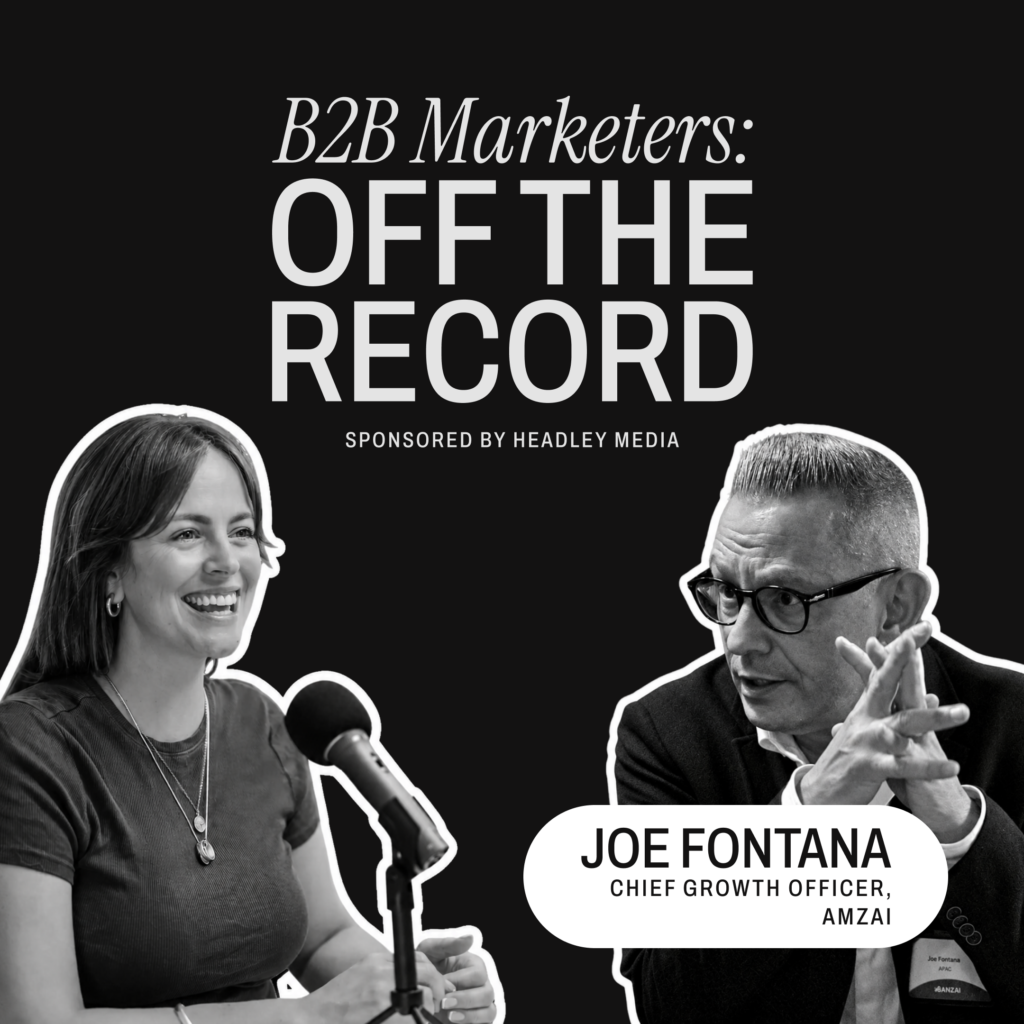
“Great sales and marketing functions don't operate to different beats. It's the same beat, but it's different parts of the same orchestra.” Joe Fontana, CMO at Amzai
— Joe Fontana, Amzai
In this episode, Joe Fontana, CMO of Amzai, discusses the evolving landscape of B2B marketing, emphasizing the importance of human connection and trust in buyer-seller relationships. He shares insights on the role of AI in marketing, the necessity of personal engagement, and the strategic value of in-person events. The conversation explores the critical alignment between sales and marketing, emphasizing the need for mutual understanding and collaboration to drive success. Joe Fontana shares insights on the importance of defining success metrics and fostering human connections in a technology-driven landscape.
Takeaways


Welcome to another episode of B2B Marketers off the Record. I am joined by my good friend Joe Fontana, who I speak to quite regularly. Joe is the CMO chief marketing officer at a business called Amzai and who better to introduce themselves but Joe himself?
Joe Fontana – CMO Amzai (01:11)
Hi everybody. yeah, I am Chief Marketing Officer for Amzai Buyer Foresight. We help B2B companies get in rooms with their top prospects. and we do it through conversations. Conversations that give sellers and buyers the opportunity to develop trust and credibility, to move past automation and AI, to have conversations that move the needle. But yes, Freya and I talk quite a bit.
She is my best B2B marketing friend on the other side of the pond. I’m excited to be here.
Freya Ward (01:46)
Amazing. Thank you so much for joining me, Joe. Let’s take it back to the beginning when it comes to your your entry into the B2B marketing world. how did you get into the space in the first place?
Joe Fontana – CMO Amzai (01:58)
Well, I was chiseling on a stone rock one day and a Neanderthal seller suggested that I get into
Freya Ward (02:05)
Yeah.
Joe Fontana – CMO Amzai (02:06)
marketing. but jokes aside, I I’ve spent most of my career on the sales side building sales works out. I came to Buyer Foresight several years ago, seeing the sales and marketing alignment gap. and eventually found myself in the chief marketing officer role. I’ve learned from some of the best.
I am a big believer that sellers are only good as the marketers that have their back and vice versa.
Freya Ward (02:35)
Yeah. You and I are singing from the same hymn sheet on that one. we’ve had
Joe Fontana – CMO Amzai (02:40)
I know I stole your hem cheat.
Freya Ward (02:43)
we’ve had kind of oppos opposite careers. I went from the marketing side into sales, you’ve gone from the sales side into marketing. I think both there’s definitely no right or wrong way, but I think we both have an interesting perspective because we’ve we’ve been in both seats.
and there’s a lot of change going on in the marketing landscape at the moment. you mentioned at the top of this conversation how important that human connection is and getting people in the room. That’s you know, why you’re representing the company that you’re working for now. what’s a belief that you maybe have, Joe, that about B2B marketing that you’ve changed your mind on in the last twelve months?
Joe Fontana – CMO Amzai (03:22)
Something that I’ve changed my mind on in the last 12 months. probably just to build on what you said. The power of human connection. today’s buyer is the most educated buyer ever. by the time they’re having a conversation with you, the homework has been done. you can’t cut corners anymore. Used to be that automation would get you the results, it still does.
But now requires a human skill set to check all the boxes, to look at all the work, ensure that the automation and AI extension of themselves are doing the needful and not burning their reputation. I did a post about it the other day, after you know everybody read about anthropic saying that AI was gonna destroy the world. And I think it will. but it’s not gonna be Terminators and Time Machines. It’s gonna be
Muppets, as you Brits like to say, that don’t have the context around the content that AI provides them with. So they’re sending their messages, they’re bombarding people with content, but don’t have any of the context around it to get those messages to resonate properly.
Freya Ward (04:39)
Yeah, I think it’s really interesting and I think there’s a lot when you start really geeking out in the AI space, there’s a lot of research around cognitive surrender, which is essentially the concept that humans are trusting AI so much that they’re actually surrendering their own cognitive functioning and that and not applying that thought process into whatever is being regurgitated out of the, you know, if we’re talking about AI in the context of LLMs and AI models.
They’re just trusting that information so much. And I guess there’s so many different directions we could take this conversation. And maybe it’s a separate conversation. but you know, the next generation of sellers, the next generation of marketers, the next generation of human beings, the future of human beings, are they going to be looking for those mistakes in the same way that you and I do, Joe, when we’re looking at something that’s produced by AI?
Joe Fontana – CMO Amzai (05:34)
If you saw my DMs on LinkedIn, the answer to that would be an resounding no. And it’s funny you say that, because people look at me, they know I’m a little older, long in the tooth, white in the hair, and you’re like, you’re anti-AI because you don’t want to adopt technology. And nothing could be further from the truth. Because I lived in a world without it. I remember going from filing cabinets to spreadsheets and spreadsheets to CRMs and all of the intent.
Tools and I mean things as simple as gong and fathom any impact they can have on a sales process. I remember years ago training sellers through an issue we thought they had, only to find out on a phone call three months later it wasn’t the issue they had. Because you couldn’t hear the conversation, you couldn’t see it live unless you were there. So I’m a big proponent and a big advocate of technology. What I’m not a fan of.
Is this current generation of marketers and sellers that look at AI as a replacement function in their skill sets? I don’t know how to do this, but AI does. AI does not know how to do it. People tend to forget these models are young. Would you hire a seven year old to go out and do your marketing outreach? So why would you depend on a model that you haven’t trained? Are you taking the time to train it?
Most people don’t. I currently have let me see forty-seven unopened DMs in my inbox right now. And I could tell you if I opened them, and this would be a great conversation, which one was written by chat, which one was written by Claude, and which one was written by Gemini Because they all have their own beat And you can tell which tool is taking what from your profile to put pardon my language, a message together.
That shows that no homework was done. I did a bit of consulting when I was on sabbatical about a year ago. Not sure if I may have shared this story with you, but for your audience, I was brought in to help a team that was just struggling. And what I noticed before I started working with them is that it wasn’t a struggle, it was like you said, it was a a surrender of their own cognitive skills. So they had a tool.
That would tell them these are the people that you talk to. Another tool that would tell them the messages that you send.
Another tool that would develop the cadences in which those messages go out. So for the first few days of working with them, I sabotaged every tool. Giving you the wrong ICP. Messages that are hallucinating and mirroring what the prospect does. So in essence, it was selling the prospect on their own company. IBM, please buy a computer.
And then I made sure that those messages went out in the middle of the night. But before I let anybody to so it got to a point that I was like, I wonder how long it’s gonna take before these people realize that I have mucked up the works. And no one realized it.
Freya Ward (08:44)
Wow.
Joe Fontana – CMO Amzai (08:45)
So I had to put the brakes on. Before you get any of these tools back, here’s what research looks like. I’m gonna teach you to do it.
You’re going to come back to me with the companies that you’ve researched and why you think they’re a fit. Then you’re going to tell me who in the organization are the best people to listen to your story. Then you’re going to show me that you know how to write a message from their perspective. Can’t use word I. Can’t use the word me. Don’t use the word us. Don’t mention the name of your brand. Talk through the pain. Now let me see eight messages that tell that story. Now we’ll figure out when to send it.
You guys could do that for ninety days, I’ll give you your tech back. On on day ninety one of this eighteen member team, only two people asked for the tech back.
Freya Ward (09:32)
Wow.
Joe Fontana – CMO Amzai (09:33)
Because they’re like, hey, I’m doing well with fifteen, thirty, fifty contacts. I’d like to get to a hundred. Okay, what are you gonna do the moment I give it to you?
Well, I’m gonna re ch check everything so I don’t have the mistake I had the first time.
Freya Ward (09:49)
Yeah. ‘Cause you
Joe Fontana – CMO Amzai (09:50)
so
many people look at it like I remember I used to have to do research on prospects. Let’s just say for argument’s sake, it’s eight hours of work a week to do non-automated, not tech enabled research on your prospects. I’m gonna target these five accounts, these individuals within these accounts. Now you have a tool that does it in an hour. And people think, great, I got seven hours back. I’m gonna go la de da
You ice cream and candy canes, great. I don’t have to do any work. The smart people still take an hour to review the work. They realize that the tool is an enhancement and an efficiency multiplier, but it still needs to be reviewed. Because as much as you train a model, it can still hallucinate. As much as you train a model, it will get everything wrong. And there isn’t a person in your audience.
that can contradict that.
Freya Ward (10:50)
Yeah, I agree. And I think that’s the value, isn’t it, in AI? Is is it’s speeding things up, but it still requires the human eye, the human judgment, the human review. and also the feedback. It needs the feedback where it’s gone wrong and where it’s incorrect so that it can learn. It’s constantly working on learning, training, etc. And
If we’re I think it’s so interesting when you said about your DMs, because if you I can it’s the telltale signs, right? I I can listen to a webinar, for example, and I can hear that the person is reading something that was written by chat or by Claude or whatever it might be. Rather than using the AI model to coach them and feedback and critique, instead they’ve used it to write it because they
The words that they’re using, you know, it’s not just the word genuinely or the play you know, the the slightly odd use of words. It’s not just that, it’s the it’s the lack of relevance. I actually saw a post on LinkedIn and someone I’m not I’m not necessarily all in favour of calling out other people’s work on LinkedIn.
Joe Fontana – CMO Amzai (11:58)
I am. Send me a DM, I’ll call it out for you.
Freya Ward (12:01)
But I saw someone posted about one of the DMs they’d received, and it was exactly as you’ve just said, Joe. It was
using their company name, so the IBM, do you want to buy a computer thing? Dell, do you want to buy a computer? You know, Vodafone, do you want a phone contract? It was that kind of approach. And I get it all the time. I get it all the time at Headley. I get people asking if they can if I if I want to improve my lead generation campaigns. And I’m like, I take great offense for that.
Joe Fontana – CMO Amzai (12:26)
Do you know how people sell me events? So
here’s something good. I’m not gonna name the company because they’re gonna find out soon enough. But one of my biggest competitors, I mean if you Googled us, our names are head to head, has invited me to speak to a group of their prospects on the value of human-based marketing.
Freya Ward (12:49)
That’s wild
Joe Fontana – CMO Amzai (12:51)
I was like, have you done your homework? Yeah, yeah, yeah. Really done your homework? You really want me in the room? Yeah, you know, you you build you know, you build the conversations and you do this, and they’re just regurgitating four words from my profile or the first three posts that they saw on my feed. And I’m gonna be there tomorrow speaking to a group of my competitors top clients and prospects.
Freya Ward (13:20)
Fantastic. That’s awful.
Joe Fontana – CMO Amzai (13:21)
And yeah, fantastic. My partner’s like, wait, they what? Yeah,
I’m not gonna stop them. I’ve given them every opportunity. I’m the crazy old man because I’ve coached so many sellers and led so many sales teams. I I’ve worked with hundreds of marketers and when I get those notes, I will reply.
people take it in stride, appreciate it, and and I hop on calls with them to help them better themselves. Most people will defend it. Like, did
Freya Ward (13:51)
Mm, yeah.
Joe Fontana – CMO Amzai (13:52)
you really mean to send this to me considering we’re in the same industry doing the same work? And they’ll sit there and defend the garbage output that their garbage tool is giving them because they don’t know any better. Like honestly, without tech, how long does it really take?
To research a prospect. I used to train teams and to be able to do it in under three minutes. Look at these things, look at it as a human. How would you take this as a human and apply it to bridging the gap between I don’t know you and I’m aware of what you do? So that you could further that journey from I’m aware of what you do, I’d like to consider working with you. It’s not that difficult.
I mean and even these tools that take the first few sentences of your profile can be refined a little bit better to bridge the gap and show that you’ve done your homework. My events
Freya Ward (14:51)
This is
Joe Fontana – CMO Amzai (14:52)
work because people feel heard.
Freya Ward (14:54)
Yeah.
Joe Fontana – CMO Amzai (14:54)
And when you feel heard, you’ll be open to respecting that person. And when you respect that person, that means the door is open for them to develop credibility. And when the door is open for credibility, there’s the foundation of trust.
And trust is what every relationship is built on. Everybody tells me all the time people buy from people they like. I I’ll grant them that. Okay. But they like you in 2026 because they trust you. Where in 1996, you liked me because I was bringing you data and information you could not get for yourself. You relied on me, you depended on me. The dynamic is different now. You cannot cut corners as a marketer.
or a seller, or you will be sitting there with mud on your face and open to work banner and wondering why clicking easy apply is getting you nowhere.
Freya Ward (15:51)
Mm. Trust is such a big thing. is that would you say that’s the biggest shift that you’re seeing in B2B buyers right now? Or are you seeing something else?
Joe Fontana – CMO Amzai (16:01)
No, I would say that’s the largest shift. Like I said, the buyer is more educated today than ever before. even when I extend invitations to my events, they’re not dummies. great a conversation. That sounds awesome. They know what’s happening. they want the respect of, yeah, I’ll show up. Are you gonna keep your promise and not pitch me? Are you you really mean it when no one’s gonna hand me a case study or I’m gonna come back from the bathroom and find somebody’s pulled down a screen?
And they’re sharing bits and pieces from the demo because of an answer I gave on a survey. I mean, that’s a why our events work, why events in general work, because you’re giving them the opportunity to show that, hey, I just want to listen. if you take it further into those post event, post engagement conversations, you will find the pipeline you’ve been searching for. But it takes effort, it takes work.
A lot of sellers and marketers fail because they’re still not equipped to do the one thing that sales and marketing really is a conversation. Marketing brings the awareness to the conversation. The seller’s job is to bridge that gap from awareness to consideration. And most sellers and marketers today, in my experience, are trying to automate or technology their way out of it. Now, marketing, yeah, you can automate in technology.
your way out of it because you still have the seller at the end of the day that’s gonna take that that ball and get it to the net. See me using English football references. I had like three baseball references.
Freya Ward (17:35)
You are, yep.
Joe Fontana – CMO Amzai (17:40)
and you know I see it in the sellers I use to train. You know for an SDR, a BDR, yeah, you can automate and you can text and DM your way to success to 30, 40 qualified meetings a month.
that drive business and close. But a lot of individuals are trying to take that approach to sales. How long can I go without having to have a conversation with this individual?
What can I do? So I saw once training a group of sellers, phones ringing. I was like, hey, man, you don’t have to worry about not taking that because of me. He’s like, nah, he’s gonna leave a message and I’ll know how to answer him after the fact via email. No, you won’t. You will pick up the phone and have a conversation with that guy because in 30 seconds you can answer his problem. And if you’re not equipped to answer it, there’s this very powerful thing that develops trust instantly. I don’t know the answer to that.
Can you give me some time to circle back? If I can’t find the answer, I’ll get you on the phone with the guy who does. People.
Freya Ward (18:44)
That’s one of the strongest.
That is one of the that’s I I completely agree with you, Joe. That is the biggest trust builder because it’s honest and because you’re not trying to fabricate the way you know, you’re not trying to to fabricate who you are and your experience and your knowledge. You’re not misleading them. You’re going, tell me what the challenge is. If I can’t help you, I’ll find someone who can. And if they can’t help you.
I’ll find someone else who can. And that is that’s what sellers sorry, that’s what buyers want. They want to they want to make sure that they’re talking to the person that can help them, but if you can help them f if you can help facilitate that conversation and you can support them, you’re building trust from the beginning. The worst thing you can do is make it up.
Joe Fontana – CMO Amzai (19:34)
Or or like I said, make it up or lie. Do you know how many
Freya Ward (19:38)
like.
Joe Fontana – CMO Amzai (19:38)
people come to me over the last twenty years because I told them no? Hey, this is not a fit. I am not gonna be able to deliver. People come to me all the time. Hey, I’m in this industry. Can you build an event for Al for me? I can, but it’s gonna be like Star Trek where we’re exploring strange new worlds and new civilizations. here are three guys that live in your space and can deliver tomorrow.
And now every time they’re vetting a vendor or talking to somebody who wants to sell them something, they’re like, hey Joe, curious. Do you know this guy? Do you know this organization? So they may never buy from me, but that trust is so defined that they’ll ru hey Bill, can you make this introduction? Done. Hey, could you open this door? Done. Freya, can you come to a dinner in UK? No, but I will send my man. and that’s because we developed trust and
Credibility with one another. That’s what sells today. A seller doesn’t need to be convincing. At my dinners, there’s subject matter expert is not trying to convince anyone of anything. More than they’re there to provide clarity, because again, the buyer is more educated today than they ever have been. So they’re coming with questions. Hey, I see you guys do that. Do you do it like this? We’ve been talking to your competitor. What’s the differentiator here?
And you show your credibility instantly when you’re like, you know what? I’m not the fit. Why blow smoke at you? I’m not the fit. This is the fit. This is the person to talk to. This is how they’re gonna solve.
Freya Ward (21:18)
completely agree. I think some of the most powerful conversations I’ve had have been in my career is when I’m honest about the fact that we’re you know we’re not a specialist in healthcare so we’re not gonna be the right vendor for you. However, I can point you in this direction or that direction or should things change and you’re focusing on this area then that’s where that’s where we’re gonna align. And
a large proportion of those conversations do end up coming back round again at a later stage or if not, like you said, you become an ally, you become a peer, you become a trusted, credible source that they can go to for guidance and advice. and it works quite well.
Joe Fontana – CMO Amzai (21:54)
And they become centers
and they become centers of influence for you. Hey, you willing to make this introduction? Do you know this per know them, got it, what’s your telephone number? They’ll call you in an hour.
Freya Ward (22:05)
Yep, absolutely. I c I can I completely agree with you, Joe. what do you think is a strategic bet that more marketers will need to make over the next couple of years? I reckon I could guess the answer to this one, but please tell me.
Joe Fontana – CMO Amzai (22:19)
Yeah, you can guess it. Do you wanna say it? Show everybody how you could read my mind?
Freya Ward (22:24)
Events in person?
Joe Fontana – CMO Amzai (22:25)
There you go.
But think about it, people want to be heard. My events work because prospects feel heard. But marketers and sellers get it so very wrong. My events don’t fail because I didn’t get the right people in the room. I always get the right people in the room. I’m so good at it, I guarantee it. And I’m so good at it, I can guarantee how many people will be in the room based on what you sell and based on where you want to do the event.
My events fail because marketers, more often the sellers that they work with, have this false sense of expectation of what they’re being presented with and what they need to do after the fact.
A lot of sellers will come to me with those don’t nobody’s here is ready to buy. Excuse me, sell. You have a nine-month sales cycle? Yeah. Five, six stakeholders? Yeah, it’s about right. Fifteen, twenty touch points? Yeah. And so now I’m gonna Harry Potter that all the way for you. No, everything is still there. All I’ve given you is the opportunity to develop that credibility, to have another conversation. My dinners are nothing more than to
Earn the right to earn the right to pitch them. And this is what I mean. a good organization will let these people know as they’re sitting down that they want to talk again, and they’ve taken the steps to mitigate that other conversation. But that other conversation is not, Freya, you mentioned this. Let me show you where on the dashboard I can fix this. Hey Freya, you said this was a problem. Let me walk you through the case study that we fix it. I tell people a lot of times that the dinner.
And that first conversation is similar to when your spouse says, I don’t need you to fix my problem, I just need you to listen to me. My wife says it to me all the time. I know you fix things, I know you want to fix this. Don’t fix it. Just shut up and listen. You take that approach with these prospects at dinner and at that first phone call, and it’ll feel drawn out and like you’re extending your sales cycle.
But what magically happens when you make that effort early is that your sales cycle is reduced by a third. And your average deal size increases by 15-20% because you’ve taken the time to slow it down. I know you’re not ready to buy. I know this isn’t a call where I’m going to go through a disco and a demo. But let’s learn what needs to be done to make that a reality. So when they do it right, three weeks after an event.
You know what your pipeline looks like. Hey, I had ten people, eight people sat down for dinner. I’ve got three strong opportunities. Here’s next steps to move them from stage two to stage three. And I’ve got a few people that are super excited to work with me when the following is no longer an issue. But everybody else, you know, I I I see did a dinner last week, did another dinner when I was in the UK for a client. Great conversations. People just practically hugging each other.
Prospects at the dinner asking what differentiates you. Do you any chance you can open up a user interface so we can see what you just spoke about? And that client burned those relationships to a toasty crisp the next day with this note. Hey Freya, my name’s Tom. I work with Billy that you met last night. He thinks it’s time for us to sit down and talk further. Use this link to schedule a demo.
Freya Ward (26:08)
No
Joe Fontana – CMO Amzai (26:08)
Gig is up. Think about it. No. Think about it now. Had you sat through that dinner. You had one of your colleagues at a dinner I hosted. Imagine how he’d have felt the next day if he got that note from me. And the
Freya Ward (26:21)
Mm.
Joe Fontana – CMO Amzai (26:21)
credibility I would have burned to the ground. You wouldn’t have touched me with a ten foot cattle prod after that conversation.
I mean these people know, yeah, you’re here to sell me and I’m gonna
do some education, but don’t treat me like a number because you need me more than I need you. The dynamic has changed. The buyer used to need the seller because the buyer didn’t have access to the data, the intel, the communities, the networks, the spots to you know, trust pilot and g2. Now they have all of these tools. They don’t want to be played.
It’s funny that sellers are going out of their way to automate and not have a human interaction. Meanwhile, the buyer doesn’t even want to be bothered with the human in the first place. So the less they need to engage with them, the better. But when the time comes, they want a conversation. I want to look Freya in the eyes, and find out is Freya gonna cost me my job? Is Freya going to humiliate me and burn my career to a crisp?
Because that’s what a lot of sellers tend to forget. They always look at it from the perspective of, I’m gonna get Freya a promotion. Freya’s gonna be the VP of marketing by the time I’m done with her. But then when goes south and the tool doesn’t work and this is broken or this isn’t designed as usual, they’re running for the hills and hiding behind their phone. So easy just to block. Or yeah, it’s so easy just to block a problem away. And I’ve seen it happen. Had a a vendor I was using. The tool was not as designed.
it did not deliver. And the second time I called him, I noticed I was blocked.
Freya Ward (28:04)
Wow.
Joe Fontana – CMO Amzai (28:06)
Even better, I called the CEO Alan, and he blocked me the very same day as well.
it goes to what you said earlier. There’s a generation that doesn’t know these things and are giving up their a you know giving up their own cognitive ability. That generation is now. And it’s you’re seeing it more with individuals that never had these tools. I consider myself an exception. I love the tool because at heart I’m lazy. This tool’s gonna make this more efficient? Okay.
Eight hours of research done in an hour only takes me an hour to look it up and confirm everything. I still got six hours. A lot of people are just abdicating their cognitive functions. and what makes sales implicitly human and they’re suffering for it.
Freya Ward (28:56)
I agree with I agree with what you’re saying and I think it’s as a we have to remember that we’re consumers as well, right? So we’re in the B to B space, but regardless of whether you’re B to B or B to C, you’re still selling to a person at the end of the day. And buyers want to be heard. I completely agree with that. They wanna be listened to. They know they know the craic when they come to an event. They know
that there will be some kind of expectation, you know, there’s a reason they’re in the room. But the seller also needs to understand that those people have given you their time. They could say no. They could not come to those events. And if you then follow them up in such a cold
way and you know just because we can personalise doesn’t mean we should personalise to the extent that we were talking about earlier. But if you pass them off to a colleague, you do it in a cold way, you don’t mimic the same conversation that you’ve had the day before that is a listening, active listening exercise, no wonder that person burnt all of those contacts. because I think Joe you’ve got such an
You’re so passionate about the sellers side of things, but you’re also so passionate about the marketing side of things. I wanna ask you a question that we don’t normally ask on the podcast, if that’s okay. No, I think I think you’ll have
Joe Fontana – CMO Amzai (30:11)
Really?
Freya Ward (30:11)
a really interesting perspective on this one. We’re not sparring.
What do you think what is one thing that you think marketing needs to understand about sales and one thing that you think sales needs to understand about marketing? Because there’s a big issue with alignment. It’s always been around, it it it’s not changing. Some people are winning, some people are losing with it. But w yeah, what is one thing you think each department needs to understand about the other?
Joe Fontana – CMO Amzai (30:37)
They need to understand each other’s definition of success and what that vision looks like. And then really need to work to turn their separate visions into one. Great sales and marketing functions don’t operate to different beats. It’s the same beat, but it’s different parts of the same orchestra. One’s the bass, the other’s the percussion. They’re they’re playing the same song. When I’ve worked with organizations.
To drive better sales and marketing alignment, because with a lot of my events I need to, because the marketer has a definition of ICP that’s far different than sales. The marketer has a particular feeling of what the prospect wants to hear, and the seller has something different. It needs to start from the top. A seller, a BDR, a marketing intern needs to see their CRO and CMO in perfect lockstep, telling the same story.
But with a different flavor to it. And those misunderstandings need to be grasped early. When I used to build sales divisions out for organizations, first thing I did was knock on the marketer’s door. How do we become hand-in-glove? How do we become this symbiotic being that feeds and lives off of each other? How do our KPIs reflect that? How does success reflect that?
What are the different parts of the journey that reflect we’re on this journey together? and unfortunately, far too often you see the complete opposite of that. You know, you see a lot of organizations that are successful in spite of that alignment rather than because of it. And
Freya Ward (32:24)
Yeah.
Joe Fontana – CMO Amzai (32:24)
it’s a difficult journey because sales are very cocky and very arrogant, they’ve got a revenue number.
I it it pleases me to see that marketers have a revenue number attached to them as well, because now it demands that they be aligned, that each hand knows what the other’s doing. and that they have the same purpose, like two hands on a typewriter or a keyboard. my god, typewriter. on a keyboard.
Freya Ward (32:48)
Yeah.
Joe Fontana – CMO Amzai (32:51)
they’re both doing the same thing. The job of your hands on a keyboard is to produce a sentence.
But my right hand is on JKL and my left hand is on ASD. I literally had to look at the keyboard to get those out. You saw I was like, okay.
Freya Ward (33:03)
I did as well.
Joe Fontana – CMO Amzai (33:09)
but the but the goal is the same. My right hand and my left hand have to work together to put out a sentence. And so many teams just never even acknowledge that that’s what success looks like. which is why there’s so much friction between those two teams.
And I’ve been on both sides of the e equation. I’ve walked in as a seller to a marketer and said, Hey, let’s work together. And that marketer has told me, get out of my office or I’ll report you to AHR. True story. First day, building out a sales function for one of Buyer Foresight’s competitors, or at least a company that thinks they’re our competitor. First day, walked into the CMO’s office. She’s like, I don’t talk to sales, not ever. I was like, Ever? She’s like, never ever.
I was well, why don’t we find some time to chat? She’s like, if you continue this conversation with me, I will call HR. Hold on a second. Here’s their number.
And she refused to work with me. I had to go find, you know, demand marketers, her ABM marketer, her field marketer, and have these very weird, off the record, down the street, smoking a cigarette type of conversations. Because if I was seen talking to her, I was the CR, I was the SVP of sales. If I was seen speaking to marketers, I had to explain why. Here’s why your revenue number is off. Here’s why your conversion numbers suck.
Here’s why you’re losing more clients than we’re bringing in. Think that mitigates a conversation? Meanwhile, here’s it’s when it works. I remember earlier in my career building out a sales function. Marketer knocked on my door.
She’s like, listen, I’m gonna talk to you like you’re five for the next few weeks so that we are just shadows of each other. Ooh, what does that look like? Because I want to have these conversations so that when we build our KPIs, they’re in lockstep with each other, so that we’re actually feeding the success and catching the failures of one another before we’re even cognizant of them.
And it was because of that marketer that I dance to the beat of this drum every day. And I work with marketers on a daily basis. Quite a few that don’t have alignment with sales. And sometimes the cockiness of these sellers when I get on a phone with them, I don’t like events, can’t close deals at events. I don’t like events because can’t do this, I can’t do that. Okay. I’m your Harry Potter. Okay, we’re using it guess we’re on a Harry Potter bench today.
guess who went to the Harry Potter experience a couple of weeks ago.
Freya Ward (35:52)
Yeah.
Joe Fontana – CMO Amzai (35:55)
But I try to remind them like, dude, I’m your magic genie. You need to talk to marketers about who you want in the room and why they show up. Because my job is to put you in the room with people you can eventually, eventually, not on the spot, not in the bathroom, not on the way out, certainly not on the way in. These are opportunities for you to earn the right to pitch these people. So help me bridge that gap with your marketers of.
Who you want to talk to? What organizations do these individuals work at? And why would they wanna come to you?
And then you find out that sales doesn’t have that answer either.
Freya Ward (36:37)
Yeah.
I think I think a lot of the time, and you and I talk about this a lot, Joe, about sales and marketing misalignment and the bits that frustrate us and the things that people can do. and I think it always, in my experience, it boils down to the KPIs, the the measurement piece, and the misalignment of those two things.
the term MQL and SQL by way of example.
Joe Fontana – CMO Amzai (37:04)
What are those?
Freya Ward (37:05)
Exactly. That’s the question you should be asking. Every single time someone in a room says MQL or SQL, it’s okay, what does that mean for our business? Are we aligned? Do are we speaking the same language? Because they don’t mean the same thing inside of one company, let alone company to company. It means something different ev depending on who you
Joe Fontana – CMO Amzai (37:24)
Let it known team to team,
different verticals within the same organization. This and again, this is all conversation driven. This is where leaders at the top need to be in lockstep because when marketing and sales is in in lockstep at the very top, it trickles down. Just like a misaligned team that talks trash trickles down. So I
Freya Ward (37:48)
Trickles down. Absolutely.
Joe Fontana – CMO Amzai (37:50)
don’t want your BDR and your marketing interim to come to align with what an MQL
Is it needs to be defined from the very top? This is an MQL. This is what defines it as an MQL. This is what you do with an MQL. Now, here’s an SQL. This is what defines it as an SQL. And this is where you need to do the needful to move the, you know, to move it along as an SQL. But again, nobody wants to have those conversations because those conversations, and the reason they don’t want to have it.
is more often than not, it exposes idiocy and imbecility.
Freya Ward (38:29)
Yeah.
Joe Fontana – CMO Amzai (38:30)
I can’t
tell you how many times I’ve had marketing and sales leaders from my clients on a phone and my partners look at each other like, how are they generating billions of dollars in revenue? They can barely spell it. And that’s handing them the eye and hinting at the tape. Like, what’s going on? And again, more often than not, it’s a sign of imbecility. Listen, if if marketers and sellers could be aligned.
and take a prospect driven approach, I’d be out of business.
And you would too.
Freya Ward (39:07)
Yep. Yeah.
Joe Fontana – CMO Amzai (39:09)
Because
they would do the needful, they’d get into the trenches, they’d get themselves dirty, they would have the emotional intelligence to know it’s not about me. That’s why a lot of the people that come to me come to me. Hey, we tried to do our events, it didn’t work. Can I look at some of your content? Okay. This is all about you. No, it’s not. It’s all about the prospect. No, this is about how you can fix a prospect’s problem. What you can do to solve this.
How you’re solving that. And again, they don’t want you to fix it. They don’t even know you. They just want to be heard. So how do you take and then as an objective third party, it’s far easier for me to pinpoint the pain they have and use it to my advantage, which is to get them in a room. Hey, I know this makes you sweat the bed at 4 a.m. I know this gets you hot and bothered. I don’t have an answer for you, but
These ten guys would like to talk through with you.
Freya Ward (40:09)
Mm, yeah. Okay, Joe, what three words do you think describe B to B marketing right now?
Joe Fontana – CMO Amzai (40:19)
Three
words
Overthought, over automated.
Let’s stick with those two words. Overthought and over over automated, maybe even overmanaged. Scale
Freya Ward (40:39)
Interesting.
Joe Fontana – CMO Amzai (40:40)
scale is great. Certain organizations, scale is necessary. You have a sales team of dozens of people, they need to be fed.
I think we need to move away from the quantity plays and get back to the quality plays. And I know I am burning my company to the ground if something like that ever became the norm. And same for you, because there would be people within these teams that would do the research, know how to get into the shoes of their prospects, do everything that a third party organization like yours and like mine is doing to move the needle.
But everybody wants to be bigger and faster and and
Freya Ward (41:24)
Mm-hmm.
Joe Fontana – CMO Amzai (41:25)
artificially smarter. So, like a post I did a couple of weeks ago, please, if you’re using AI automation, keep doing it. if you’re relying on AI to do the thinking for you, please keep doing it. because it makes what we do a lot easier. Because we’re bringing that human component to it, we’re bringing the objectivity to it.
Your success is our success. Again, if if I have an event and sales does it wrong and they don’t get meetings and they don’t drive pipeline, then I don’t hear from them again.
Same way you probably don’t hear from people because they don’t want to have the conversations that actually matter with the prospects that you put in front of them. And they’re like, Great people, but where are my meetings? Where are my deals?
Freya Ward (42:12)
Yeah. The expectation is just
Yeah. The expectation is is just completely off because I think people want to they want the quick fix, they want the easy option. But the reality is if we could if we could both provide them with prospects right at that bottom stage of the funnel with their wallet open, ready to displace the vendor’s competitor and ready to sign a contract tomorrow
We’d both be on a beach, Joe. We wouldn’t be sat here recording a podcast. Or we might be recording a podcast, but it would it would be a very different podcast if we’re talking about
Joe Fontana – CMO Amzai (42:42)
Yeah, it’d be about world domination and how we’re
gonna use our super laser to burn the moon to shreds.
Freya Ward (42:48)
Exactly.
final questions for you, Joe. one of the things that we love to ask all of our guests is who we should invite to speak on the podcast in the future. that could be someone aspirational, that could be someone you know. you know a lot of people, you’re very well connected. Who would you recommend?
Joe Fontana – CMO Amzai (43:10)
A Brit
by the name of Kyle Hayes. Kyle Edmund Hayes. He’s in the RevOps world. He lives in a world of automation and technology. but truly understands the cognitive gap that you spoke to, but actually doing your homework. He’s a great chap. I speak to him as often as I speak to you. unfortunately he’s at Unbound this week. great chap to speak to. Another
Is Dave Gerhardt. He runs Exit Five. Met him last week at Drive by Exit Five. And talk about being able to take 400 people and make it feel like an intimate event where everybody felt heard. They had the opportunity to have real choices and smart choices on what they learn about, keynotes that really made a difference.
It’s the first conference I had been at in years. If it’s the only conference I go to next year, then I have a great conference calendar. They really know how to drive hum no pun intended, maybe a little, but really know how to drive human connections. But Dave Gerhardt,
Freya Ward (44:27)
I would love to.
Joe Fontana – CMO Amzai (44:28)
Dan Murphy, their entire team. It was funny because I got there early because it was a conference that I didn’t have any skin in the game. My fingerprints weren’t on anything.
I didn’t have to be bothered. Where’s this? What’s that? Like I said earlier, if I show up at a conference, several things have gone very, very wrong. so it was nice to see this team in action, to see the professionalism, to see the care, the attention to detail, the fact that he had every T crossed, every I dotted. He was prepared for every contingency. He made everybody in his team, made everybody feel heard
Maybe he doesn’t see this part, but golf clap to Dave Gerhardt Dan Murphy, his amazing team. he’s certainly somebody that either Dan or Dave you should talk to again. Followed by my good boy
Freya Ward (45:21)
love to.
Joe Fontana – CMO Amzai (45:21)
Kyle.
Freya Ward (45:22)
I’d absolutely love to. I’d love to speak with Carl, especially as a fellow Brit. but we’d love to have Dave or any of the Exit Five team on the podcast.
Joe Fontana – CMO Amzai (45:32)
You
know how it works, Reach out to each of them, tell them that I suggested you chat and you know that they will find themselves in your in your calendar. If not, annoy me and I’ll annoy them.
Freya Ward (45:41)
Yeah. I’ve seen so
I’ve seen so much content around Drive this year and I was hoping to make it myself but I didn’t manage to this year, but it is firmly on my radar for next year. the feedback from that event, I think it’s their fourth year, isn’t it, of doing it. And the feedback
Joe Fontana – CMO Amzai (45:58)
Fourth year, yeah.
Freya Ward (46:00)
has been consistently positive.
year on year on year. I mean I’m part of the Exit Five community as you know. I think that’s probably where we actually met, Joe. was within that community potentially. And
Joe Fontana – CMO Amzai (46:13)
Think so, yeah.
Freya Ward (46:14)
it’s I’ve been part of the Round Tables and I was actually on their podcast last week, with Dasha,
Joe Fontana – CMO Amzai (46:20)
Nice.
Freya Ward (46:21)
and they’re just an awesome team. They’re just real people. They believe in that human connection. They’re great marketers. but they’re just great people
Joe Fontana – CMO Amzai (46:29)
Apparently
this was the first year they had sponsors and they had maybe one, two, four, seven sponsors. but they were truly human. I made great connections there.
you know me, I love helping people, was able to help a couple of people on the spot because I overheard a conversation. great marketer. She was talking to her friends about how garbage the job search looks and you know me. This week she’s speaking to six amazing recruiters that I hope can help her get her closer to that banner coming down. but it’s all about human connection. It’s it’s the straw that stirs the drink.
Freya Ward (47:13)
I completely agree with you. Final, final, final question. What one question should we ask a future d a guest? Whether it is Dave, Dan, Carl or somebody you don’t know, what would you like us to press a guest on?
Joe Fontana – CMO Amzai (47:26)
How are you humanizing your automation? How is automation and AI driving you towards stronger human connections?
is your AI, your automation, all of this technology driving you towards a firmer, more human connection with your prospects, your clients, your colleagues, your peers, your network, your community? you’d I think you’d be surprised how that stumps a lot of people.
Freya Ward (47:56)
Mm. I think that’s an awesome
Joe Fontana – CMO Amzai (47:57)
‘Cause it’s more than
well, I have this tool that knows how to pick this from your profile and create a very personalized message. Great. How many messages I get to start out with? Congrats on getting voted CMO of the year by your son.
I’m thinking of changing my profile too. I’m a bleeping idiot.
I eat dogs for breakfast, and I’d like to see what the personalization looks like in the messaging the next day. Hey, as someone that also eats dogs for breakfast, I’d like to hop on a call with you and discuss about how your CM will get a little gristle from the tail out of your mouth.
Freya Ward (48:34)
I’ve seen some posts on LinkedIn where people have done this just to spot the pure blind automation and it is hilarious. Please do it and report back to us.
Joe Fontana – CMO Amzai (48:43)
I should. Like yeah, I eat dogs for breakfast. Yeah, you know me.
Freya Ward (48:49)
Yeah.
Joe Fontana – CMO Amzai (48:50)
I’ve got some good stories, I always do.
This has been an absolute thrill being on here today. You know, May you always make me laugh. we don’t
Freya Ward (48:59)
All that’s left all that’s
left to say, Joe, is thank you so much for joining us on B to B Marketers Off the Record. It has been an absolute pleasure, and we appreciate your time.
Joe Fontana – CMO Amzai (49:10)
Wow, I appreciate being here. You I’m your biggest fan.
In this episode of B2B Marketers: Off The Record, Freya Ward speaks with Joe Fontana, Chief Marketing Officer at Amzai Buyer Foresight. Drawing on a career building sales teams before moving into marketing leadership, Joe explores the importance of human connection, the risks of unchecked automation and why sales and marketing need a shared definition of success.
At the heart of the conversation is a simple principle: technology can make research, outreach and engagement more efficient, but people still need to apply judgement, understand their prospects and earn their trust.
Joe is an advocate for technology, having experienced the shift from filing cabinets to spreadsheets, CRMs and increasingly sophisticated sales tools.
His concern is how teams use those tools. When people rely on AI to choose their audience, write their messages and schedule their outreach without checking the output, they risk losing sight of the work itself.
He shares an example from a consulting engagement where he deliberately introduced errors into a team’s automated processes. The targeting was wrong, the messages misunderstood what prospects did, and the timing was inappropriate. Nobody noticed.
Joe’s response was to take the tools away temporarily and rebuild the fundamentals: researching accounts, identifying relevant people, understanding their problems and writing messages from their perspective.
The lesson is that teams need to understand what good work looks like before they can judge whether automation is helping them deliver it.
Joe challenges the assumption that time saved through AI should remove human involvement altogether.
If a tool reduces eight hours of research to one, spending another hour checking the results still creates a substantial efficiency gain. Reviewing the work is part of using the technology effectively.
Freya connects this to the risk of people accepting AI-generated information without applying their own thinking. Both argue that marketers and sellers need to assess accuracy, relevance and context before acting on an output.
A message can sound polished and still misunderstand the prospect completely. Referencing a company name or repeating details from a LinkedIn profile does not demonstrate that the sender understands the business.
For Joe, the value of AI depends on the judgement of the person using it.
Joe sees today’s buyers arriving with more information and more ways to assess suppliers independently.
They can research products, consult communities, read reviews and compare alternatives before speaking to sales. That changes the value a seller needs to bring to the conversation.
The opportunity is to clarify uncertainties, explain meaningful differences and demonstrate that the business can be trusted to deliver.
Joe argues that people become open to a relationship when they feel heard. Listening creates respect, respect creates space to establish credibility, and credibility provides a foundation for trust.
That requires more than a convincing pitch. It requires understanding what the buyer is trying to achieve and responding honestly to their concerns.
One of the strongest themes in the conversation is the value of being honest about limitations.
Joe believes that acknowledging an unanswered question can strengthen a relationship, particularly when it comes with a commitment to find the right person or information.
The same principle applies when a supplier is not the right fit. Rather than trying to win work it cannot deliver well, a business can explain its limitations and point the buyer towards a more suitable provider.
Freya shares similar experiences, describing how those conversations can lead to future opportunities or establish the business as a trusted source of advice.
Joe sees value even when the person never becomes a customer. A relationship built on credibility can lead to introductions, recommendations and access to a wider network.
Joe’s strategic bet is on in-person events that give prospects space to discuss the challenges that matter to them.
He is clear, however, that bringing the right people into a room does not remove the rest of the buying process.
A business with a long sales cycle, several stakeholders and multiple required interactions should not expect a dinner to produce an immediate buying decision.
For Joe, the purpose of the event is to begin building credibility and earn the opportunity for a further conversation.
That also means respecting the experience promised to attendees. If an event is positioned as a discussion without a pitch, introducing an unexpected demo or turning every contribution into a product presentation can undermine trust.
The buyer understands that a commercial relationship may develop. They still expect their time and participation to be respected.
A strong event experience can be undone by an impersonal follow-up.
Joe describes a dinner where attendees were engaged and asking detailed questions. The following day, they received a message from someone else directing them to book a demo.
In his view, that approach discarded the context and trust established in the room. A warm conversation had been turned into a standard sales process.
Freya reinforces the importance of maintaining continuity. If the event was built around listening, the next interaction should reflect what was heard and respect the buyer’s readiness to move forward.
Joe advocates using early conversations to understand the problem more fully, explore what progress would require and agree appropriate next steps.
Having worked on both sides, Joe believes alignment begins with understanding how each team defines success and bringing those definitions together.
Teams need agreement on who they are trying to reach, what those people care about and how marketing and sales contribute to the same journey.
That agreement needs to start with leadership. A CMO and CRO telling different stories create confusion that flows through the organisation.
Joe compares effective sales and marketing to different parts of the same orchestra: they have distinct roles, but they are playing the same song.
Shared purpose should therefore be reflected in messaging, responsibilities, KPIs and expectations about what happens when a prospect engages.
Freya highlights MQLs and SQLs as a common source of misunderstanding.
The terms can mean different things across businesses, departments and even teams within the same organisation. Using the same label does not guarantee that people share the same expectations.
Joe argues that leaders need to define what qualifies someone for each stage and what action should follow.
That turns alignment into a practical working agreement. Teams understand what has happened, what it means and who is responsible for the next step.
Without those conversations, marketing may believe it has delivered a valuable opportunity while sales expects a prospect who is ready to buy immediately.
Joe describes B2B marketing as overthought, overautomated and potentially overmanaged.
He recognises that scale matters, particularly when large sales teams need a consistent flow of opportunities. His challenge is to protect the quality of the research, messaging and conversations behind that volume.
The question he leaves for a future guest captures his position: how are automation and AI helping them build stronger human connections?
For Joe, more personalised messages are only useful if they lead to relevant, credible interactions. Technology should help teams understand people and engage thoughtfully, while leaving them accountable for the experience they create.
Ultimately, his message is that better B2B marketing requires people to do the thinking, keep their promises and earn the right to continue the conversation.
B2B Marketers: Off The Record is a podcast providing honest, practical conversations about what’s really working in B2B marketing. We know that many marketers can feel isolated within their businesses and constantly facing an uphill battle for marketing to be heard and understood. Off The Record was created to bring conversations to light that usually stay off the record, but are also the ones that make marketers feel less alone in what we know to be very common challenges and also uncover some interesting takes.
B2B Marketers: Off The Record is sponsored by Headley Media.
Headley Media helps technology marketers get more value from their content investment by creating engagement with audiences that are actively researching technical challenges and solutions – providing opportunities to educate, engage and nurture potential buyers, build net-new pipeline and demonstrate ROI.
In this episode, Freya Ward interviews Heather Barnett, a seasoned B2B copywriter and content creator,…
In this conversation, Beth Norton shares her journey from a marketing professional to a strategic…
In this conversation, Mark O’Donnell shares insights on the evolving landscape of B2B marketing, emphasizing…