


S02E08 – Heather Barnett – B2B Marketers: Off The Record
In this episode, Freya Ward interviews Heather Barnett, a seasoned B2B copywriter and content creator,…
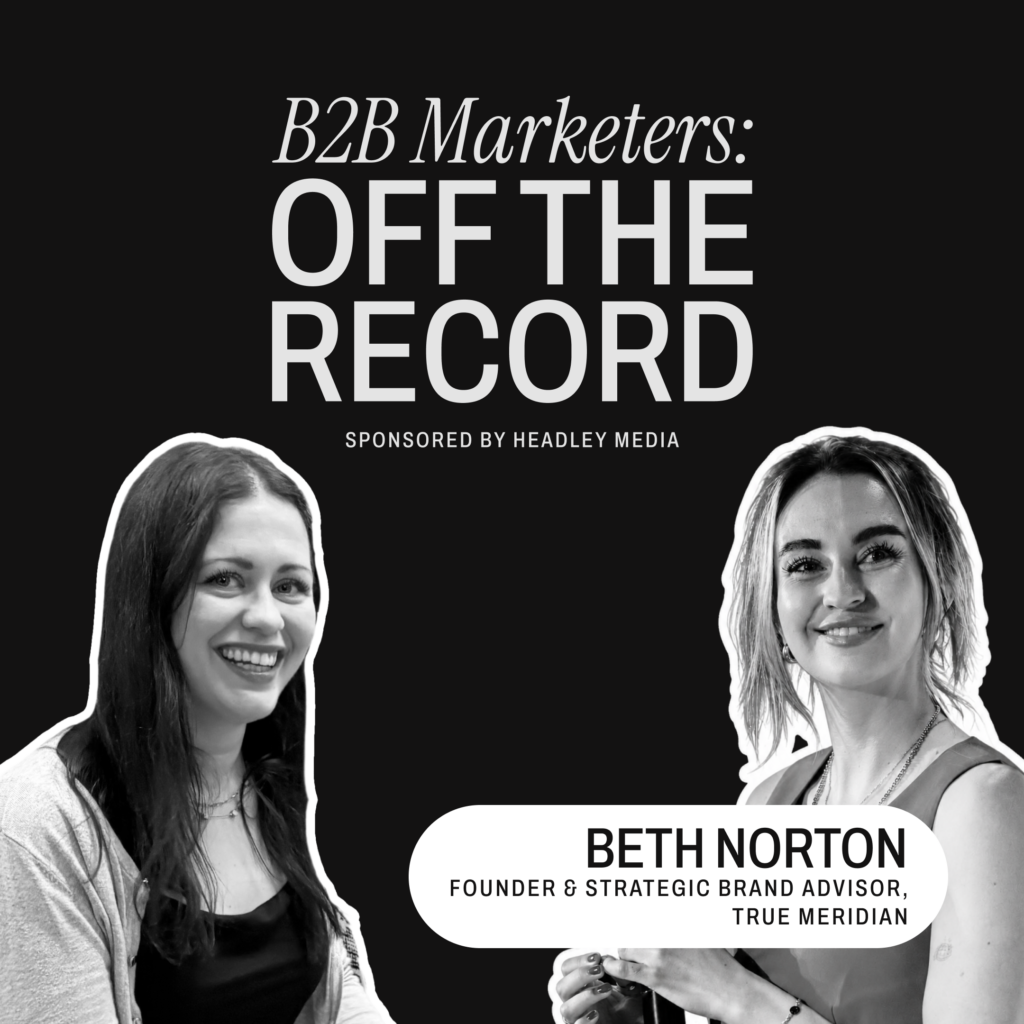
"More activity doesn't necessarily mean commercial success."
— Beth Norton, True Meridian
In this conversation, Beth Norton shares her journey from a marketing professional to a strategic brand advisor. Key themes include the importance of strategic alignment within organizations, and the need for effective brand differentiation in a competitive market. The conversation explores the evolving landscape of metrics, the importance of data-driven decision-making, and the need for better integration between brand and marketing teams. Key insights highlight the shift towards valuing engaged audiences over sheer volume and the necessity of continuous market research.
Takeaways


Chloe Addis (01:09)
Welcome to B2B Marketers Off the Record. I’m delighted to be joined here by Beth Norton today. Beth is the founder and strategic brand advisor at True Meridian. Would you be able to introduce yourself a little bit for our guests, please, Beth?
Beth Norton (01:24)
Yes, absolutely. And thank you for having me. Really excited to be here. So I am Beth Norton. As Chloe said, I’m the founder and strategic brand advisor at True Meridian, which is an advisory business that I founded earlier this year. I have been in marketing and brand for probably over 12 years now. Most recently, I was senior director of global brand and content at Ampliance. And then I decided to start my own business. So now I partner with
founders, marketing leaders at high-grade technology companies, and I work with them on market positioning, brand strategy, narrative, and GTM strategy as well.
Chloe Addis (02:02)
Amazing, and it’s just super interesting you’ve made that kind of switch from being in the marketing function in the business and then now into kind of entrepreneurship and working with businesses in that way. It must be
Beth Norton (02:13)
Yeah,
Chloe Addis (02:14)
super interesting for you.
Beth Norton (02:15)
it is. And I really enjoy the variety. So I was at the Hut Group for several years, which was a great education in of commercial high growth marketing. And it was very stressful. Working agency side is very stressful, but actually that’s one of the parts of my job that I love now is that I get to work with so many different clients. So no two
Chloe Addis (02:34)
Yeah.
Beth Norton (02:34)
days look the same and I’m actually really enjoying that variety.
Chloe Addis (02:39)
Amazing. So how did you get into marketing in the first place?
Beth Norton (02:44)
So I had a very unconventional journey into marketing.
Chloe Addis (02:47)
Thank
Beth Norton (02:48)
I didn’t study marketing at university. I actually went to university to study psychology and I dropped out after six months. I had a fashion and lifestyle blog at the time. I’d been able to monetize. I was earning a full-time salary from it and I wasn’t enjoying university. So I dropped out to focus on that.
I taught myself everything. So I was doing kind of content creation. I built the website. I was doing SEO. I was working with global brands. I was traveling all the time. And that was kind of my introduction to marketing from a really young age. I was like 16 when I started that website. And that was my career for, gosh, probably like five years, which was really exciting. And then I moved into more traditional marketing roles. So I had a couple of SEO and content freelance contracts. I also did PR.
And then I kind of went into more full-time roles, so more in e-commerce and then also B2B technology most recently.
Chloe Addis (03:43)
It must have been really difficult, like, I mean, a really interesting and, know, you’d got yourself into this great position that you were actually able to go, no, I’m not enjoying university. fair enough, that’s not for everyone, but you could already jump into what you’d set up for yourself full time. But it must have been a hard switch then going from, the, like, you know, I decide my destiny and I’m running this company, you know, everything that you must have been able to do with the blog.
and then go back. So that’s a really interesting, you don’t hear that. mean, you hear a lot of people say to me, it wasn’t a traditional path, but not a
Beth Norton (04:19)
I’m
Chloe Addis (04:20)
lot of people say, I was actually doing something already on my own. you know, I feel
Beth Norton (04:24)
Yeah.
Chloe Addis (04:24)
like what you’re doing now is not this entrepreneurship type leap is not new to you. But what is
Beth Norton (04:31)
It’s.
Chloe Addis (04:31)
interesting is, and it wasn’t going back a step at all because you obviously wanted to go and do that and fill out the knowledge, but that must’ve been really interesting.
Beth Norton (04:41)
It was. So this actually came about Chloe, I moved from the South, I grew up in the South of England, and I
Chloe Addis (04:47)
Mm-hmm.
Beth Norton (04:47)
moved to Manchester at the time when I was kind of doing my blog full time. So the only person I knew there was my stepbrother. I completely started again, I didn’t know anybody. And I think I lost a lot of the contacts that had in London. Like I used to spend probably three or four days a week on campaign shoots in London, meeting, know, PR from within different organizations. And I really kind of lost that network. And I think
That definitely had an impact. And I also realized the isolating part of kind of running your own business. I was doing the shooting, I was doing the admin, I was traveling most
Chloe Addis (05:17)
Yeah.
Beth Norton (05:18)
often kind of on my own or with a photographer. And I really missed working with a team. those were two elements. There was
Chloe Addis (05:26)
Yeah.
Beth Norton (05:26)
another element that, you know, there was kind of a bit of a, there was a of a fear mongering at the time when this kind of influence industry was new, you know, what if Instagram went down or what if something happened with the website, your income stops.
Chloe Addis (05:38)
Mm.
Beth Norton (05:39)
I really kind of wanted to go back into full-time employment and hold in-house roles to expand my skill set. I really wanted to make sure that I had a broad understanding of marketing and working in different environments. I
Chloe Addis (05:51)
Mm-hmm.
Beth Norton (05:52)
wanted to meet new people and I also wanted to give myself the security of having other skills that I could kind of lean on later in my career.
Chloe Addis (06:00)
Yeah, really interesting. And I think absolutely you can and have shown that you can go back to each one of those kinds of skills that you’ve picked up from different places along the way and
Beth Norton (06:09)
Yeah.
Chloe Addis (06:10)
being able to understand that you’re working with founders now and, you know, wider teams, broader teams, you can kind of put yourself in that own head space and think, like you said, it might be quite a lonely space actually. And, you know, everything falls on me. I’m doing all of these different jobs, whether it was your point doing, you know, the
the blogs and the writing and the social media and all of that kind of stuff, or whether it’s whatever you’re doing in business, you
Beth Norton (06:36)
Thank
Chloe Addis (06:37)
know, the finance and running all of it. I think you’ll have like such a broad insight, which is obviously what you bring to the companies that you work with at the moment. So let’s start off at the top. What
is
Beth Norton (06:50)
I’m
Chloe Addis (06:51)
one belief about B2B marketing that you have changed your mind on in the last 12 months?
Beth Norton (06:58)
I think the biggest belief is around the volume of activity and realizing that actually more activity doesn’t necessarily mean commercial success.
Chloe Addis (07:09)
Mm-hmm.
Beth Norton (07:10)
And I think this is a really interesting point because there is a kind of a default tactic within organizations. And I’m seeing this now with the clients that I work with. If something isn’t working and if there isn’t enough pipeline, they automatically default to let’s produce more content, let’s produce more campaigns, let’s do another event.
Actually, none of that is valuable if there isn’t clarity that underpins all of the activity. And by clarity, mean, you know, the whole business being aligned on positioning, the brand narrative, the customer that they’re speaking to and what their pain points are. I think it is much more valuable when a company produces, say, five fantastic pieces of content or does five activities throughout the year, very kind of specific events that
Chloe Addis (07:52)
you
Beth Norton (07:53)
are actually designed for their buyer in mind.
rather than just doing this kind of blast of a lot of activity and hoping it lands somewhere. And I think that’s the biggest shift I’ve seen is my belief is that it needs to be a lot more strategic. And I think I’m starting to see that shift within businesses as well.
Chloe Addis (08:10)
Yeah, think, you know, AI is obviously enabling people to do more. So I think this is probably, what I’m getting from what you’re saying is like, there’s a combination of these things as well, is that we are able to just push a button you know, effectively to have
Beth Norton (08:29)
Absolutely.
Chloe Addis (08:31)
more content be produced, more campaigns be produced, but that’s not really the answer.
Beth Norton (08:36)
It’s not. I think it’s really interesting because especially when businesses are early in their AI adoption, it’s a novelty. So I think
Chloe Addis (08:42)
Mm.
Beth Norton (08:43)
people do just push that button and there is a blast of, know, there’s automatically an increase in content volume and people are getting really excited because they’re able to generate more and they’re able to generate
Chloe Addis (08:51)
Mm-hmm.
Beth Norton (08:52)
it very quickly. Using less resource as well. You can have, you know, one person managing this workflow and you’re producing tens of pieces of content a week. And I think it takes businesses, it’s almost kind of at the second or third stage.
of this adoption where they realize that they need to refine that output and they need to be more strategic about what they’re producing. Because I think with the availability of AI at the moment, content volume has stopped becoming a point of differentiation. And I think businesses are slowly starting to realize that.
Chloe Addis (09:22)
Yeah. And do you find it’s so that, I mean, it’s all very well and easy to say, right, okay, we’re going to generate some more content. But as you’ve kind of said, it’s the, that strategic thread that needs to come as to why, what we’re going to achieve with that. Where are you finding that the strategic challenge or the problem is originating?
Beth Norton (09:46)
It is quite a hard thing to identify. have seen, I’m going to be really honest, I see a lot
Chloe Addis (09:51)
Mm.
Beth Norton (09:52)
of misalignment internally, cross-functionally, and with
Chloe Addis (09:55)
Mm.
Beth Norton (09:56)
stakeholders that have got a different opinion about how they should be speaking to the market, what the core pain points and value proposition is for each individual persona.
Chloe Addis (10:07)
Mm.
Beth Norton (10:07)
And it causes a lot of problems because you’ve got marketing who, you know, they’re sending out a very particular set of messages to the market.
Product marketing might not believe that those features translate into the capabilities that are then being delivered to the market. The CEO generally tends to have a long-term vision that doesn’t quite align with where the business is.
Chloe Addis (10:27)
Mm.
Beth Norton (10:27)
And the difficulty is aligning everybody internally around a shared narrative so that it runs like a well-oiled machine. And
Chloe Addis (10:33)
Mm.
Beth Norton (10:34)
that’s quite rare. I’ll be really honest, that’s quite rare. think especially in high-growth businesses where teams are going really quickly, the product is evolving really quickly.
The messaging needs to evolve quite quickly to keep up with the pace of the industry and competitors. And
Chloe Addis (10:46)
Yeah.
Beth Norton (10:47)
they’re almost chasing their tail a little bit. And I think it kind of takes somebody to come in and just say, you know, let’s all get around a table. Let’s have a look at the product roadmap. Let’s have a look at what it is you’re going to be delivering and let’s refine your ICP and your personas so that we can be clear about who you’re speaking to when you deliver that content to market.
Chloe Addis (11:06)
Yeah. And I think a lot of people will be able to relate to this, of course, like in bigger kind of technology companies, but also in kind of mid-sized smaller teams. We often see it a lot. And, you know, particularly we talk about the sales and marketing alignment because that’s the, know, those teams should work very closely together. There’s always, you know, even if they don’t, there’s always, and that’s what causes issues really.
Beth Norton (11:34)
Mm-hmm.
Chloe Addis (11:35)
But what your…
kind of getting at is that it’s much, it’s much wider really. And having kind of worked in the past in a startup type environment like that, I absolutely know what you mean. So I know that people listening to this can be like, yes, that’s like hits the nail on the head because people are not aligned, but it’s, it’s, it’s such a wider problem and you need all of those people in the room. Like you said, the product development, the technical people, all of those, like, know, giving you the
what’s happening, what’s really happening inside the company to then be
Beth Norton (12:10)
Absolutely.
Chloe Addis (12:11)
able to talk to the marketing of what’s really happening in the market. the people, our
Beth Norton (12:15)
I’m sorry.
Chloe Addis (12:16)
customers, what do they want? What are they saying?
Beth Norton (12:20)
It’s not an easy problem to solve, right? And I think especially
Chloe Addis (12:22)
and
Beth Norton (12:23)
in those startup environments or high growth environments, because the pace is so fast. So alignment is incredibly hard to maintain. Even if you get it right initially, it’s
Chloe Addis (12:28)
Yeah.
Beth Norton (12:32)
then having processes in place that can maintain that as the kind of product evolves. And I think it’s something that a lot of businesses are struggling with.
Chloe Addis (12:41)
Yeah, yeah. like, how do you stay aligned? And I think there’s like, you know, we talk a lot about the cadence of it and having a manager that’s sort of almost directly responsible for that communication. But yeah, I mean, it’s a headache that a lot of companies are facing.
So what shifts are you seeing in how B2B buyers are behaving right now?
Beth Norton (13:09)
It’s
a great question. I think the biggest shift at the moment is that buyers are forming their own opinions and doing a lot of the work themselves before they ever speak to sales. So you’ve got buyers that are conducting research, they’re speaking to peers, they’re
Chloe Addis (13:26)
Mm-hmm.
Beth Norton (13:26)
evaluating founder messaging and employee perspectives online, and they’re also using AI to compare vendors and feature capabilities.
Chloe Addis (13:36)
Mm-hmm.
Beth Norton (13:36)
It means that actually they’re consuming a lot of information before they ever even put their foot in the door and speak to you. And
Chloe Addis (13:42)
Mm.
Beth Norton (13:43)
they form an opinion about you before that happens, which I think makes it even more important for, you know, the content that you put out and the marketing activity that you run to make you distinguishable from other competitors and from other vendors in the category. And with the way that AI is changing discovery at the moment.
There are lot of buyers out there who wouldn’t even land on your website while they’re making an evaluation decision. They will work
Chloe Addis (14:07)
Yeah.
Beth Norton (14:08)
directly within the AI. They get the comparison information fed directly to them. So if your brand isn’t distinguishable enough to show up in those AI answers, you may not even have a chance of being considered. And it’s a huge shift that I think is causing businesses to really evaluate how they’re taking their product to market.
Chloe Addis (14:27)
Yeah, and how are you recommending the approach to that? It’s such a huge problem.
Beth Norton (14:35)
Yeah, so I’m looking very specifically at the brand piece. So in terms of brand narrative, now
Chloe Addis (14:40)
Yeah.
Beth Norton (14:41)
this gets quite tricky, when you’re thinking about, you know, if you’re thinking about top of funnel content and it’s informative and it’s educational, that content is necessary, but that is the content that can also be almost cut and paste from competitors, right? Because you all want to educate about the same thing. You’re a technically very, very similar product. And you want to educate the buyers about, you know,
key use cases, for example. But I think that middle of funnel to bottom of funnel content is where you can start to really distinguish point of view, your perspective, also demonstrating an understanding of your buyers’ daily challenges and how you can
Chloe Addis (15:18)
Mm-hmm.
Beth Norton (15:19)
directly solve those problems. Because essentially what they’re looking for is buyers want to feel seen and understood by your business. They want to think, yeah, this is an easy decision. You totally get the problems that I’m facing daily.
And it’s really important that a brand is able to produce that content and speak to an audience in that way.
Chloe Addis (15:38)
Yeah, it’s interesting, isn’t it? There’s a huge, I mean, as we, as I’m having all of these conversations, there’s a lot about how AI is actually bringing everything back together. So there’s the thread between PR at the top of the funnel is now even more important because it’s not only kind of affecting the LLMs and search and visibility, but it’s the trust element, the branding, you know, that kind of making the list.
and being different and kind of having those opinions that mean that you will be influenced, like, you know, you’ll be surfaced and have a voice and a unique perspective.
Beth Norton (16:19)
Absolutely, and I think it’s really interesting because I’ve seen a couple of businesses prioritize what they call like, know, geo specific content. So
Chloe Addis (16:25)
Yes.
Beth Norton (16:25)
they’re trying to increase visibility by, you know, increasing content volume, making it kind of geo optimized, which is very important for visibility. But again, that brand piece is missing where a customer really understands what it is that you stand for and what your point of view is.
Chloe Addis (16:41)
Mm-hmm.
Beth Norton (16:42)
And just trying to surface in LLMs again.
you may end up creating generic content if it hasn’t got your distinctive brand point of view. that’s something that think people are also learning to balance kind of within internal teams.
Chloe Addis (16:55)
Yeah. So what’s the strategic bet you think more marketing leaders will need to make over the next couple of years?
Beth Norton (17:05)
I
think they will need to strategically think about brand differentiation.
Chloe Addis (17:12)
Mm-hmm.
Beth Norton (17:14)
And the reason I say this, I know that sometimes, you know, brand sits on a separate team for marketing and is it’s kind of its own function. But it’s really important that marketing understands how they can basically make noise in the market and yeah, and distinguish themselves. I think one of the biggest things will be understanding
customer feedback, customer value, and also understanding the market. So investment in things like analysts and research and data, for example, to help them then inform marketing activity, because fundamentally everything needs to be underpinned by the value that you’re creating for the customer. And
Chloe Addis (17:52)
Mm-hmm.
Beth Norton (17:53)
I think that is a step that often gets missed. It’s either handed off to another team or it’s not run as frequently as it should be. So they haven’t got that analysis to support activity.
Chloe Addis (18:02)
Yeah. So if you’re going into a kind of a tech, a high growth tech company and they have an issue like this and they feel very similar in terms of content or kind of what they’re trying to say about the uniqueness of their product. And you kind of can recognize that. What is, I mean, do you follow a framework or what would be your kind of first port of call to start addressing and, and get the differentiation back into the messaging?
Beth Norton (18:31)
So
I would actually, I usually hold executive workshops with
Chloe Addis (18:36)
Mm-hmm.
Beth Norton (18:37)
stakeholders in the business and I would take it back to persona development. So I would work very closely
Chloe Addis (18:41)
Okay, interesting.
Beth Norton (18:42)
with product marketing and take a look at each of the core by personas, potentially refine them based on the available data and analysis
Chloe Addis (18:51)
Mm.
Beth Norton (18:52)
and basically profile them. So what are their key pain points? What use cases, how would they be using the product and why?
Chloe Addis (18:59)
Mm-hmm.
Beth Norton (19:00)
What is their position in the buying process? So are they a key decision maker? Will they need to go and take that decision to a senior stakeholder? And therefore,
Chloe Addis (19:08)
Yeah.
Beth Norton (19:08)
what information can we give them to make that process easier for them? And also, essentially, what value we can deliver. So I would start from that positioning and product piece, and then make sure all teams were aligned. And I would almost suggest that the marketing team has a strategy based on each of those personas.
They know very clearly when they’re doing an event, you know, kind of who are the people going to be in the room? How does that align with the ICP and the target personas? When they produce a piece of content, who directly are they speaking to? And get very, very clear on the individual that that piece of content or the activity is targeted at.
Chloe Addis (19:47)
It’s really interesting being in a room earlier this week, there was a marketing talk conference and one of the topics was about personas and about how much they have really developed, especially with AI and everything that you can really learn about your market.
that there’s so many threads, isn’t there? Not with just sort of automation and really digging into the data to really get a full picture. It’s not the persona that, you know,
Beth Norton (20:22)
We’re
Chloe Addis (20:22)
we’ve come to learn from kind of, I don’t know, 15 years ago that was sort
Beth Norton (20:26)
Yeah.
Chloe Addis (20:27)
of just made up, this is Maggie and she likes this music and listens to it. Like, you know, it’s kind of like, okay, we didn’t really, the idea
Beth Norton (20:29)
Yeah, it used to be very basic.
Chloe Addis (20:36)
was there, I think, but now it can be kind of.
you’ve filled out with real information that we know about our customers, real language. You know, we’ve got so much data at our fingertips that we can kind
Beth Norton (20:49)
Thank
Chloe Addis (20:50)
of thread back through the business nowadays.
Beth Norton (20:54)
Yeah, agree, completely agree.
Chloe Addis (20:56)
Really interesting
that you said that, so just hyper relevant. It’s like you’ve been in the room with me all week. So
Beth Norton (20:59)
I’m sorry.
Chloe Addis (21:06)
what’s something B2B marketing teams are currently still doing that you like kind of out of habit that you think needs to not be happening anymore?
Beth Norton (21:20)
I think it comes down to content volume and tying like
Chloe Addis (21:25)
Hmm
Beth Norton (21:26)
a quarterly or like I guess kind of quarterly targets or weekly targets based on content volume. So I see a lot of businesses and I’ll say, okay, what’s your kind of marketing activity plan for this week?
And they say, right, we’re doing three blog posts, we’re doing four LinkedIn posts, we’re doing one event and we might film a video of TikTok or Instagram or whatever it is.
Chloe Addis (21:45)
Mm.
Beth Norton (21:47)
And…
I think the difficulty with that is they’re essentially kind of working towards these, I guess, like quantifiable targets, but they don’t necessarily have a clear purpose for each of them. So they’re focused too much on how much content and how much activity they’re doing as opposed to the value that all of that content and activity would deliver.
Chloe Addis (22:09)
Yeah.
Beth Norton (22:09)
And it’s something that I see quite often because…
you know, it would be far more valuable for a business to say, right, we’re producing one blog post, it’s going to be about this product feature, it’s for this persona, we’re going to speak directly to them. And off the back of it, we’re hoping to generate X number of leads like tie,
Chloe Addis (22:24)
Mm.
Beth Norton (22:25)
tie the outcome directly to that piece of content,
but to try and hit a quota as such. And I think this is often done to appease senior leadership. But trying to hit a quota is not actually kind of fulfilling the role of the team. And actually they may be wasting
time and resources on doing that rather than thinking more strategically about output. that’s something that I’m still seeing a lot that I think
Chloe Addis (22:49)
you
Beth Norton (22:49)
probably needs to start changing.
Chloe Addis (22:51)
Yeah. I think there is a more, I guess something to do with like the counter to AI and having all this volume like we mentioned.
Beth Norton (23:00)
the day.
Chloe Addis (23:01)
But it is about, you I guess it’s reflective in, you know, how much less organic like, you know, traffic we’re seeing to our websites. And, you know, that drop that I think has been cited at a number of like 70 % drop in traffic to a lot of websites and
You know, we’re not seeing that anymore. Obviously the volume is there, but it’s just like diff distributed differently.
Beth Norton (23:27)
Yeah.
Chloe Addis (23:28)
but I think that overall that’s kind of coming about in an acceptance of marketers saying, okay, well it’s niching down is fine because we’ve lost, we’ve lost that traffic or we’ve lost visibility of where that traffic is. But what we’re seeing is what we’re left with is.
more valuable, you know, they are the people that are coming
Beth Norton (23:48)
right.
Chloe Addis (23:49)
and they’re converting and, you know, it’s highlighted that we need to work on the conversions of the site because we know these people are interested. So therefore, you know,
Beth Norton (23:57)
Yeah.
Chloe Addis (23:58)
what’s happening and it’s, it’s, it’s truer numbers, you know, it’s more reflective of what’s actually happening.
Beth Norton (24:05)
100%. And I think this is so interesting because when you’re doing kind of reporting internally to senior leadership, they like the big numbers, they want the big
Chloe Addis (24:12)
Mm.
Beth Norton (24:13)
volume, they want to know that visibility is improving. But actually, I think you need to drill down a little bit further into those numbers and say, okay, but who is it that’s visiting the site? Are they an engaged buyer? Can we get them into the sales funnel? Those conversations actually don’t happen. Like it’s very common to happen. So
Chloe Addis (24:27)
Yeah. Yeah.
Beth Norton (24:31)
It’s
almost as if some marketing teams are chasing targets that actually wouldn’t reflect commercial value. And I think
Chloe Addis (24:37)
Mm.
Beth Norton (24:37)
what you said there is really interesting that actually, even if the numbers have dropped, that particular audience is incredibly engaged and there’s a lot of opportunity there. So what
Chloe Addis (24:46)
Yeah.
Beth Norton (24:46)
needs to be doing is maximizing that rather than kind of focusing on broader visibility in general, because they may actually end up targeting the people that aren’t interested in the product.
Chloe Addis (24:56)
Yeah. 100%. It is something we see kind of, know, with, with lead generation a lot as well. Like you said, there’s this, the challenge is the focus on number of MQLs, get them in, know, and then, and then you know, they haven’t been nurtured enough, they’ve been handed across to sales and they weren’t ready. And, you know,
if we apply the same lens and you can look to do that targeting to the right people and, and.
the niche-ness, niching down into areas where they are specifically engaged and the audience is getting something back, you know, from the content in terms of like, it’s highly technical or it’s highly, you know, it’s specialist for them in that way. That’s going to be
Beth Norton (25:40)
Absolutely.
Chloe Addis (25:41)
so much more useful and compelling for them to
Beth Norton (25:45)
Yeah.
Chloe Addis (25:46)
continue that journey with the company.
Beth Norton (25:47)
Yeah,
I completely agree. think there are, I have seen in a couple of businesses, they do have kind of like nurture workflows for very specific personas. So they are kind of able to identify key personas,
Chloe Addis (25:56)
Yeah, yeah.
Beth Norton (25:58)
get them into a workflow, make sure they’re being served the relevant content and you kind of, you know, move them along the buyer journey, which is so valuable. But I have been surprised at a couple of businesses that don’t do that.
Chloe Addis (26:08)
Yeah.
Beth Norton (26:09)
Also, so that’s where the value is, is really, really understanding who’s engaging with your brand.
Chloe Addis (26:16)
Yeah, so important. I can talk about all of that all day, be honest.
Beth Norton (26:21)
I’m joking.
Chloe Addis (26:24)
So what type of investment, so that’s kind of things, things that you think teams shouldn’t be doing anymore, but what types of investment should marketing leaders protect, do you think, at the moment, even if kind of budgets are tightened in different areas?
Beth Norton (26:40)
I
think there is a tendency when budgets are tightened for marketing teams or marketing leaders to cut anything that isn’t directly tied to attribution.
Chloe Addis (26:50)
Mm-hmm.
Beth Norton (26:51)
And I actually think this is where the data collection piece often gets dropped. And I say that because I think there needs to be a lot of research conducted, not just within the existing customer base to get kind of, know, qualitative feedback on the product. You might get proof points, you might get case studies, you might…
want to understand their usage of the product and then you can use kind of that in marketing materials, that’s all very valuable. But also kind of market research, for example, how buying behavior is shifting, how the market is responding to certain messages. I think there is a real element of, I guess it kind of comes out, yeah, market research and social listening.
Chloe Addis (27:30)
Mm-hmm.
Beth Norton (27:30)
I think that piece is really key because again, all of that data informs the marketing strategy.
And
Chloe Addis (27:36)
Yeah.
Beth Norton (27:36)
it’s very difficult when you’re in a position where you have to make budget cuts because, you know, you’ve got really stringent pipeline goals and you’re being held to these really high kind of commercial targets.
Chloe Addis (27:47)
Mm.
Beth Norton (27:48)
But actually, I think if you don’t have that consistent data being fed in around your customers and around the market, you can’t then evolve the marketing activity to suit that and make sure that it kind of lands successfully. So it’s something that I think a lot of marketing leaders fail to consider or will automatically
Chloe Addis (28:04)
you
Beth Norton (28:05)
chop just because it’s not tied to pipeline so for them it’s not a priority.
Chloe Addis (28:09)
Yeah, that’s a really good point actually. it’s not like knee-jerk reaction to that question.
But that is really the
basic of marketing is this understanding your market, understanding what your customers want, because if there isn’t a demand, or at least an understanding of their challenges, then how are you going to prove, you know, it’s the, it’s the proof point, isn’t
Beth Norton (28:34)
Thank you.
Chloe Addis (28:34)
it? The data point though, which you’re trying to communicate
Beth Norton (28:37)
It is.
Chloe Addis (28:38)
with.
Beth Norton (28:39)
And I think something I saw recently, there was a team I was working with and they were running surveys. It was only twice a year. So it was biannually and they were running surveys basically to their customers and on their LinkedIn channel and collecting
Chloe Addis (28:51)
Mm.
Beth Norton (28:52)
information about, it was like feedback on brand messaging and interaction with the product, their favorite or kind of most used features and capabilities and then their least used. There was almost no uptake.
because
Chloe Addis (29:03)
Mm.
Beth Norton (29:04)
I think honestly nobody wanted to fill it out and I get it, it’s a time commitment.
Chloe Addis (29:09)
Yeah.
Beth Norton (29:09)
I do think there was an incentive and obviously incentives can help, even something as simple as a voucher. But I just thought it was really interesting because it was such a, it was an activity that was so heavily deprioritized on their list that
Chloe Addis (29:21)
Mm.
Beth Norton (29:22)
I think for me anyway, coming from, you know, the outside and as an external perspective, it was blindingly obvious that some of that activity
could have been strategically improved by a refresh of that data and having that consistent stream of information. I do think it’s a lot of, I understand it’s a lot of work, but I think it is almost a funnel that needs to be built into the marketing process before you start building out the campaign calendars and the activity for the year. And you need that constant stream. I do think it’s a lot of things. It’s a lot of marketing teams miss that.
Chloe Addis (29:55)
Yeah, yeah. Because you’re so close to the product. You think, you know, you know it better than anyone else. We’ve been, you know, talking about
Beth Norton (30:00)
Exactly.
Chloe Addis (30:01)
this for years and years and it’s not, you know, it’s inbuilt and you think, well, I know it and we communicate it and that’s that. And, you know, this is, this is a funnel. clearly works because we do get customers, but
Beth Norton (30:13)
Yes.
Chloe Addis (30:13)
that understanding, it changes, like just like marketing changes and you know, there’s, so much that we need to keep up to date with that. If there’s a gap between.
even just the language that you’re using and the language that your customers are using, it can be, you know, pretty detrimental.
So I actually want to ask you a question that was left for us by one of our other guests, Lindy O’Brien recently. She asked, what do you think will reshape your marketing organization based on
buyer behaviour and AI in the next five years.
Beth Norton (30:51)
I
So I think there are a lot of ways that AI can maximize efficiencies. There are a lot of fantastic automation capabilities that kind of reduce manual work and, know, free up strategic time on the team.
Chloe Addis (31:04)
Mm.
Beth Norton (31:05)
One thing I will say is, I…
I have said this until I’m blue in the face, like to different clients, but there is no process that will not require human oversight. Even with agentic AI, I
Chloe Addis (31:15)
Mm-hmm.
Beth Norton (31:16)
really fundamentally believe and still maintain that all of those processes need human oversight. So yes, it frees up time strategically, but I don’t think we’re at a point yet where it should be trusted to run completely autonomously. So I think it will be interesting because in terms of output, I think we’ll see a big difference there. You know, there could be more output.
I think creative on a marketing team will probably mostly be handed off to AI. But
Chloe Addis (31:44)
Mm-hmm.
Beth Norton (31:44)
I think in terms of marketing activity, there is probably a lot of campaigns, for example, or content creation. It will mostly be produced by AI with that human review and optimization kind of embedded within the end.
Chloe Addis (31:58)
Mm-hmm.
Beth Norton (32:01)
Yeah, gosh, how else? I think that’s probably the biggest change
Chloe Addis (32:02)
Yeah, yeah.
Beth Norton (32:06)
is wider adoption within marketing teams. Because I do think at the moment, people are still testing and learning how to integrate
Chloe Addis (32:13)
Yeah.
Beth Norton (32:13)
it and how to use it successfully. And I think in five years, we’ll have almost kind of total adoption. think every business will be utilizing it.
Chloe Addis (32:22)
Yeah, that automation element of it is just part of the flow. But as you said, whether it is the case or I mean, it should be the case, I’m also definitely on that side that you can’t just let it run riot and be determining
Beth Norton (32:38)
you
Chloe Addis (32:39)
everything. But, know, like we’ve said, all that is going to happen if everybody kind of relies on it too much is that it all becomes the same.
and there’s no
Beth Norton (32:48)
Thanks.
Chloe Addis (32:48)
uniqueness there. So I guess that kind of proves your point as to
Beth Norton (32:52)
Thank you.
Chloe Addis (32:53)
what we’re talking about. So final question before we kind of go into our referrals. So what is one thing you wish you could change about marketing, if you could?
Beth Norton (33:04)
one thing I wish I could change about marketing? I think I wish there was more of brand integration within marketing teams.
Chloe Addis (33:16)
Okay.
Beth Norton (33:17)
And I don’t say this lightly, I know there are a lot of organizations that kind of, you they have their separate functions, they’ve got marketing, they’ve got product marketing, they’ve got brand, which is, you know, probably working in tandem with PR.
Chloe Addis (33:28)
Mm.
Beth Norton (33:29)
But I do think that
I see a lot of teams working in silo in those different areas. And a really, really common problem that I’ve seen in the last several months is marketing having one set of messaging, but actually it doesn’t align with the overall brand narrative. And it’s actually quite rare that you see a marketing team with either brand embedded or that they work really closely with brand. But I do think that all marketing activities should be underpinned by this kind core narrative. I always say it of comes from
it kind of runs top down. So you’ve got kind of the overarching narrative and positioning that kind of sits further upstream and then marketing is downstream. But I think
Chloe Addis (34:10)
Mm.
Beth Norton (34:10)
without that alignment, all of the marketing activity is going to be far less effective. And
Chloe Addis (34:15)
Okay.
Beth Norton (34:16)
it’s something that I’m kind of trying to speak to different clients about is that integration understanding of what is our core positioning and how can we then embed that into marketing activity.
Chloe Addis (34:26)
I see. So the marketing team having almost like siloed campaigns and messages that work on a kind of smaller level, but they don’t necessarily reflect the brand or they’re almost going against the brand.
Beth Norton (34:42)
Yeah, think sometimes, and this is what happens when it’s a high growth environment, but the messaging can sometimes get confused or it’s
Chloe Addis (34:49)
Mm-hmm.
Beth Norton (34:50)
outdated with where the kind of product evolution has happened. And I think…
there was one organization that comes to mind and I remember them saying, we, you know, we haven’t done that brand piece yet. That’s a really big piece of work to redo the brand narrative and the positioning. So then the marketing activity was run. It was completely outdated. They
Chloe Addis (35:09)
Yeah.
Beth Norton (35:09)
weren’t sending the right message to the market. And what was happening was buyers were then getting very confused when they spoke to sales and
Chloe Addis (35:16)
Right.
Beth Norton (35:16)
was completely different to the expectations of kind of the content that they consumed in the market. So that’s something that I think
would be brilliant if that could change, if brand was just more closely aligned with marketing or even there was kind of an integration between the two teams because without that kind of clarity piece, the marketing tactics are just not going to be as effective.
Chloe Addis (35:36)
Yeah, and I kind of, like you said, that stream, it does make sense where brand is almost the mouthpiece, if you like, of kind of those real stakeholders in the business and communicates that internally as well as externally.
Beth Norton (35:53)
Exactly. And I think there has to be, you know, kind of accountability and ownership for those meetings and those workshops to happen internally quite frequently. But
Chloe Addis (36:02)
Mm-hmm.
Beth Norton (36:03)
I think it almost needs to be an ongoing process as part of kind of marketing workflow, because really, they just need to sense check the positioning, the narrative before they put anything out into the market.
Chloe Addis (36:12)
Yeah.
Beth Norton (36:14)
And unfortunately, when that’s disjointed, it causes a lot of problems, especially from a sales perspective.
Chloe Addis (36:19)
Yeah, 100%. Amazing.
So I’ve really enjoyed this conversation. It’s been really kind of from a strategic level as well, kind of going in and that can be the hardest stuff to unpack really. And obviously from your position as kind of working with organizations rather than from within and trying to kind of battle against the flow of these things,
Beth Norton (36:43)
Yeah.
Chloe Addis (36:44)
being able to go in and have that kind of outside of perspective and say that…
There’s some real big problems here and
Beth Norton (36:51)
Yeah.
Chloe Addis (36:51)
those are obviously the biggest attack to tackle the stickiest kind of things that are going to make the most difference once they are fixed.
Chloe Addis (37:01)
So sorry about that, just having a little bit of technical difficulty. But where we were was just to say thank you so much for the conversation that we’ve had today. Again, it’s very, really strategic conversation that is hugely valuable and quite a unique perspective actually that we’ve had on the podcast. So it’s been really interesting to talk to you. The last kind of couple of questions is just to ask you who you think we should invite on to the podcast next and why.
Beth Norton (37:31)
Gosh, that’s a great question.
Chloe Addis (37:32)
Thank you.
Beth Norton (37:34)
actually recommend, there’s an old colleague of mine that
Chloe Addis (37:37)
Mm-hmm.
Beth Norton (37:38)
I worked with at Ampliance. She’s VP of Marketing and I think she is seeing some of these kind of challenges around where to prioritise marketing budget and that kind of positioning piece internally. That’s
Chloe Addis (37:52)
Yeah.
Beth Norton (37:53)
something that she’s dealing with at the moment. She’s a fantastic speaker and a brilliant marketer and I think certainly from a demand generation perspective, she’d give you some really valuable insights.
Chloe Addis (38:03)
Awesome, absolutely, we’ll be reaching out to her. Thank you so much. And what’s a question that you would like to ask, whether it’s her or not, that we could kind of bake in and ask to the next guest?
Beth Norton (38:16)
would maybe ask how the kind of marketing channel mix or demand generation channel mix will change over the next 12 months as businesses start to adopt and implement kind of more AI within the organization.
Chloe Addis (38:32)
Yeah, it’s a really interesting one, isn’t it? And people are kind of really questioning the ways that they’ve always done things, whether that’s in terms of like the strategy that they bring to it, to the tactic, kind of like, you know, if it’s an ABM approach and they’re kind of rethinking that, or if it’s, yeah, exactly that, the channels that they’re using,
Yeah. And like we said, kind of to our point earlier, it’s it’s it is about kind of the niche and the kind of making sure that you’re you’re where your customers are in that
Beth Norton (39:04)
Absolutely.
Chloe Addis (39:04)
right time and feeding them on their research journey that you know, you’ve got less influence on but
Beth Norton (39:11)
Exactly.
Chloe Addis (39:12)
right time, right place, which I guess is coming back to the age
Beth Norton (39:14)
Yeah.
Chloe Addis (39:16)
old principles of marketing there. But
Beth Norton (39:18)
Okay.
Chloe Addis (39:18)
yeah, thank you so much for coming on.
One final thing if you could do for me is tell people where they can find you.
Beth Norton (39:25)
Yes, probably LinkedIn is the best bet. Beth Norton. My website is still in process, so I’m hoping to have it
Chloe Addis (39:33)
You
Beth Norton (39:33)
up and running within the month. I’m working with a designer at the moment, so LinkedIn for now.
Chloe Addis (39:37)
Amazing,
perfect. All right, thank you so much for joining me.
Beth Norton (39:41)
Thank you, Chloe. Thanks for having me.
In this episode of B2B Marketers: Off The Record, Chloe Addis speaks with Beth Norton, Founder and Strategic Brand Advisor at True Meridian. Drawing on more than 12 years in marketing and brand, Beth explores how businesses can strengthen their positioning, bring teams together around a shared narrative and create marketing activity with a clear commercial purpose.
At the heart of the conversation is a challenge to the instinct to do more: when pipeline slows or campaigns underperform, increasing content volume will not resolve unclear positioning or a weak understanding of the customer. Beth argues that effective marketing starts with clarity about who the business serves, what value it delivers and why buyers should choose it.
Beth has become increasingly sceptical of the assumption that more marketing activity will produce better results.
She sees businesses respond to pipeline challenges by commissioning more content, launching additional campaigns or adding another event. But without a clear strategic foundation, those activities can consume resources without addressing the underlying problem.
That foundation includes agreement on positioning, the brand narrative, the intended audience and the problems that matter to those buyers.
Beth believes a smaller number of carefully designed activities can be more valuable than a broad programme that relies on volume to find an audience.
AI makes this distinction particularly important. As producing content becomes faster and cheaper, the ability to publish more is losing its value as a point of differentiation.
Beth sees conflicting perspectives within a business as a common source of ineffective messaging.
Marketing may communicate one proposition, product marketing may have a different understanding of the capabilities being promoted, and the CEO may be focused on a future vision that does not reflect the product available today.
In high-growth technology businesses, those gaps can widen quickly as products, teams and market conditions evolve.
Her response is to bring the relevant stakeholders together to review the product roadmap, customer profiles and messaging. The aim is to establish a shared narrative that accurately reflects what the business can deliver and why it matters.
Chloe highlights that this is a wider challenge than sales and marketing alignment alone. Product, technical and leadership teams also need to contribute.
Beth stresses that reaching agreement once is not enough. Businesses need ongoing processes and clear ownership to maintain alignment as they grow.
Beth sees buyers doing more of their own evaluation before speaking to a supplier.
They are consulting peers, reviewing founder and employee perspectives, and using AI to compare vendors and product capabilities.
Some may form an opinion without visiting the company’s website at all. That makes the information available across different channels increasingly important to whether a brand is considered.
For Beth, the challenge is both visibility and differentiation. A business needs to be discoverable, but buyers also need to understand what makes it a distinct and credible option.
Content should help them recognise a relevant perspective and see evidence that the supplier understands their situation.
Beth recognises the importance of educational content, particularly when buyers are learning about a category or use case.
However, businesses selling similar products can easily produce similar explanations. That content may be useful without giving a buyer a compelling reason to choose one supplier over another.
She sees an opportunity in content that expresses a clear point of view, demonstrates an understanding of daily customer challenges and explains how the business addresses them.
Buyers should be able to recognise their own problems in the material and feel that the supplier understands what they are trying to achieve.
Beth also cautions against focusing on appearing in AI-generated answers while neglecting the brand narrative. Optimising for discovery can still result in generic content if the business has not established what it stands for.
When helping a business sharpen its positioning, Beth often begins with executive workshops and a review of its core buyer personas.
Working with product marketing, she examines the available research and data to understand each audience’s challenges, use cases and reasons for needing the product.
She also considers the person’s role in the buying process. Are they the final decision-maker, or do they need to build a case for someone more senior? What information would help them move that decision forward?
Those insights should inform a specific approach for each persona.
An event should have a clear connection to the people the business needs to reach. A piece of content should speak directly to an identifiable audience and serve a defined purpose.
Chloe contrasts this with older persona exercises based on superficial or invented characteristics. The opportunity now is to build a more useful understanding from real customer information and language.
Beth challenges activity plans built around publishing targets: a fixed number of blog posts, social updates, videos or events each week.
Those targets are easy to count, but they do not necessarily explain what the work is intended to achieve.
She would rather see a team identify the audience for a piece of content, the problem it addresses and the outcome it should support.
The same principle applies to reporting. Large traffic figures may reassure leadership, but teams need to understand who is visiting, how relevant those visitors are and whether their engagement creates a meaningful opportunity.
Chloe connects this to declining website traffic and lead generation. A smaller, more engaged audience can be valuable, particularly when the content is relevant and the next steps reflect the buyer’s readiness.
Beth highlights persona-specific nurture journeys as one way to turn that understanding into a more useful experience.
Beth would protect the research that keeps marketing connected to customers and the wider market.
She sees a tendency to cut activities that cannot be directly attributed to pipeline, even when those activities provide the insight needed to improve performance.
Customer feedback can reveal product usage, valued capabilities, proof points and opportunities for case studies. Market research and social listening can show how buying behaviour, expectations and responses to messaging are changing.
Without that information, teams risk continuing with activity based on outdated assumptions.
Beth describes a business collecting feedback through occasional surveys with very limited participation. From her perspective, a more consistent flow of insight could have helped improve the strategy.
Her recommendation is to build research into the marketing process before planning the campaign calendar, then keep refreshing it as the market changes.
Beth expects AI to become more widely embedded in marketing workflows, reducing manual work and supporting content and creative production.
However, she maintains that those processes require human oversight. Greater efficiency should create room for strategic thinking, review and optimisation.
Her broader ambition is for brand to become more closely integrated with marketing.
Positioning and the core narrative should guide campaigns, rather than sit in a separate function that teams consult only occasionally.
She shares an example of a business running marketing activity while postponing work on its outdated brand narrative. Buyers then encountered a different story when they spoke to sales, creating confusion.
For Beth, regularly checking positioning and messaging should be part of the workflow.
Ultimately, her message is that effective B2B marketing depends on clear positioning, current customer insight and a shared narrative that gives every activity a purpose.
B2B Marketers: Off The Record is a podcast providing honest, practical conversations about what’s really working in B2B marketing. We know that many marketers can feel isolated within their businesses and constantly facing an uphill battle for marketing to be heard and understood. Off The Record was created to bring conversations to light that usually stay off the record, but are also the ones that make marketers feel less alone in what we know to be very common challenges and also uncover some interesting takes.
B2B Marketers: Off The Record is sponsored by Headley Media.
Headley Media helps technology marketers get more value from their content investment by creating engagement with audiences that are actively researching technical challenges and solutions – providing opportunities to educate, engage and nurture potential buyers, build net-new pipeline and demonstrate ROI.
In this episode, Freya Ward interviews Heather Barnett, a seasoned B2B copywriter and content creator,…
In this episode, Joe Fontana, CMO of Amzai, discusses the evolving landscape of B2B marketing,…
In this conversation, Mark O’Donnell shares insights on the evolving landscape of B2B marketing, emphasizing…