

S01E17 – Conor Bant – B2B Marketers: Off The Record
Conor Bant, Head of Media and Performance at Fox Agency, discusses the evolution of B2B…
This conversation covers the importance of funding and tactical campaigns for B2B marketers, the need to challenge the status quo, and the impact of internal stakeholder buy-in on marketing success. It also addresses the changing landscape of LinkedIn and the challenges and opportunities for B2B marketers in the current environment.
Takeaways
Chapters



Freya Ward (01:04)
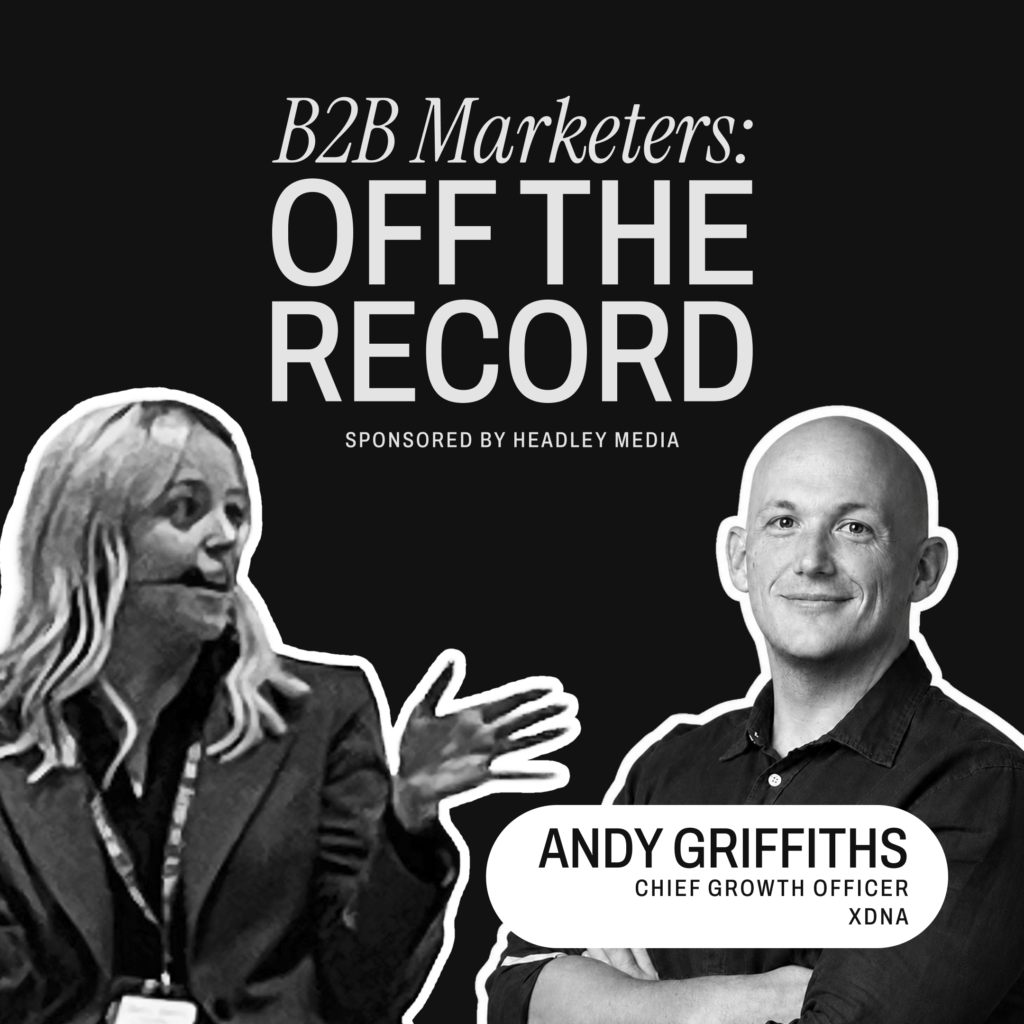
Welcome to B2B Marketers Off the Record. I am joined by Andy Griffiths. He is the Chief Growth Officer at XDNA and who better to introduce themselves but Andy.
love that. I just know you’re going to be a great guest for our listeners. Before we dive into the questions that we ask every guest, what we like to do at the top of this podcast is play on a little bit of nostalgia. So tell me you’ve been in the B2B marketing space for a number of years without telling me. I’ll go first. So the one that I tend to use is QR codes the first time, the second time, and probably the third time too. What about you, Andy?
Andy Griffiths | xDNA Group (01:45)
No pressure.
I’m going to follow you up then with augmented reality.
Freya Ward (02:13)
spicy, okay.
Andy Griffiths | xDNA Group (02:15)
except that augmented reality didn’t have a COVID to rescue it from the the abyss of tech that theoretically we should all be using all the time but no one really bothers with.
Freya Ward (02:24)
No one really bothers with COVID saved a few things when it comes to kind of the marketing space and changed a few things. But yeah, augmented reality didn’t quite make it through.
Well exactly. How did you get into the space originally, Andy? What was your journey like into B2B marketing?
Andy Griffiths | xDNA Group (02:51)
Good question. I think I’d always been interested in marketing without realising that’s what I wanted to do, is the honest answer. Really, really sad, but as a kid watching TV, mean, the adverts were pretty much my favourite bit.
Freya Ward (03:07)
You
Andy Griffiths | xDNA Group (03:08)
I’m not even lying, not even just out of seeing what toys were coming out or anything else. I genuinely enjoyed sort of advertising marketing. I’ve always enjoyed sort of wordplay and good copy and that kind of stuff. And I don’t think I’ve really sort of clocked it there for marketing was where I wanted to go to. I started off in the event space. So conferencing exhibition. So an absolute classic channel for B2B marketing really, which was theoretically great.
with a pretty at the time young business full of really creative people, did really well, they eventually got bought by Reuters. However, my journey through them was a little less rosy because I decided to start my career on the cusp of the 2007 and 2008 recession.
So the start of my career is sort of, I think for a good few years, my profession was getting made redundant for a little while there. But I sort of landed in that aspect of kind of, yeah, conferences, trade show, focus content across a number of different sort of verticals within B2B, but always in that kind of B2B marketing stakeholder. I fell into various bits and pieces around things like industry trade publications and things like that as well.
But I sort of stumbled into it and it was only really through kind of think sort of grafting and stumbling and eventually I hope landing on my feet that yeah sort of solidified and realized that yeah no marketing advertising this is me. Yeah absolutely.
Freya Ward (04:42)
This is what I do. This is what I enjoy.
How interesting. Do you know what, Andy, in all of the episodes that we’ve recorded so far, I would say more than 90 % of the guests tripped and fell. Until they were knee deep in marketing, that they then realized, actually, this is what I love. And then they learned about the psychology behind it all the science side of it. And it just blew their minds. And that’s why they kind of locked in to this as their career path.
I don’t think I’ve had one guest so far that said, you know, this is, marketing is exactly what the course that I knew I would take from the off. It’s, it’s, was inspired. I saw something, someone opened a door for me. I went for a job interview for this role and ended up in this role. It’s, yeah, it’s fascinating.
Andy Griffiths | xDNA Group (05:30)
It’s interesting you say that because I’ve been fortunate enough to hire and manage over my career a couple of people that very deliberately did come from a deliberate choice of marketing, qualified in it, all the rest of it. And it’s difficult, right? Because I’ve held over, of course, my career, various marketing and sales roles and probably always felt like a bit of an imposter.
in both thinking is this what I’m supposed to do etc and have know absolutely sort of fallen in love with it over the course of time but it is sort of it is always interesting when you see someone that I’m always envious of anyone that knows exactly what they want to do.
Freya Ward (06:01)
Yeah.
Yeah, me too. Still figuring it out at this point. So there’s been a lot of change in the marketing landscape, particularly in the B2B space over the last five, six years. Is there one particular belief that you have changed your mind on in the last 12 months?
Andy Griffiths | xDNA Group (06:28)
yeah, last 12 months, certainly, I think kind of there’s, there’s two aspects, right? I think one, I don’t know I’d call it a belief or a complacency. I think it’s more, I don’t know if it’s a core belief so much as things that were taken for granted. And I think it’s flipped. something so for me, this is around the use of sort of referral network and marketing.
particularly in terms of generating growth and sort of revenue, et cetera. I still think for many businesses it’s massively underdone.
I’m now going to completely contradict myself and say that I think the core belief that a lot of people still have is that you can continue to successfully build scale and run your business on that as sort of the heart of it. If not that alone, then the core way of doing business, etc.
And I’m not saying you can’t take over doing that, but in terms of the limitations I’m seeing now around sort of scale, I think it’s coming to a bit of a head. One, you know, we’ve had various trends over the years between particularly sort of post COVID around more flexible working. People move around in roles a bit more often now. In some ways, that’s great for referral and sort of network and everything. other areas, it means that your biggest advocate can leave that client overnight and, you know, bring someone else in with their
Freya Ward (07:28)
you
Andy Griffiths | xDNA Group (07:51)
own network and referral etc and I think it’s highlighted particularly with AI really having started to come into its own in the last 12 to 18 months into marketing. I think it’s sort of consolidated the need for people to look further afield than perhaps they always tried and trusted.
Freya Ward (08:11)
yeah, interesting. I think my take on it is leaning even further into your network, leaning even further into that referral piece. And I think what’s interesting as well is there’s also the opportunity to work on the referral and partnership piece, like a shared go-to-market approach with complimentary.
software vendors or stuff that’s been happening in the channel for years, right? I think is expanding outside of the channel and into other areas and other industries from a marketing standpoint. But yeah, there’s the flip side of it. There’s so much movement in the market. When I’m recruiting and hiring inside of our business, by way of example, I don’t trust anyone that says they’ve got a little black book of…
connections because that connection those connections will have moved on you know they might be able to open doors yeah for sure yeah 100 % I mean I’ve worked in this industry for several years I pride myself on my network the relationships I’ve built over the years my friends and allies in the industry but if I was to leave my business tomorrow I would never hang my hat on my black book of contacts
Andy Griffiths | xDNA Group (08:59)
Interesting. So you’re now seeing that as the less valuable asset. Yeah.
I think that’s exactly what I’m trying to get to really. It’s the fact that I still see it underutilized in a lot of places and it’s quite often, you know, where some low hanging fruit can be found if people have a really good referral or partnership network and scheme and they’re leveraging that. But I think the flip side to that is I often speak to businesses and brands where that is the core, you know, reliance for generating any kind of leads or growth, et cetera.
Freya Ward (09:32)
Mm-hmm.
Andy Griffiths | xDNA Group (09:52)
how people search, how they drive recommendations, how they research, how they shortlist, etc. is changing amidst an economy at the moment is think kind of causing a lot of risk aversion as well.
Freya Ward (10:06)
for sure, which takes us really nicely actually onto our next question, which is how are you seeing the B2B buying behaviour change at the moment?
Andy Griffiths | xDNA Group (10:18)
hugely joining about for our business or for clients. Okay. Well, I mean the, the, the commonality I think for everyone, regardless of my own sort of personal experience, heading up growth for our, our group is, has been around the, you know, the increasing use of AI.
Freya Ward (10:21)
Either or, whichever one you want to lean into.
Andy Griffiths | xDNA Group (10:39)
I’m seeing more people actually adopt it as a regular part of how they do work. think particularly around marketing, we’re all constantly looking at the next shiny toy, whether it’s the next marketing opportunity or piece of tech or whatever it might be. So think we’re, a type of stakeholder, quite key or quite quick to adopt it. It’s also, let’s be honest, B2B can often be one of those areas where, unless you’re fortunate, you can be pretty heavily under-resourced in terms
Whether it’s a growth consultancy that has a marketing team of 0.5 or whatever else it might be. people are therefore adopting use of LLMs, I think, at a slightly quicker rate. And the bigger thing, because as I said, a lot of us are under-resourced or under-staffed, cetera, in that front. And we’re not currently in economy that is favorable to speculative hires and an abundance of spare resource. Anything that helps shortcut, right?
And part of that historically in the media buying process has been a good old bit of desktop research or whatever else it might be. And with the use of LLMs comes an inherent trust of the answers. Here’s my first sort of stat I’ll drop on you today at the moment. that’s probably the biggest thing that kind of is making people sit up and look around is that you’re looking at about sort of 30 to 40 %
Freya Ward (12:03)
Please do.
Andy Griffiths | xDNA Group (12:13)
stronger conversion rate of a lead that comes through an LLM versus anything else. Inbound into sales inbox, LinkedIn prospecting, paid search, SEO work, whatever else. If you’re that stuff through an LLM, typically on average you’ve got about 30, 40 % more likelihood.
The challenge has always been, obviously I’ve worked a lot in my career around advertising, media buying, digital marketing, et cetera. And the reality for any business that goes out to tender for a new, whether it’s agency, third party, whoever to help support them in those services. The typical rule is that they’re gonna take through for procurement cycle maybe five.
Right, so you’ve got the incumbent normally, you’ve got sort of two who are vouched for and you know about, and then you’ve got maybe one or two that have been shortlisted to make up the numbers. And if you don’t have an existing relationship with them, you’ve got maybe a 5 % chance of winning it.
And that’s a lot of expense and work for business. So think of our own sort of challenges that you invest time, effort, resource into completing RFIs and RFPs, cetera. So the fact now the leads that come through LLM or the role that is taking in helping marketers find either major opportunities like you guys have at Headley or whether it’s agencies and sort of performance marketing support like we offer, new website, whatever it might be.
the trust and credibility that people are apportioning to an LLM on the assumption that Claude’s not gonna let me down, he’s really done his homework here, know, of course he’s found the best market, why wouldn’t I just do what Claude has? And also, you know, that wasn’t that much quicker than sort of all that sort of resource or ringing around my entire network to find out or putting something on LinkedIn and having my inbox absolutely destroyed within the first 30 seconds of posting.
all that kind of stuff. like I said, the conversion rates are showing. And that’s honestly something we’re seeing as well. So, you know, like any other business and we’re B2B as well, right, in our own marketing across XDNA Group, we’ve got various different capabilities and access points to the business, slightly, slight variance in our ICP on that front. And where we’ve sort of doubled down on trying to drive LLM in bounds, those are converting at a better rate.
Freya Ward (14:46)
Yeah, it’s, I mean, we’re seeing it as well. We’re seeing it inside of our business. Leads that come through, any kind of inbound lead that comes through the website that is coming from any kind of LLM search is stronger, they’re more informed, they’re more engaged, they’ve essentially done their desk research and we’ve made it to that short list so much quicker as well.
Andy Griffiths | xDNA Group (15:11)
I think from war
side, we take more confidence that they’re a genuine prospect or opportunity or buyer, right, as well, because the assumption is that we take some bias that, they must have done their homework, they’re, you know, putting some proper thought into it, they’re not just sort of recalling the first person they’ve heard or used two years ago and throwing that in there as well.
Freya Ward (15:31)
Yeah, or honoring a referral that a friend made or, you know, they’ve conducted a level of research. But what does that tell us then about trust in AI search? So flip it on its head and the individuals that are using LLMs to shortlist. How has the LLM built that trust with them so quickly?
Andy Griffiths | xDNA Group (15:56)
I we’ve always been relatively quick to trust impressive technology. I think if you think about, I’m old enough to remember sort of adoption of the internet when it became sort of more mainstream. I was, think, probably one of the first generations in mid teams where we all had mobile phones. If anyone wants to know what my high score on Snake was, then DM me, that’s fine.
But I think it’s something that we, once we’re kind of past the natural human sort of skepticism of something, we’re generally pretty trusting in it. So I think that kind of ability to lean in and adopt it, let’s be honest, it’s a lot of it’s really cool. The kind of stuff that you can do through Claude or integrations, vibe coding, et cetera, et cetera, it makes it an invaluable tool to you, right? Particularly as I said, if you’re short on time or resource, there’s a load of stuff
that you can start to set up and integrate that can make a really modest marketing team in terms of FTEs, etc.
get through and achieve an awful lot, right? The challenge with that, think it comes with sort of the quality and scrutiny with it. tend to, one of my many faults, right, is I tend to be quite black and white with stuff. I drive my wife mad with this all the time. I can be quite sort of binary. It’s either this or that. And as part of that horrible trend, I’ve tended to sort of bucket people a bit in terms of how they are adopting AI. I tend to see sort of two camps.
There’s those that are doing it from a, how can I use this to be able to achieve more or to do more? And there’s the camp that go into it kind of, oh, how can I make this easier or quicker or less work to do? And I think the motivators are quite different in terms of how I’ve seen people go about adopting a user tech.
Freya Ward (17:52)
Yeah, yeah, that’s right. Yeah, I mean, I can’t fault what you’ve just said. I think there’s obviously gray area in between the two. I know you want to be in the black and white, but there is gray area between the two. But on a simplistic level, yeah, I completely agree with you. So B2B marketers need to, and I think already are aware of this, you know, they’re trying to figure out exactly how and what drives it, but they need to be really focusing efforts in on improving their
Andy Griffiths | xDNA Group (18:03)
Yeah.
Freya Ward (18:22)
search. So LLM identification, surfacing their brand, partnering with any sources, know, digital PR, all that side of things, any sources that are going to improve their ranking essentially within LLM search is where they need to get their their brand surfaced. What’s the strategic bet then that you think more marketers need to make in the next couple of years if I didn’t already cover it off?
Andy Griffiths | xDNA Group (18:51)
I think you’ve summed up really nicely, Freya to be honest I don’t see this going anywhere. This is around to stay. It is going to continue to actually transform the way that people buy and procure services and how B2B marketers need to be discoverable and seen in the same way that if you were a slow adopter of when the internet came around and so, we don’t need a website or whatever, you got found out pretty quick.
because they’re now getting the classic of, oh, someone on the board searched for us on chat GPT and we didn’t come up. Now I’ve got to worry about it or whatever sort of vanity metrics you want to throw at it, that kind of classic thing. from a deeper route in terms of performance is, you you’re just now really seeing kind of a shift in weight and value of a channel that, you know, if you’re starting from scratch now and have been under investing can take you a good couple of years to really see massive results
Freya Ward (20:34)
Yeah, yeah, for sure. And I think it’s interesting because I completely agree with you. It’s not going away, as you rightly said. It’s, if anything, trust is going to build even further with the results that are coming up through LLM search. There’s efficiencies there. There’s, I think there’s confidence in shortlisting, using an LLM for shortlisting because the user…
knows that they’re still going to vet them. You know, it’s not making a business decision for them right now, it may in the future, but right now it’s not. So therefore, any agentic AI that is shortlisting for you, or if you’re using an LLM, you know, there’s still an element of human vetting and there’s still going to be five, 10, 12 levels of approval and sign off before anyone is onboarded. So there’s that assurance that that’s going to happen, which is maybe why the trust is there in the first place.
it’s just getting you to that first step, isn’t it? And businesses that aren’t investing in it are going to fall behind. We’re seeing, so at Headley, we’re a lead gen company. So we, we have our own brands and our own publications and we’re seeing an increase in engagement.
within those brands within the B2B tech space. And I’ve got some working theories as to why that is happening. I’m curious about the future of AI search and what the verticalization of search will be or LLMs will be when it comes to specific niches. So within the tech space, you know, you’ve got finance, you’ve got HR, you’ve got cybersecurity, you’ve got AI investment, all of these different areas and industries, healthcare.
that verticalization I think is going to be really, really interesting. And one of my working theories on why we’re seeing more engagement across our publications is because the LLMs aren’t necessarily, you know, there’s gaps in the learning. There’s gaps in the training. There’s gaps in the data. And I’m curious how, how that feels for specific niche audiences when they’re using LLMs, because for Headley and for XDNA, you’re more of a service and you’re
It’s marketers that are coming and searching and utilizing it. So I’m curious about technical leaders and how they’re trusting the LLM surface or discoverability or whatever it might be. We could unpack this for hours though.
Andy Griffiths | xDNA Group (22:58)
really
likely to disclose stuff that I’m not supposed to about what we were looking on as well. it’s a bit of a… Yeah, look, it’s a really good point. I like the idea of verticalization of the LLMs themselves. know, we’re already kind of seeing it a little bit in that kind of, I think, know, Claude is the LLM for business. You’ve got Gemini as the household family, all-round kind of go-to. ChatGPT still seems to be talked of more in terms of retail spaces than any others. So I don’t know how we’ll sort of carve that out. There’ll be others that come along as
Freya Ward (23:01)
Okay, let’s move on.
Yeah, absolutely. So the advice for any B2B marketer is just start, just start. If you’re not already, just start investing in your search and your discoverability.
Andy Griffiths | xDNA Group (24:00)
I think, so I have a lot of both empathy for marketing stakeholders. We like many other businesses, we’d sort of do round tables and events, et cetera. And a couple of months ago, we we held one on AI search, right? And how that is shifting kind of discoverability for brands. And, you know, we didn’t have a single dropout. had 20 turn up and come around the table and discuss it. It’s a really hot topic right now. We could have run that round table sort of several times over.
the prevailing kind of empathy that I have for those in the room. And we had everyone from sort of large blue chips to startups, sort of the pre-seed almost. And the prevailing sort of empathy was how challenging it is to navigate everything right now, right? I think it is really, really tricky, particularly if I’ve ever said, you you’re starting from behind and a lot of them are. And I think the bit that really worries me
is just how much of a chasm there is in this. was McKinsey’s latest study, Pulse came out on sort of B2B marketing a couple of weeks, it might be three weeks ago now.
in public domain, everyone can go check it out, but it’s worth a read if you’re in the space, I think. And sort of called out a couple of things. First of all, the, you know, good basic digital omni-channel marketing, which I think is still an aspiration for so many B2B businesses, is I think the turn of phrase they use was merely the price of admission. Now.
not the aim to get to, it’s like the absolute bare minimum. So the expectation of what’s required as a bare minimum, as a benchmark has leveled up and shifted, I think. And the other thing that I was really surprised to read out, and I wasn’t, I’m not sure, maybe I’ll ask Claude or something if this is true, but without him just referring back to McKinsey, but the other key stat was that I think it was something like 70 % of B2B businesses are e-com now.
And if you think about the reliance, if there’s some kind of transactional aspect of your B2B marketing.
the reliance, I’m going to shameless plug, but within XDNA Group, we also do a lot around DTC and consumer facing brands as well. We do a lot around sort of driving econ revenue growth and stuff through acquisition marketing, et cetera. And it is, it is savage. It is an absolute, you know, a technical, it’s a number soup. It’s a lot of expertise into it to really manipulate an entire customer journey. And that’s just for someone who might be searching for something for,
I don’t know, size nine socks, same day delivery or next day delivery or something. If you think about some of the aspects of LLM search, where for B2B, we ask more prescriptive questions, because it doesn’t just have to be B2B media owners UK, that might have got Headley or something, right? You’re now starting to look at things like,
What are the best ones, XYZ, where a budget of ABC would achieve something for me that specifically has worked with, and then I’m list a couple of my competitors’ or something about my ICP, so that long tail of really prescriptive search.
is getting quite tricky now, I think. I
think if there’s one thing that everyone should be doing, as challenging as all that is and as under resourced everything is, what is super achievable right now for very little investment, I mean very little investment, is to at least measure what you’re doing.
because look, it’s shifting all the time. I’d be a complete charlatan if I turned around and said, look, this is exactly what it’s going to be. I think if you work in search marketing right now, you can open any random publication or blog and one will tell you that search has completely changed overnight. Another one will tell you that actually no, it hasn’t. It’s just good old fashioned SEO. It’s probably a bit of both the classic thing, right? But good core SEO is a really good starting point. I think what’s really tough for B2B marketers is if you’ve got a situation where⁓
you know, they’ve not had that investment and backing internally into things like their organic search and discoverability for their brand. Then turning around in the current climate to a CFO or whoever you report in your CMO, et cetera, board level, and saying, look, we’re probably two years behind where we need to be. And I now need an incremental anything from two to six to 12 to 20 K a month to invest into.
SEO and by the way it’ll take a little bit of time for us to really start getting those results. So that’s a tough sell right now.
Freya Ward (28:58)
Yeah.
Andy Griffiths | xDNA Group (28:59)
That’s a really, really tough sell. So I think, you know, there’s a couple of things to double down on, right? One is the quick wins you can do over a very short period of time. Get your hands on a good AI measuring tool or an agency that can set one up for you. is very little money. And at least then you have the data and the visibility to either abate some of the pressure you’ve got internally. And you can say, look, this is really important. Currently, it’s
only X amount of searches on these kind of prompts per month. So we’re still we’re still in time. This is Oh my god, we’re miles behind. Look, right here is the data that backs up why you need to, you know, to be be funding this immediately into the next fiscal. And the second bit of it is, is be tactical around short term tactical campaigns that will bear results that focus on media opportunities that are leveraging this. So, you know, I’m going to do a
a really shameless plug for Headley here, right? And you’ll love me for this. But you guys are a good example. You’re not the only one out there. Sorry, Freya, but you’re a really good example of where you guys have invested into some of this stuff. Go find A, the data that you know how prompts and AI visibility is affecting your own brand.
and then go spend a little bit of money on some tactical opportunities that prove that if you are active and relevant in the areas that are picking up this visibility, you get the kind of results that will give internal stakeholders a bit of that confidence to underpin some of that investment.
because I think otherwise there be a lot of people trying to cheat and shortcut it and they’ll get found out in sort of 6 to 18 months. I think they’re going to get found out.
Freya Ward (30:49)
they’ll be even further behind, right, if they don’t start properly.
Andy Griffiths | xDNA Group (30:52)
Yeah, mean,
exactly. mean, it can take even before LLMs and everything else, right? If you’re looking at just sort of organic visibility thing, want to be top of the Google search results pages for being known as, you know, I don’t know, the best in whatever business you might be in paper clips, waste management, whatever it might be, right? You know, that can take quite a bit of time to build that domain authority and rating.
Freya Ward (31:49)
Yeah, such solid advice. Thank you, Andy. knew that you would be a fantastic guest and give us loads. No, not at all. You give us loads of different insights. And I think this is something that is on the forefront of so many B2B marketers’ minds at the moment. It’s kind of how do we start? We’re far behind or how do we improve? And actually you’ve given two really, in the grand scheme of things, simplistic things that they can take away. They’re practical.
Andy Griffiths | xDNA Group (31:55)
That’s because I don’t shut up for you.
Freya Ward (32:19)
and they can evaluate what they’re currently doing and how does that help feed some of this.
Tell me something then that you think that B2B marketers should stop doing. Something they do out of habit that maybe doesn’t work anymore.
Andy Griffiths | xDNA Group (32:38)
okay, okay. This might be an unpopular opinion, right? But it’s something that in the last sort of couple of years I have pulled back on in, you know, sort of previous roles and in this one. Blind loyalty to, yeah, of course, it’s, you know…
Freya Ward (32:42)
you
Andy Griffiths | xDNA Group (33:01)
BizFest, the NEC, and well of course we’ll take our usual stand like we do every year, et cetera. I think kind of the event space and trade show space is also one that has shifted a little bit. I have, would, you know, there’s a lot of people that is this kind of, of course we do this every year.
of course, we’ll have a stand again. And it becomes that point of complacency where you rinse and repeat.
and it’s probably the easiest part of your account, it’s a lot of work doing events, but it’s probably the easiest thing that you don’t have to think about, you know, it’s gonna happen. I’ve previously worked at a business where, because it was so intrinsic to the vertical where a lot of our customers were, we had blindly, blindly been sponsoring a trade press.
magazine and it was one of these you know inside front cover or something you know the kind of that we did every year and it was this classic kind of b2b thinking of you know sort of well we don’t want one of our competitors to get it and it took i think a good sort of
maybe four years of me having an absolute hissy fit and being a complete grump and moaning about it and doing things like, can at least start to put a QR code on it so that we can see if we get any kind of referral from it, right? And then when that didn’t, the narrative was, yeah, but we just do it for brand awareness or visibility. Okay, well then let’s change the CTAs. Let’s try and make that, it took a long time to stop securing what was actually a decent amount of money.
Freya Ward (34:25)
Okay.
Andy Griffiths | xDNA Group (34:45)
into just having a bit of a cover presence on something. And I think if there’s ever a time to try and say and point to, look, this has changed, this has changed, can we just review what we’re currently doing, particularly in the current environment, the current economy? I don’t wanna be too…
negative about UK PLC. It’s very hard. in Qatar for Web Summit earlier this year and everything’s just buzzing, know, sort of that optimism that has been perhaps absent for a little bit. There is a little bit of malaise in the economy, but I think what it really means is that, you know, we’ve not got heaps of organic growth where we’re just going to get a natural share of a pie anyway.
You know, so if every penny needs to work and be accountable and answer back, which is again, comes back to this point around sort of AI measurement and making sure you’re kind of monitoring what’s what’s going on. And I think kind of, you know, be a status quo challenger right now. Challenge the status quo. Be honest with yourself, scrutinize what you’re doing, build the case, make it internally and, you know, go forth, be brave.
Freya Ward (36:08)
forth, be brave. I love that. It’s, it’s, it’s so true. Like I remember when I was working agency side, and I remember one of the big trade shows that one of our clients used to go to that we kind of reordered audited how they were spending their marketing budget year on year. And there was a significant proportion of that budget that was allocated to trade show, presence, stands, etc. That almost wasn’t
seen in the marketing budget, it was like we always spend that so that just exists and that just happens. And then we were playing with the extra, the other 40 % of the marketing budget, essentially, the 60 % was just always allocated for that. And we did an audit and the feedback that we got from the stakeholders was something along the lines of our, not being there will be noticed more than us being there. So our lack of presence and I was like, yeah, but by who? And it was our competitors and
That is not a reason to have a stand at a trade show.
Andy Griffiths | xDNA Group (37:06)
I love this, Freya. is exactly the narrative. So I was on that side of the table with my own marketing P &L at a previous business, like I said, this sort of trade press thing. the concern was that one of the competitors, for me, we were one of, know, gold, let one of our competitors spend a heap of their cash that could be sort of, I don’t know, spent trying to improve upon our positioning or whatever else, and let them get nothing from it.
Freya Ward (37:35)
Yeah.
Andy Griffiths | xDNA Group (37:36)
Really
happy with that, really happy with that. Because it’s almost an argument saying, oh no, we don’t want to sort of handicap our competitors by having them spend their money on something that won’t work. Yeah, prove to me it works or not. Not everything has to be accountable to the last.
Freya Ward (37:47)
that isn’t working for us anyway. Yeah, 100 % whilst we focus our efforts.
Andy Griffiths | xDNA Group (37:56)
absolute penny, right? Not that there is across the marketing funnel, there is absolutely, you know, lot of people are so kind of lead gen focused that they forget the importance of brand and it’s one of the biggest sort of parts and you do have to do some above the line and upper funnel work in the same way you’re not immune to that.
But yeah, I do find it quite amusing how many people will, to your point, your budget, it’s a really astute observation from your guys, Your budget’s actually only 40 % of what you spend.
Freya Ward (38:31)
Yeah, yeah, the only you can work with is 40 % of it. 60 % is pre-allocated to something that someone else previously decided was the most important thing for you to invest in.
What’s one thing that you wish you could change in B2B marketing?
Andy Griffiths | xDNA Group (38:52)
ooooh well that’s a good one just one
Freya Ward (38:56)
Just one.
Andy Griffiths | xDNA Group (38:57)
I feel like I should go for something a bit more substantial or meaningful but purely because I was rage-baited by it over lunch today I’m gonna I’m gonna I’ve got a lot of LinkedIn fatigue at the moment
I’m a fan of LinkedIn, I’m on there a fair bit, know, shout about, know, like, subscribe, follow me or whatever else, you know, but I think what I don’t need is…
some of the absolute dross that you see on it. I feel like it used to be, I tied my shoes today and this is what it taught me about B2B sales, it used to be the exception rather than rule and the volume of that and it is becoming LinkedInstagram a little bit. I still find it really good for networking, for keeping in touch with people. I find it good for promoting my business and lead generation search. There’s still a lot of value in it. So I think my upset comes from I feel like
with a post and trying to turn it into some sort of, you what can we learn from this for a bit? I mean, I just, yeah, I couldn’t, I thought this is probably one of the most crass things I’ve seen. And I struggle with that, right? So I think if there’s one thing I could change at the moment, it would be, can we just take it back to it being used as a really good kind of professional networking tool and not a substitute for hashtags and LinkedIn a little bit.
Freya Ward (40:32)
Right.
You
Yeah, I don’t disagree with you. think LinkedIn need to tighten it up a little bit, don’t they? Like they’ve introduced the, I don’t know if you’ve seen it on the mobile version, they’ve reintroduced what they trialed a while ago in the UK, which is the video. So the video feed, which I was actually really enthused about because I love seeing video content on LinkedIn when it’s insightful, you know, when it’s about events or talks or snippets, takeaways, whatever, I like consuming that content. I went on it and it was…
Andy Griffiths | xDNA Group (41:20)
Right.
Freya Ward (41:27)
absolutely nobody I’ve ever engaged with their content, not even third, fourth, fifth connection away. And I don’t have TikTok because I know that I will lose far too many hours to TikTok. I am the Instagram generation and even then I have to put a time limit on it. So I don’t have TikTok. I’ve never lent into TikTok. It felt like I was on what I imagine it to be like on TikTok if I’d searched up like a business section. It was so irrelevant and
Andy Griffiths | xDNA Group (41:38)
you
Freya Ward (41:57)
It was really disappointing because I thought, amazing, LinkedIn, you’ve brought in this new feature, this new section of someone that uses LinkedIn a lot to engage with my network. And I put a lot of content on there for a specific reason to try and help B2B marketers and, you know, build rapport and expand my network. It was just so tainted and it’s, there’s a lot of AI slop on there. There’s a lot of, yeah, what I learned.
I can’t even, the one that you, the example you’ve given, Andy, I can’t even entertain. Like it’s, it’s so disappointing because yeah, it is coming from a place of you gave it to us and it was wonderful. We actually had a professional network too. You’ve taken it away.
Andy Griffiths | xDNA Group (42:35)
Yeah,
yeah, yeah, yeah, no, I’m completely with you. I’ve got no issue with people putting out sort of personal posts and things like that, but don’t be just pure self-promotion and cringe-worthy kind of, it’s like it’s run by David Brent at the moment a little bit.
Freya Ward (42:40)
Mm.
I mean, I do love the office, but I just don’t expect to see it on LinkedIn.
Andy Griffiths | xDNA Group (42:56)
I’m a massive fan of yours.
I’ll start quoting and then we’ll really be there for hours.
Freya Ward (43:03)
Okay, one final question for you, which is, well, I kind of have two final questions, nearly the final, nearly the final question is a question that came from Nile Sullivan, which is one of our previous guests. What is the biggest mistake that you have made in your professional capacity and what did you learn from it?
Andy Griffiths | xDNA Group (43:25)
Probably not appearing on Off the Record sooner to be honest with you, Frey, I thought you’d like that. No, look, I don’t, I mean, there’s so many to choose from, right? Which I take as a good sign, because nothing ventured, nothing gained. I could talk you through horrendously embarrassing typos, I could talk you through that time that I forgot that I was still sharing my screen or various other sort of things, et cetera, but the…
Probably the biggest learning in the last that I’ve taken or held onto the last 10 years of my career has been around, and this is very relative to B2B because…
I was in a situation which hopefully lot of your listeners will relate to, which is that I felt like my biggest barrier or challenge around sort of, you know, was only digital piano at the time. And my biggest barrier and challenge was not the market, was not necessarily the tools I had, was not.
pricing or productization or anything like that. The biggest barrier I had was in internal stakeholder buy-in. And I had a whole, there was a sales team of 20, I think, at the time, all of whom, KPI, OKR, whichever acronym you want to use on driving this revenue growth, which is one of the most profitable parts of the business. It was one of the biggest areas that had the most headway to grow into as well.
And it was a real kind of realization of, well, that’s, yes, we’re on the same team, theoretically at least, but if it’s in the way of what I need to achieve and what’s gonna be sort of a route to my success or what I have to get done and how I’m measured for performance, it’s my problem.
and I started to be able to deal with the way that I looked at things or how it would affect me in a very different way and that’s something I’ve sort of tried to grab onto with both hands and I just have to remind myself of sometimes every now and again but it’s…
you know, it’s been a bit of a cheat code for me, I think, in terms of any time when I felt really kind of like, the barrier here is an internal stakeholder. Come on, the fight’s out there, guys, you know, not here or whatever. And instead of letting that kind of really just drag me down, going, right, what am I gonna do about it? How can I fix it?
Freya Ward (46:39)
What can I control? What is, what part of this can I control? And what, yeah, it’s.
Andy Griffiths | xDNA Group (46:43)
Yeah.
Or if I can’t control this, then what can I do to try and circumvent it or improve it or remove the barrier, et cetera,
Freya Ward (46:52)
Yeah, yeah, 100 % because I think it is so frustrating. I think it will really relate to a lot of marketers because the expectation on marketing even more so now than it ever has been is revenue, right? The end result has to be revenue. But so much of that process is out of the marketer’s control. They’re so reliant on stakeholders, peers, other departments to…
to carry their part and there’s only so much they can do to influence that. But if they can focus in on what they can control in that process and what they can, yeah, what they can influence, what they can control, what parts of it, so rather than becoming frustrated with the other stakeholder and creating that friction instead, okay, what…
what part of this is my responsibility and what can I do to improve it? And what else, what other, you know, is it communication? What is it that I can do to get what I need to be able to take this one step further forward rather than the final end result? And one step, one step, one step, you know.
Andy Griffiths | xDNA Group (47:53)
Well, I think the the budget, the the measurement is so important, trying to build that narrative and have the facts you need to drive budget to break down the internal barriers that you’ve you’ve gotten. I was speaking to a business of the day. Classic, classic SME, right? I think about sort of three, 350 people. Good revenue solvent turnover, but pretty stagnant. And
hadn’t really grown for a little while. here’s the surprise, right? I was speaking to their head of marketing, Department of One, and they’d cut all…
I was thinking, my God, where does this person go? How are they going to try and overnight, what a bleak existence? then you juxtapose that kind of classic scenario against the fact that how much change there’s been in the marketing landscape, the tools, channels there are, and throw that business and scenario into a conversation where you’re trying to talk about LLM visibility and dropping things in like…
Reddit is three times more likely to be cited as an authority than Wikipedia now. How does that kind of align?
Freya Ward (49:34)
No, that’s wild. Absolutely wild. Okay, we’re coming up to time and I would love to know, and it can be aspirational or it can be someone you know, who would you recommend as a future guest on B2B Marketers Off the Record?
Andy Griffiths | xDNA Group (49:36)
you
there’s a really obvious one, a mutual connection of ours if you haven’t already had them on. You probably know what I’m gonna say. You gonna have mic on?
Freya Ward (50:00)
I would love to have Mike on. He is on my list of people that I absolutely would love to have on the podcast. I’m so glad.
Andy Griffiths | xDNA Group (50:07)
Well, look,
Mike, I know you’re a busy man in demand, but clear a slot in your diary, yeah, I would absolutely love to hear Mike speak on all things off the record.
Freya Ward (50:21)
Amazing, thank you Andy. And if it is Mike or if it’s someone else, what question would you give to a future guest?
Andy Griffiths | xDNA Group (50:29)
I would, if it’s Mike, I would love to hear his take and advice on how on earth in some of the scenarios we’ve talked about, he would advise marketing stakeholders in the B2B space right now, building that argument and narrative.
Freya Ward (51:08)
you just know Mike Lander is gonna have the the best answer.
Andy Griffiths | xDNA Group (51:10)
Oh my god, I know right, I know and not
least because then I can just sort of you know rip off any of the ideas of my own and uh and go forward with that but I do think it’s you know it’s a really huge challenge at the moment and I think um you know it’s it’s going to be um I think in the next year sort of like I said six, 18 months are really going to define which businesses um lean into where things are going.
Freya Ward (51:42)
Yeah, it’s there’s gonna be a lot of change a lot of change but with change comes opportunity right and it comes opportunity for businesses to invest in the right things follow the right paths and Rewind two years ago. We wouldn’t have even known this would necessarily be a challenge in front of us Well, you might have in in your in your industry, but we might not have in ours. Where can people find you Andy?
Andy Griffiths | xDNA Group (52:07)
Good question. So they can find me on LinkedIn, Andy Griffiths. There’s not that many of us, so I should be relatively easy to find. You can find me via searching XDNA group on LinkedIn. Likewise, Climb Agency or any other brands within the group is all good. Alternatively, Strolling Around Hartfordshire with a Dog.
Freya Ward (52:35)
I would love it if one of our audience members found you strolling around Hertfordshire with your dog.
Andy Griffiths | xDNA Group (52:40)
I’ll
let you know if they do. I’ll let you know if they do, yeah.
Freya Ward (52:44)
All that’s left to say is thank you so much for joining us on the podcast. It’s been an absolute pleasure. Yeah, thank you.
In this episode of B2B Marketers Off the Record, Freya Ward speaks with Andy Griffiths, Chief Growth Officer at XDNA Group, about how AI is reshaping B2B marketing, buying behaviour and search.
Andy explains that although he always loved advertising, he didn’t intentionally pursue marketing. After starting his career in events during the 2008 recession and experiencing several redundancies, he gradually built a career across exhibitions, publishing and marketing before realising it was where he belonged. The conversation highlights that many successful B2B marketers arrive in the profession through unconventional career paths.
Andy believes referral networks remain valuable but should no longer be relied upon as the primary source of growth. Increased job mobility and changing buyer behaviour mean businesses need a broader demand generation strategy that extends beyond personal networks.
The biggest shift Andy is seeing is the growing use of Large Language Models (LLMs) such as Claude and ChatGPT during the buying journey. Buyers are increasingly using AI to shortlist vendors before speaking to anyone.
According to Andy:
Both speakers agree that marketers need to prioritise AI discoverability.
Key recommendations include:
Andy warns that businesses delaying investment could find themselves years behind competitors.
Andy argues that marketers should:
One of Andy’s strongest opinions is that marketers should stop automatically renewing trade show sponsorships, event stands and long-standing media placements simply because “that’s what we’ve always done.”
Instead, marketers should:
Andy also discusses his growing frustration with LinkedIn becoming increasingly filled with low quality personal storytelling and AI-generated content. While he still values it as a networking platform, he believes its professional focus has become diluted.
Reflecting on his career, Andy says one of his biggest lessons was recognising that internal stakeholder buy-in is often the biggest barrier to marketing success. Rather than becoming frustrated, marketers should focus on:
Andy leaves listeners with several practical takeaways:
He believes the next 6 to 18 months will determine which B2B businesses successfully adapt to AI-driven buying journeys and which fall behind.
Andy is Chief Growth Officer at xDNA, where he leads the agency’s commercial strategy and helps B2B organisations drive growth through effective marketing, sales alignment and go-to-market strategies. With experience across agencies, networks, sectorsand brands, he brings a broad perspective on the challenges and opportunities facing modern marketers.
Recognised as one of the UK’s leading commercial professionals, Andy has been named in the BD100 for five consecutive years, celebrating the UK’s 100 most influential business developers.
Conor Bant, Head of Media and Performance at Fox Agency, discusses the evolution of B2B…
The conversation covers search visibility optimization, digital ads, marketing operations, and the importance of building…
Lindsay O’Brien, Head of Marketing at Pragmatico, shares her marketing journey, insights on B2B marketing…