
S01E12 – Carina O’Brien – B2B Marketers: Off The Record
Carina O’Brien, Head of Strategy ANZ at Siemens Mobility, shares insights on B2B marketing and…
The conversation covers the transformation of B2B marketing with the rise of AI and SEO, shifts in B2B marketing beliefs, challenges in tracking B2B marketing, changes in B2B buyer behavior, the role of video content in B2B marketing, and content creation and B2B marketing habits. The conversation covers topics such as commercial alignment, the impact of AI on content development, leveraging brand heritage in marketing, challenges in marketing and collaboration, and barriers in marketing and human connection.
Takeaways
Chapters



Chloe Addis (01:41)
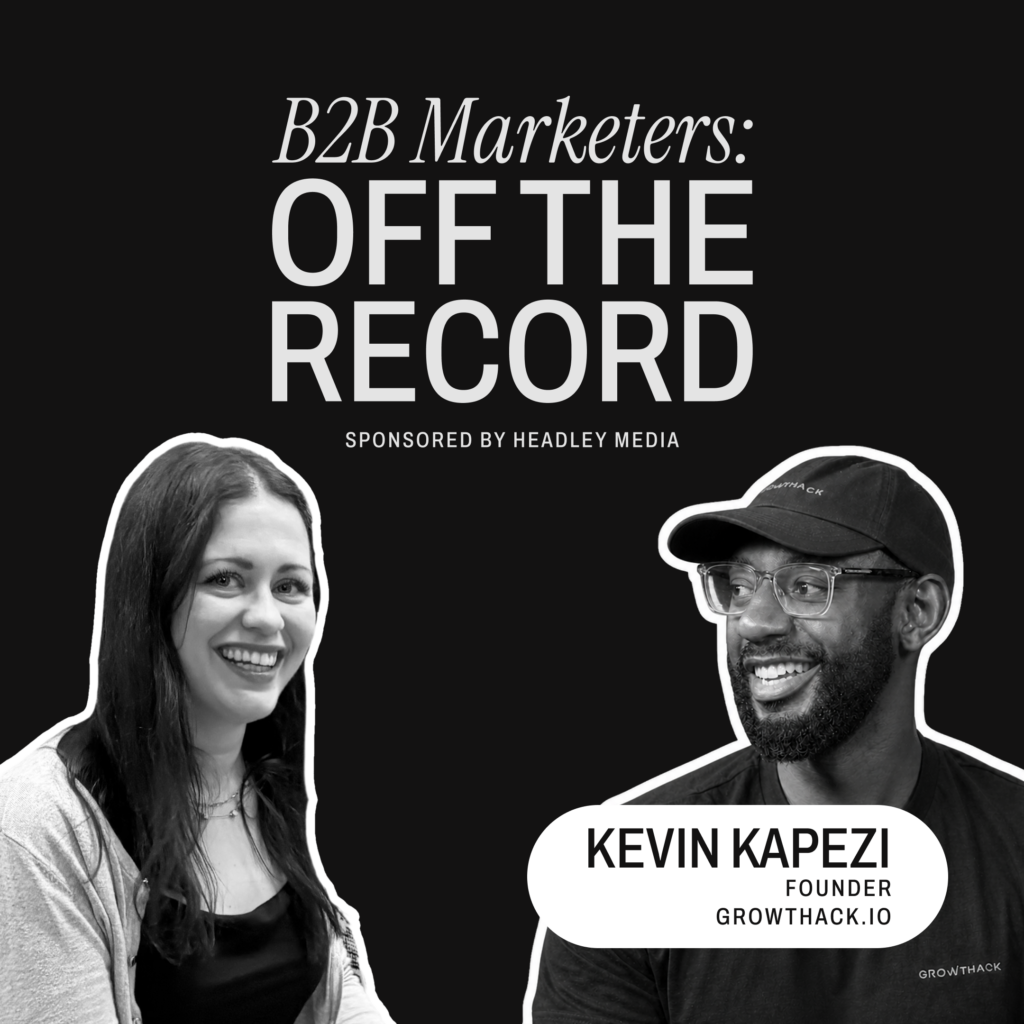
welcome to B2B marketers off the record. I’m excited to be joined today by Kevin Kapezi from Growth Hack IO, which is an SEO and AI search agency. So Kevin, would you introduce yourself please?
Kevin Kapezi (01:58)
Yeah, so hi, I’m Kevin. I’m the founder of Growth Hack. We’ve been running for about five years now. And previous to that, I was in-house as the SEO lead at Experian B2B based in Nottingham. And what we do at Growth Hack is help e-commerce, SaaS, and B2B brands through SEO content brand building up the authority with AI Search now becoming more prominent for sure in recent times.
Chloe Addis (02:26)
Amazing. It’s definitely such a central kind of focus for so many marketers at the moment. So I’m really excited to have you on and talking about this stuff. Before we dive into our questions, we always ask our guests to get going on the pod tell me you’ve been in marketing, B2B marketing for many years without telling me.
Kevin Kapezi (02:47)
Yes, I’d say.
If you spend half your working life or more than half your working life in meetings, I’d say meeting, meeting after meeting, meeting for the meeting, planning for the next meeting, you know that, I don’t
Chloe Addis (02:59)
Hehehehehe
Kevin Kapezi (03:02)
know if there’s a meme that explains that, but you know, literally like a meeting to discuss the meeting, which goes on to the next meeting for sure. I’ve been
Chloe Addis (03:04)
Absolutely. Yeah. 100%.
Kevin Kapezi (03:12)
a lot of, yeah, scenarios where it’s like a loop. You’re like, whoa, okay, when are you going to stop having the meeting for
eating. Yeah.
Chloe Addis (03:21)
The
post meeting, the pre meeting. I think the best thing that kind of relates to that is I’ve seen caps with this meeting could have been an email written on it. Perfect. For all
Kevin Kapezi (03:30)
Yeah, exactly.
Chloe Addis (03:33)
the frustrated B2B marketers out there.
Okay, so tell me, how did you get into marketing in the first place?
Kevin Kapezi (03:44)
Yeah,
so I don’t have the conventional path. I’ve always been interested in marketing, so I’ve always had a passion just for business in general. I’m originally from Zimbabwe.
So yeah, I’m not going to tell you my whole life story, but when I came to the UK, when I came to the UK, you know, was like 17, know, teenager, moving on to an adult. I didn’t really know what I wanted to in my life, to be honest. So I just started like, you know, getting into music in my spare time. And then when I moved to Nottingham, I started meeting other musicians, et cetera, you know, in the area.
to build my own website, which I did, and that kind of was my first stab at marketing because I had to market myself
Chloe Addis (04:21)
Okay.
Kevin Kapezi (04:21)
to other musicians and the local community. And then I had a passion for, I guess, the websites and how they worked. And I tried doing some consulting in the early days, not really knowing what I was doing. And then that led me to meet somebody who was in IT and was also trying to be a musician. And then he told me about this thing called SEO, which I knew nothing about at the time.
And then I started researching a lot more about it and then I decided, okay, listen, I’m gonna quit my job. And I just decided from that moment to do this course with the hope of quitting my job and then getting a role in marketing. So at the time I was working at Specsavers in various finance roles, not really having a lot of success in that, know, finance admin. And I was just really bored, like honestly looking at spreadsheets.
Chloe Addis (05:07)
Mm.
Kevin Kapezi (05:09)
know, bank reconciliation, know, exciting stuff like that. I decided, you know, I want to be the one who’s influencing the numbers rather than just seeing the numbers on the page. So
Chloe Addis (05:20)
Mm.
Kevin Kapezi (05:20)
yeah, that’s what, you know, kind of brought me to where I’m now, which is, yeah, marketing.
Chloe Addis (05:26)
Wow. I know. So one of the reasons we asked that question is because nobody seems to really have a direct path into marketing. But
Kevin Kapezi (05:34)
No.
Chloe Addis (05:35)
that’s really interesting. think yours is definitely quite varied. And I think it is kind of often driven by wanting to have more of an influence and an understanding of like, okay, well, like you said, these are the numbers on the page. How can I have a role in that? So yeah, that’s really interesting. Wow.
And the musician piece as well, it’s definitely like the creativity that comes into marketing. So yeah, it makes sense.
Kevin Kapezi (06:03)
Yes, yes absolutely. Absolutely and
I’m not a very creative marketer so it’s quite interesting that I started my journey being well trying to be more creative but yeah I’m not a creative person I’m more technical now so yeah.
Chloe Addis (06:18)
Yeah, yeah,
very interesting, actually. So, okay, what’s one belief about B2B marketing you’ve changed your mind on in the last 12 months?
Kevin Kapezi (06:29)
In
the last 12 months, for sure with the rise in AI and everyone’s talking about it,
Chloe Addis (06:33)
Mm-mm. Yeah.
Kevin Kapezi (06:35)
my belief used to be, yes, you need to be on top of your marketing campaigns, you need to have the best website structure, you need to be really on it with your, I guess, overall marketing strategy.
But I think now in the last 12 months, for sure, think the shift has been the brands who’ve really invested in their brand, like over a long period of time.
Chloe Addis (06:55)
Yeah. Yeah.
Kevin Kapezi (06:58)
Those are the ones that are really moving ahead with all the changes. So I don’t think you need to have like the best website, the best structure, even though that’s what I do in a day to day. If I’m up against a brand that’s heavily invested in…
you know, lot of really good rich content, their people being in front of a camera, you know, they’ve got thousands of views on YouTube, et cetera. If I’m competing against a brand like that versus a brand that’s got really nice website, et cetera, I’m going to really struggle because they’ve built up so much brand equity. So I think in the last 12 months, for sure, I think my shift in mindset has been, yeah, we’re not really, we’re not really optimizing in terms of how we used to optimize, I don’t think.
Chloe Addis (07:41)
Yeah.
Kevin Kapezi (07:42)
It’s a wider discussion.
And yeah, think SEO has for sure changed in terms of the perception. So before
Chloe Addis (07:50)
Yeah.
Kevin Kapezi (07:50)
it was just, you you just handle the website, you know, kind of sit in your website corner, but now it’s no, no, no, how are we integrated across all the other channels and how do we all
Chloe Addis (07:58)
Thank you.
Kevin Kapezi (07:58)
come together to deliver growth?
Chloe Addis (08:01)
Yeah, and I guess there’s definitely challenges that come with that as well, kind of trying to box out the work almost in firstly, because there’s always been the kind of blurred lines between what is content, what’s SEO, what’s content management, where does, where’s the line of like, you know, creation of blogs to do with keywords and things like that. And where’s that? Where are the
you know, the writers and the, you know, you’ve got digital PR and the journalistic kind of traditional work that needs to be done still. So it has, yeah, I think from my perspective as a head of marketing, I can completely relate to that because it has brought everything together and given more focus on wider activities that are
or that used to be more difficult to say, to link back to ROI, for example, you know, which, we’re all trying to do all of the time, but actually we know that those activities, the brand building is now pulling through to AI search and you know, it’s all having kind of cross-level impact all of the time. So that’s,
Kevin Kapezi (09:15)
Yes.
Chloe Addis (09:16)
it’s really difficult, isn’t it? How do, how are you finding
Kevin Kapezi (09:18)
It is, yeah.
Chloe Addis (09:19)
tracking with that?
Kevin Kapezi (09:23)
think tracking is becoming more of a myth day by day, in all honesty,
Chloe Addis (09:25)
Nearly. Yeah.
Kevin Kapezi (09:26)
because the journeys that people take when they want to purchase something, especially in B2B, is very difficult to attribute and say, okay, this campaign led to that, you know, get that cause and effect from
Chloe Addis (09:37)
Yeah.
Kevin Kapezi (09:38)
a campaign perspective. So I think businesses should just have a strong, what can I say, in terms of, a strong identity in terms of who they are and how they want to appear in the market.
and then look at those channels that are closer to their customer, where their customer is spending most of their time, and just have consistency in terms of what they’re saying across all those different channels, obviously in all
Chloe Addis (10:00)
Mm-hmm.
Kevin Kapezi (10:00)
those different formats and make sure it’s optimized for those different places. But for sure, think, yeah, it’s just difficult. It’s difficult to track things back.
Chloe Addis (10:12)
Yeah.
Kevin Kapezi (10:13)
It’s easier with e-commerce. You can say, yeah, this thing led to that because the window is so short. But if
Chloe Addis (10:19)
Yes.
Kevin Kapezi (10:19)
you’re dealing with B2B and something takes 12 to 18 months to convert,
Chloe Addis (10:24)
Mm.
Kevin Kapezi (10:25)
yes, they might have come to your website, but they could have interacted with you so many different times before that interaction.
Chloe Addis (10:32)
Yeah.
Kevin Kapezi (10:35)
I had the pleasure of seeing Daniel Priestley speak when he came up to Nottingham. And he was saying that people, need to have, I don’t know how many interactions it is, I think it’s 11. Don’t misquote me on this. But it’s a lot of
Chloe Addis (10:47)
Also, yeah, yeah, yes.
Kevin Kapezi (10:49)
interactions that you need to have with somebody before they can actually trust you, before they feel like
Chloe Addis (10:54)
Mm.
Kevin Kapezi (10:54)
they can be your customer. So in B2B, I’m sure it’s at least 11, right?
Chloe Addis (11:02)
Yeah.
Kevin Kapezi (11:04)
how can you attribute one interaction or one platform, one website interaction,
Chloe Addis (11:11)
Yeah.
Kevin Kapezi (11:12)
how can you attribute that to be the thing that drove the growth. So yeah, it’s becoming more difficult, I’ll say.
Chloe Addis (11:20)
Yeah, yeah, it’s definitely an art, it? And like you said, focusing on the customers and where they’re, where they are, where they’re interacting with things and where they’re kind of doing the buying or the research is a better metric. I supposed to be optimizing instead of optimizing for the end result, like the tracking, because you could just be kind of looking
Kevin Kapezi (11:43)
Cheers.
Chloe Addis (11:43)
at that, the last click, the last attribution method. It doesn’t really give
Kevin Kapezi (11:48)
Exactly.
Chloe Addis (11:48)
the full picture, does it?
Kevin Kapezi (11:51)
No.
No, I mean, to answer your question as well, in terms of what we do with B2B companies. So we try
Chloe Addis (11:56)
Mm.
Kevin Kapezi (11:56)
and have a conversation with the person who’s closer to the numbers than we are. So
Chloe Addis (12:01)
Mm.
Kevin Kapezi (12:02)
most of time we can’t get CRM access. So we have to ask them questions like, what kind of leads have come through, you know,
Chloe Addis (12:08)
Yeah.
Kevin Kapezi (12:09)
your CRM, you know, can we tie it back somehow to the website in terms of it having an impact and then kind of start the conversation from there and then kind of track how that company progresses through their pipeline.
Chloe Addis (12:21)
Yeah. Yeah.
Kevin Kapezi (12:22)
over time and then maybe in six months
time be like, you remember that lead that we tracked in January? that’s now at a stage of sales, you know, being able to close that.
Chloe Addis (12:32)
Yeah.
Kevin Kapezi (12:32)
So I think, I think, yeah, it’s those kinds of conversations that are helping.
Chloe Addis (12:38)
Yeah, yeah, taking a long term view, which does lead me nicely into the next question, which is about B2B buyers. So are you seeing on what kind of shifts are you seeing in how B2B buyers are behaving right now?
Kevin Kapezi (12:58)
For
sure with AI being
Chloe Addis (13:01)
Mmm.
Kevin Kapezi (13:02)
more conversational
Chloe Addis (13:04)
Mm-hmm.
Kevin Kapezi (13:05)
and so conversational search is very different from something that’s more keyword led. You know, before people would say, hey, I want this software and it’d be very, well, more short tail. Yes, there are longer tail queries in terms of, you know, people being very specific about their needs, but I think now so.
because it’s so conversational and so specific, think B2B buyers are going to be more influenced by something that is tailored to them and to whatever they’re searching for specifically.
And it’s very difficult to get that across through, I think, content more
Chloe Addis (13:43)
Okay.
Kevin Kapezi (13:44)
so now. And it’s the reason why we’re doing this podcast right now. video, those kind of conversations,
Chloe Addis (13:49)
Yeah.
Kevin Kapezi (13:50)
think creating more conversations is certainly what buyers are looking for and seeing how people are talking about certain products. And the best place to do that is video. So think buyers are going to be more influenced by video than anything else.
Chloe Addis (14:03)
Mm-hmm.
Kevin Kapezi (14:06)
We are seeing it from a search perspective where certain queries, you’re seeing more videos pop up in the search panels, et cetera. So I think buyers are going to be influenced more so by video than anything else, especially the video that you wouldn’t expect. So before really funny video campaigns used to be just our consumer brands or
Chloe Addis (14:30)
Yeah.
Kevin Kapezi (14:31)
cool brands in the space that we’re familiar with, like Nike or whatever.
bigger consumer brands, but now I think the smaller B2B SaaS companies are leaning into funny videos, getting emotion out of people.
Chloe Addis (14:43)
Yeah.
Kevin Kapezi (14:44)
I think that is going to be the trend where people want to be entertained rather than sold to. I think that’s going to
Chloe Addis (14:49)
Yeah.
Kevin Kapezi (14:49)
be a continuing trend, I think.
Chloe Addis (14:53)
It’s interesting, isn’t it? And I think on a podcast we did the other day, we were talking about B2C versus B2B and B2B being labeled as boring all the time. But I think
Kevin Kapezi (15:05)
Yep.
Chloe Addis (15:06)
there are a lot of funny videos that are about awareness and definitely like the top of funnel stage. And then if you can build that recognition, the brand recognition, the trust at that level,
then when you’re releasing videos that do talk about the important things, you know, what you’re trying to sell or marketing, you know, then you’re going to, you’re going to already have got the, that relationship with your audience. So I suppose it is, it’s quite basic marketing really, but we
Kevin Kapezi (15:40)
Yeah. Yeah.
Chloe Addis (15:42)
just are behind, you know, so many years behind what is happening in the kind of consumer world. But
I can see why from a business perspective there is that kind of holding back from things like that because, you know, getting the sign off on stuff like that is going to be harder for sure than kind of videos that are directly talking about what you’re selling and kind of your expertise.
Kevin Kapezi (16:11)
Yes.
Chloe Addis (16:12)
But yeah, it’s definitely working. think there’s lots of lots of videos out there that are getting the attention.
based on that and that’s what we know as marketers, right? Like, know, emotion, as you said, we’re trying to pull in all different sorts of directions on that one. So that’s really interesting. Do you think in terms of video there is where would you kind of place your bets? it like long form, short form? Are those funny, the kind of humorous ones, I suppose, are a bit shorter sometimes?
Kevin Kapezi (16:46)
Yeah,
do you know what? I would say short form but
Chloe Addis (16:51)
Mm.
Kevin Kapezi (16:51)
I think yes. But what we’ve seen I think on all the platforms and social media, I’m not a social expert so please don’t kill me if I get this wrong. But I think
Chloe Addis (17:03)
Hehehe
Kevin Kapezi (17:04)
the format on all these social platforms is getting a lot longer and it’s been getting longer like over time hasn’t it?
Chloe Addis (17:09)
Yes. Yeah.
Kevin Kapezi (17:11)
So I think people are wanting to watch Long Form.
Chloe Addis (17:16)
Yeah.
Kevin Kapezi (17:17)
If it is genuinely interesting, entertaining, even LinkedIn. Like honestly, sometimes I’m sat there watching a LinkedIn video, like, hang on, why am I watching this? Why am I watching this LinkedIn video? But it’s entertaining. Like they’re telling a
Chloe Addis (17:26)
Yeah. Yeah.
Kevin Kapezi (17:28)
story. I think these guys on, what are called? I think they’re called Passion Fruit. I don’t know if you’ve seen their videos.
Chloe Addis (17:34)
I’m not sure I have.
Kevin Kapezi (17:36)
I that’s what they’re called, but they recreate
these really funny moments in film, but they make it like B2B or something. They
Chloe Addis (17:42)
okay.
Kevin Kapezi (17:43)
have a little play around it. yeah, think those kind of entertaining videos, if you can make it entertaining, then obviously long form, but if you can’t be entertaining, obviously try and keep it short and sweet and get to the point before you lose your audience. But
Chloe Addis (17:58)
Yeah.
Kevin Kapezi (18:00)
yeah, I think…
Certainly a mixture of formats, yeah, if it’s entertaining, yeah, as long as you can keep your audience engaged, then I don’t see why it can’t be longer.
Chloe Addis (18:08)
Yeah.
I guess like any content creation, it’s finding the niches and it’s finding what people, what, what people relate to. and then, you know, testing everything again and kind of seeing what they are interested in. Can you get away with a longer video and kind of going from there really, I guess.
Kevin Kapezi (18:30)
Yes.
Chloe Addis (18:31)
so what is, something B2B marketing teams are still doing out of habit?
that you think no longer works.
Kevin Kapezi (18:41)
I
think from my time being in-house and also what I’ve experienced with some of our clients on the B2B
Chloe Addis (18:47)
Mm-hmm.
Kevin Kapezi (18:48)
side and I really feel for them but
I do feel that sometimes the hierarchy, know, the C-suite, they demand activity rather than true commercial alignment, true commercial impact. Sometimes…
Chloe Addis (19:04)
Okay.
Kevin Kapezi (19:06)
the activity just sounds like, okay, we’re just busy for being busy sake. Okay, why are we doing this activity? Are we doing it just
Chloe Addis (19:13)
Okay.
Kevin Kapezi (19:13)
to say we’re active? And
Chloe Addis (19:17)
Anyway.
Kevin Kapezi (19:18)
maybe that’s been driven by the need to be more efficient as well. if somebody, know, theoretically, they’re supposed to have more time because of all these AI tools. And
Chloe Addis (19:30)
Yes.
Kevin Kapezi (19:32)
okay, if they’ve got more time, then they should be doing more things.
Whereas I think the biggest impact that I’ve always seen when I work with B2B companies is when we have more space to think and actually just have a conversation and just
Chloe Addis (19:45)
Mm-hmm.
Kevin Kapezi (19:45)
create space for that. We can really be innovative or something might come up in the conversation. Okay, that’s really interesting. Let’s lean into that rather
Chloe Addis (19:54)
Mm-hmm.
Kevin Kapezi (19:54)
than just being so consumed by activity. think that’s something that we need to change. think we shouldn’t just be busy all the time. need space to
to be creative, to be
Chloe Addis (20:07)
Yeah.
Kevin Kapezi (20:08)
thinking about other alternatives to grow.
Chloe Addis (20:13)
Yeah, it’s really hard. And I think you’ve hit a really important point there about AI content development and it being about like number of letters and can you get four more blogs done because you’re now using AI or, know, and it’s, there’s obviously that draws in a lot of questions around like quality and, know, the human level of optimization, not just kind of relying on something to do it. but
Yeah, you’re right, that gives you an extra bit of time, but it should be time honing the craft almost like, you know, being able to have the strategic input rather than just keep churning out or being so kind of close to the detail. It’s almost what this podcast is about is having the conversations off the record, the ones that kind of get your brain going, that get the cogs going so that you can really truly think about something, take a step back and go, okay, that’s…
actually not, you we’ve made all of these blogs to focus on these keywords, but actually we need to be focused on video. So why don’t we turn, turn on our heels of a little bit and kind of use what we were doing. Same content. It’s not like you’ve completely abandoning what you were doing, but it gives you the time to think, actually there’s more that can be done with what, what we’ve already created. That’s really,
really
Kevin Kapezi (21:37)
Yes.
Chloe Addis (21:37)
important point about AI, I think in general.
Which actually makes me
Kevin Kapezi (21:41)
Yes.
Chloe Addis (21:41)
think about one of the podcasts that we had the other day. So at the end of the podcast, we ask about questions you want to ask the next guest. But here we are having questions from our previous guests. So one that I had in the other day from Eryn Lueders, who is head of marketing at Basis Theory. She asked, which I’m going to ask you because I just think it ties in so well with AI.
Kevin Kapezi (22:07)
Okay.
Chloe Addis (22:10)
is how are you leveraging AI workflows and processes for your teams?
Kevin Kapezi (22:17)
I mean, my answer is going to be quite basic because, yeah, we’re not trying to automate everything. think there’s
Chloe Addis (22:25)
Okay.
Kevin Kapezi (22:25)
certain things that can be automated, but we don’t automate badly because we’re a very small consultancy and our clients, they need a bespoke approach in terms of what we do for them.
But in terms of our workflow, certainly note takers, I think note takers are amazing.
Chloe Addis (22:43)
Yeah.
Kevin Kapezi (22:44)
And we use G Suite, and we’re trying to find out how we can more or less automate that note taking process to actions, actions from the meeting.
Chloe Addis (22:54)
You’re okay.
Uh-huh.
Kevin Kapezi (22:57)
And we’re spaces, know, with, you know, Gmail, can create these spaces. We’ve got a space for client and you know, when we have a meeting, it kind of ties into that space. And then sometimes you can use Gemini to summarize your thoughts, even just based on the space discussion. So obviously we’ve got
Chloe Addis (23:16)
Okay.
Kevin Kapezi (23:16)
the meeting and then we can chat about what we want to do after the meeting in the space.
and then you can kind of have actions from that discussion, internal as well as external, and then you can fire off an email. So you can really kind of optimize all of that cognitive load and
Chloe Addis (23:36)
Yes.
Kevin Kapezi (23:37)
all that discussion. And it really frees up our time really to just crack on, I think, and kind of take action after the discussion. think
Chloe Addis (23:44)
Yeah. Yeah.
Kevin Kapezi (23:46)
that’s what we’re trying to do. We’ve had this great chat. What’s next? How can we impact?
things moving forward so yeah definitely trying to leverage Gemini a lot more because that’s what we use I mean I’m sure a lot of people use Copilot etc so we’re just trying to use our workspace and what we’ve got a bit more.
Chloe Addis (24:06)
Yeah, yeah, absolutely. I think most people are trying to do exactly that. It’s just kind of to where can we cut down the thinking space, but that’s informed by us. So when it’s come directly from the meeting notes, that’s it’s almost one of the best uses, isn’t it? Okay, we’ve got all of these things written up. Nothing’s lost as well. Like, know, nothing’s like, that was a side thought. But actually if…
Gemini or your meeting notes have got it, then it won’t get kind of forgotten about and can be kind of, or it would just sort of work out where that slots in the bigger picture, which is great. And I think, definitely very relatable, even though you said it was basic, but I think actually, you know, having that reminder or just having some flows, some workflows in place, because yeah, people love it. But then if you haven’t got that, the hook in to the next process.
then it can kind of slow down a little bit and you still have to kind of go back and reference what you were thinking at the time.
Kevin Kapezi (25:09)
Absolutely, absolutely. Yeah, that camp management piece, project management piece,
Chloe Addis (25:14)
Mm.
Kevin Kapezi (25:14)
that’s the most basic answer I’ve got to that
one. Yeah.
Chloe Addis (25:18)
Yeah, yeah, perfect.
Okay, so what type of investment should marketing leaders protect even if budgets are tightened?
Kevin Kapezi (25:30)
think even if budgets are tightened, from my perspective, leveraging your brand, leveraging your
Chloe Addis (25:37)
Mm.
Kevin Kapezi (25:38)
heritage, telling your story in whatever format that is, obviously video, I’m a big fan of video, so leading into that.
Chloe Addis (25:45)
Yep.
Kevin Kapezi (25:46)
I think is going to be more important now, especially with the rise in just costs in general and just budgets being tighter in terms of personal spend, business spend, the economy, essentially,
Chloe Addis (26:01)
Yeah.
Kevin Kapezi (26:02)
and everything that’s going on in the world. The brands that just seem to survive like centuries are those heritage brands, know, luxury brands.
Chloe Addis (26:09)
Mm-hmm.
Kevin Kapezi (26:10)
I’ve been recently trying to research watches and…
was doing a lot of research and it’s quite interesting, you these watch brands, some of them have been around for like 200 years. Like, that’s insane, right? I imagine
Chloe Addis (26:21)
Yeah.
Kevin Kapezi (26:22)
a SaaS brand around for 200 years, that’s crazy. And it’s quite interesting, like the thing that people are still buying is the old technology. It’s like they still want, you know,
Chloe Addis (26:34)
Yeah.
Kevin Kapezi (26:34)
the really, you know, old way of timekeeping, like because it’s
Chloe Addis (26:39)
Mm-hmm.
Kevin Kapezi (26:40)
so intricate, you know, in terms of the design, in terms of…
how they’ve been made, etc. So people buy into that story rather than, know, let’s
Chloe Addis (26:48)
Yeah.
Kevin Kapezi (26:48)
just get a quartz watch because it’s got the modern technology. So I think…
Chloe Addis (26:52)
Yeah.
Kevin Kapezi (26:54)
Yeah, if you’re a brand, think lean into your heritage, lean into why you exist, lean into how many years you’ve been around, you know, the
Chloe Addis (27:01)
Yeah.
Kevin Kapezi (27:02)
founder story. I think people buy into that more than anything else and especially social media. Like, you know, we’ve seen that, you know, the brands that tend to win in social are the ones that’ve got
Chloe Addis (27:12)
Yeah.
Kevin Kapezi (27:13)
a powerful founder story.
Chloe Addis (27:16)
storytelling
Kevin Kapezi (27:18)
Yes.
Chloe Addis (27:19)
and I guess differentiation. Like, you know, if you’re able to get your voice out there or, on video, then that’s, that’s again, pulling away from everyone else. You can tell it’s individual, isn’t it? So therefore the differentiation is kind of innate in that package and how it’s, how it’s getting out. That’s really interesting.
Kevin Kapezi (27:39)
Yeah.
Chloe Addis (27:40)
And I guess it sort of ties back to what we were talking about before of like,
brand influencing everything and kind of AI having had that effect on search and kind of it’s all pulling together now. It’s almost kind of, yeah, like we said, blurred the boundaries, but it’s pulled everything together to make it, I think, a bit more cohesive as a whole go-to-market at the moment.
Kevin Kapezi (28:08)
Yes, I think it’s becoming how it was always supposed to be. don’t know, I mean I’ve not been in marketing for like decades, right? I’m only, what, 10 years in this, but I don’t know at what point we decided to separate everything and say, hey,
Chloe Addis (28:21)
Yeah.
Kevin Kapezi (28:21)
this is that channel, that’s that channel, and that channel. Maybe that just was broken from the get-go. It’s all just coming
Chloe Addis (28:28)
Yeah.
Kevin Kapezi (28:28)
back to people working together.
Chloe Addis (28:31)
Yeah, I think
you’re right as well. mean, through, whether it’s B2B SaaS, whether it’s B2C or like small companies, big companies, global corporations, there has to be some way of like dividing the work. And it just doesn’t seem like that’s ever that simple or kind of, you know, you’ve got people in charge of certain tactics, but the content.
is the same across them or, know, it’s kind of, can feel so fragmented.
Kevin Kapezi (29:03)
Yes.
Chloe Addis (29:04)
And, know, with the same with results and revenue, you know, like trying to prove that that’s come from email, that’s come from SEO, that’s come, even though it’s brand related, you know, it’s very difficult across different teams, yeah, across different.
tactics. So we’ve kind of come
Kevin Kapezi (29:24)
Yes.
Chloe Addis (29:24)
full circle really with, you know, how it’s meant to be. Yeah, we’ve arrived at the same thing. So what is one thing you wish you could change about marketing if you could?
Kevin Kapezi (29:38)
I think we put our walls up, I think, so much in marketing. It’s
Chloe Addis (29:48)
Yeah.
Kevin Kapezi (29:49)
such a strange industry where
Chloe Addis (29:51)
Hehehehe
Kevin Kapezi (29:53)
it’s literally like we create all these barriers.
I don’t know why they exist. Why can’t
Chloe Addis (30:01)
Yeah.
Kevin Kapezi (30:01)
we just challenge the C-suite as an example? If they’ve made some decision without considering the people who are actually going to deliver the campaigns, deliver the strategy, and they’ve made some random decision that doesn’t make any sense, like, we’re going to do this big rebrand and not
Chloe Addis (30:20)
Mm.
Kevin Kapezi (30:21)
consult the people who are day in and day out living that brand. I’ve always
Chloe Addis (30:25)
Yes, yeah, yeah.
Kevin Kapezi (30:27)
questioned why.
happens. know someone comes in like a big CMO, something just wants to create loads of
Chloe Addis (30:33)
Yeah.
Kevin Kapezi (30:34)
noise and just says hey we’re gonna do this and then just not consult the people you know on the ground. That’s always been a fascinating one for me so yeah you know if we could change that that would be great.
Chloe Addis (30:47)
I think, yeah,
I completely agree with that. People just sort of are so good at marketing, they create stories about everything, don’t they? And like their own discipline is better than everyone else’s discipline or like, know, don’t, nobody really is seeing, in some cases it can feel like people aren’t seeing that the whole of the marketing department is this engine that works together. So you get, you know, everyone taken to LinkedIn saying,
Oh, SEO is dead. it’s now AI. Like, why
Kevin Kapezi (31:18)
Yeah.
Chloe Addis (31:19)
does, why does one have to be dead for the other to exist? Or like, you know, for AI to have happened,
Kevin Kapezi (31:23)
Yup, yup.
Chloe Addis (31:25)
it’s like, why are we taking shots at ourselves? We should be kind of all together and you know, like that, the C-suite have done something against marketing, but together we can prove the value, the revenue, you know, the metrics, all of those things. Um, I do find, I think it’s, it is quite funny that, that marketers create.
their own, like you said, their own walls, their own boundaries, and then spend
Kevin Kapezi (31:49)
Yeah.
Chloe Addis (31:50)
a lot of the time having to justify themselves against it or kind of, you know, creating new ways of reporting and then being held to those specific metrics that don’t show the full picture that we’re well aware they don’t show the full picture. So yeah, it’s kind of, I would also stand with that and change that about marketing if I could.
So yeah, we’ve come to the end of our questions and this next kind of stage is about who we should invite on the pod next, who you think would be a person to have on as a guest.
Kevin Kapezi (32:27)
Cool.
Well, just because I’ve been interacting with him a lot recently, this really funny guy based in Canada, he’s Nigerian I think as well, Ademola.
Chloe Addis (32:39)
Okay.
Kevin Kapezi (32:39)
Adelakun
I don’t know if I pronounced that right, but he’s a very funny guy and he runs a B2B SaaS video agency. Some of his LinkedIn content, just check it out. You’ll definitely laugh a couple of times. He speaks Japanese and he’s got all these really funny stories, does videos with his wife and stuff. It’s like I know the guy, but obviously I don’t know him.
Chloe Addis (33:02)
There you go, everything we’ve been talking about, the perfect branding.
Kevin Kapezi (33:06)
Exactly,
like he’s a good example and I remember having a chat with him and he was saying pretty much what we’ve just been talking about that he
Chloe Addis (33:13)
Mm-hmm.
Kevin Kapezi (33:14)
posts a really silly video
Chloe Addis (33:16)
Yeah.
Kevin Kapezi (33:16)
And
it’s that video that brings in so many inquiries versus the video where he goes in depth with, you know, oh, we service and, you know, how he helps clients and how they’ve delivered
Chloe Addis (33:26)
Yeah.
Kevin Kapezi (33:27)
so much growth and, know, all these stories, you know, the case study kind of content. It’s the really silly video that’s got nothing to do with what he does. That’s the one that
Chloe Addis (33:35)
Yeah. Yeah.
Kevin Kapezi (33:37)
brings in the inquiries. So I think he’d be really interesting to chat with.
Chloe Addis (33:43)
Perfect. Even though I haven’t heard of him, I will go and look him up and drag him on. Perfect.
Kevin Kapezi (33:47)
Yeah, go check him out.
Chloe Addis (33:51)
then also, so final question, what is one question that you’d want to ask the next guest?
Kevin Kapezi (33:59)
question I’d love to ask. I would say with the way the world is changing what one thing do you think is always going to remain the same? I’ve just thought of that off the top of my head but hopefully that’s a good question. Cool.
Chloe Addis (34:17)
That’s a good one. That is a good one.
It sort of makes me want to try and answer it. If I was just asked that kind of off the cuff, what would I say? But I think, and again, from talking to a few people on the podcast, it’s definitely human connection, human emotion, and what’s the drivers of decision making. And often we come back to, like time and time again,
people buy from people and you know, all of those things that we’ve been mentioning today about building brand, building presence, having your, you know, video unique story, all of that kind of stuff.
But I think it’s a great, great.
Kevin Kapezi (34:55)
Yeah, yeah, I’d agree.
Chloe Addis (34:57)
Yeah. Yeah. It’s great question.
Kevin Kapezi (34:59)
Yeah.
Chloe Addis (35:01)
So thank you so much for joining me on the podcast today.
do, where can people get a hold of you, where can they find you if they’re after a bit more information from you?
Kevin Kapezi (35:12)
Yeah, it’s been great. Thanks for having me. Yeah, if you want to get hold of me, just find me on LinkedIn. There’s not many people with my surname, so I should be easy to find. Or just Google growth hack, one word, one age, and yeah, you’ll be able to find us.
Chloe Addis (35:27)
Perfect. Thank you so much, Kevin.
Kevin Kapezi (35:30)
Thank you. Thanks, Chloe.
Kevin Kapezi, Founder of Growth Hack IO, joins Chloe Addis to discuss how AI is reshaping SEO, brand building, and B2B marketing. Drawing on his experience as both an in-house SEO lead and agency founder, Kevin shares practical insights into what marketers should prioritise as search and buyer behaviour evolve.
1. Brand is becoming more important than technical optimisation
2. Attribution is becoming increasingly difficult
3. Video is becoming a major influence on B2B buyers
4. B2B should embrace personality
5. AI should free up thinking time, not just increase output
6. Marketing teams need space to think
7. Protect investment in brand during budget cuts
Kevin argues that if budgets tighten, companies should continue investing in:
These assets build trust over time and help businesses remain competitive, especially as AI increasingly values recognised brands.
8. Marketing should break down internal silos
Kevin believes marketing disciplines have become unnecessarily fragmented.
The conversation highlights a significant shift in B2B marketing. Technical optimisation still matters, but long-term success increasingly depends on building a recognisable brand, creating authentic video content, using AI to improve efficiency rather than replace strategy, and focusing on customer trust instead of chasing perfect attribution. As AI changes how buyers discover and evaluate companies, marketers who invest in storytelling and integrated brand building are likely to have the strongest competitive advantage.
After leading SEO across more than 20 EMEA websites at Experian, Kevin has spent the past five years assisting ambitious e-commerce, SaaS, and B2B brands in their growth initiatives. His team helps brands go Beyond SEO® by integrating technology, content, brand, and authority into a cohesive growth system that delivers measurable organic growth and improved AI search visibility.
Carina O’Brien, Head of Strategy ANZ at Siemens Mobility, shares insights on B2B marketing and…
The conversation covers the introduction to Span B2B, the evolution of B2B marketing, the importance…
Max Gordon, Director of Campaigns at Tanium, shares insights on B2B marketing, buyer behavior, and…