

S02E03 – Niall Ratcliffe – B2B Marketers: Off The Record
In this episode of B2B Marketers Off the Record, Freya Ward interviews Niall Ratcliffe, CEO…
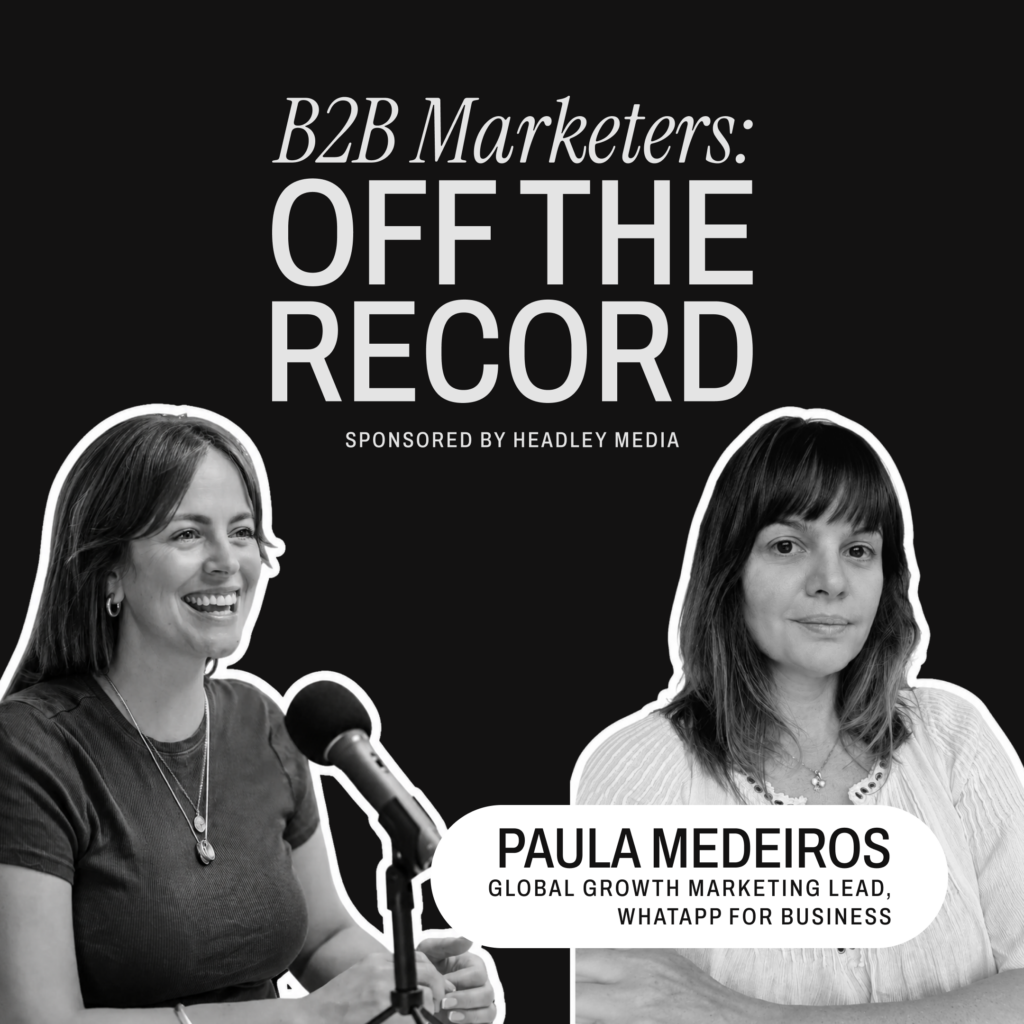
"You need to bet on the unfakeable type of content.”
— Paula Medeiros, WhatsApp for Business
In this conversation, Freya Ward and Paula Medeiros explore the evolving landscape of B2B marketing, how we should be demanding more from AI, emphasizing the importance of trust, long-term strategies, and the ongoing debate between gated and ungated content. They discuss how marketers can shift their focus from short-term metrics to building meaningful relationships with their audience.
Takeaways



Freya Ward (01:22)
Welcome to another episode of B2B Marketers Off the Record. I’m absolutely delighted to be joined by Paula Medeiros, who is the Global Growth Marketing Lead at WhatsApp for Business. Paula, please introduce yourself.
Paula Medeiros (01:36)
Hi, thanks for having me for you. It’s honor to be here talking about marketing as one of my favorite topics. And yeah, I am we’ve met an now, but been my careers with tech marketing. I’ve done plenty of brands before, Cybersecurity, Palo Alto, Oracle, and a number of others while I was in a agency space, which was for almost ten years, and I’m still really enjoying it, still in the midst of it all, have great colleagues, great friends that work in the space.
And yeah, let’s talk a little bit more about B2B marketing.
Freya Ward (02:12)
amazing
Paula I’m so happy to have you on this episode because I know you’ve got heaps of experience in this space, working at a variety of different companies as you’ve already mentioned. How did you get into the B2B marketing space to begin with?
Paula Medeiros (02:26)
It was pretty much by a chance, I would say. As I finished my marketing degree, master degree in Sarah University, I got a position with analytical software, which is called SPSS. And as I joined them, they were already being integrated to IBM, because IBM had bought them. And I was part of all this process of integration and acquisition, and then I start my first few weeks was in the actual SPSS office in walking, but within a few weeks we are
Writing Bad Font Lakes inside IBMs, huge, using the big systems, learning the systems all together. So it was a like a very tech introduction, I would say, now knowing that acquisition is part of the tech world so much, we’re still doing that. And that was in a part of that acquisition, the very beginning of my career. And since then, I went to work for agencies. And I think because I was at IBM, they thought, my god, she knows tech. And I didn’t really at the time. But then when I entered the B2B agencies.
space. I really learn a lot more carry on and I still learning today really. But yes since then since my very first contract robot kind of IBM by a chance, I’m still here and yeah I wouldn’t if I could choose today I’d still choose the same.
Freya Ward (03:41)
Yeah, still choose that B2B marketing space. I completely agree with you. Wow,
Paula Medeiros (03:43)
That’s my thing.
Freya Ward (03:45)
that is quite an entry into the industry, isn’t it? It’s kind of straight into that merger and acquisition. And I’m sure that that taught you a lot very, very quickly, like
Paula Medeiros (03:54)
Yes.
Freya Ward (03:55)
a sink or swim type of situation and clearly.
Paula Medeiros (03:57)
I think you just
don’t realize at the time as well because I was in the midst of that. But for me, okay, let’s just like they tell me to do this today, I do this today. They tell me to do this tomorrow, I do that tomorrow, and just keep moving as it was just normal business, but then realize, my god, that’s actually happening all the time and it’s this strategy and this everything behind it that with time you get to absorb and comprehend from a different
Freya Ward (04:19)
Yeah,
Paula Medeiros (04:19)
perspective as well.
Freya Ward (04:20)
yeah, definitely. And it kind of created the beginning of that path of your career. Lots
Paula Medeiros (04:25)
Yeah.
Freya Ward (04:27)
of change from the beginning of your career and then all throughout it, I’m sure, and you’ve seen both sides of, well, you’ve seen how cyclical the B2B marketing environment can be and also the tech space as well. Is there a particular belief, one belief about B2B marketing that you’ve changed your mind on in the last 12 months?
Paula Medeiros (04:44)
Yes, there is. I always been very optimistic about everything really, but of course about technology and how innovation is super cool and give us a allow us to have a better world, to build a better world, to create a better world. And that’s literally what I work for. I work because I believe it in that. But within the last twelve months there are some points that I become a bit more not as okay, let’s just do
Do
it and see what happens. It’s more like we need to stop a little bit and think through it. And that’s related to AI. Of course, AI is great, everybody’s using it, we use a lot in the B2B, we promote part of our products, so the new features everybody’s talking about.
There’s AI in every single conference and message out there. But I think as a citizen and as a marketeer, we should stop and really demand more of the platforms we work with.
Because we are the ones who fund most of them as marketeers. And then as citizens, as a R and D of AI, we really should be demanding more of our governments, international governments. I truly believe that. And as a marketer, because I understand a little bit more than most other people that don’t that don’t work in the space, and I’m not a technical person, I just like a digital marketeer, but of course there’s a lot back end that we do understand. I do think that we do need to
Be extra careful and don’t just jump and see what happens. Let’s stop and think through it and analyze it and see really what are the benefits because I think we are in a position that I haven’t experienced before that the benefits are perhaps not outweighted massively by the downfalls
that this technology potentially can bring to us. And I think that’s something I’m reading a lot more, being a lot more careful and really thinking twice before using and promoting.
and how we’re using the whole discussion about the build of data centers and the use of electricity and the consuming that’s that’s demands, etc. It’s a very valid and important conversation that I’m having more and more.
Which I didn’t have before. And
Freya Ward (07:00)
Yeah.
Paula Medeiros (07:01)
I think that yeah, there’s a responsibility as a marketeer that we should have it. And that that’s
Freya Ward (07:05)
I co-
Paula Medeiros (07:05)
what I’m changing slightly. I do need to be more careful, not just jump at it. And I think the second point that’s kind of related to with the social platforms is the promotion to of advertising and the algorithms behind the social platforms for people under 18. I do think that’s also as a society and again as marketeer that we understand a little bit more than everybody around.
We should be extremely careful and really push to stop that. It’s not banned completely because this there’s no need for it. The under thing they’re not paying the bills. Other people
Freya Ward (07:38)
Yes.
Paula Medeiros (07:38)
are, all the businesses are. So why don’t we just restructure and reassess what we’re doing and hopefully do but I’m sure we can we can always do better. There’s always room for improvement everywhere. That’s my belief. Everything I always work towards, my campaigns, my teams, etc., we always say that’s there’s room for improvement, let’s improve. And I think we as a collective.
We should st start doing that more and more.
Freya Ward (08:00)
I think that’s so powerful and I think it’s so true, Paula. Just because we can doesn’t mean we should, right? And that’s
Paula Medeiros (08:07)
Yeah.
Freya Ward (08:08)
with everything. That’s with accessibility of data. Just because you can target someone under 18 doesn’t necessarily mean you should. Just because you can use AI to speed something up and create efficiency doesn’t necessarily mean you should. There’s consequences with everything, right? And…
citizen and also as a marketer, as a responsible marketer, it’s something that we should definitely be taking into consideration. Not just from a, you know, we see huge layoffs and we see efficiency savings and everything else for businesses, but there’s also the ethical side of it and the sustainability side of it. And we should never, never take the attitude of I’m just one person and instead it’s
It’s a collective, right? If you don’t make a stand for something and feel passionately about what’s right and wrong and don’t then nobody will. And then, you know, we end up in certain situations. So that’s
Paula Medeiros (09:03)
Yeah.
Freya Ward (09:04)
such an interesting answer to that question and definitely not one that we’ve had before on B2B Marketers Off The Record. So.
Paula Medeiros (09:09)
Yeah. It is it
is of course a bit more wider than B 2 B marketing,
Freya Ward (09:13)
You
Paula Medeiros (09:13)
I do realise that. But it’s just something that’s is top of my mind for a while and is becoming more and more important and just things that yeah is in my mind all the time and I want to just do more and I think people should just think through and try and even though like sad just e everyone can contribute in a small a larger way. So if everybody does something, I think we can make a difference. I still like an optimistic at heart, I still believe
that we can make a difference and talks like that, conversations like that, little messages putting out like that, I think yeah, it’s what I can do.
Freya Ward (09:48)
Yeah, absolutely. No,
I fully support it. Thank you. let’s talk a little bit about the B2B buying behavior and where you’re seeing changes there. Obviously working at WhatsApp for business, there’s been some big changes in the way that people can target and everything else. but I’d love to understand, Paula, from your perspective, what shifts you’re seeing in that B2B buying behavior right now.
Paula Medeiros (10:09)
Yeah, so I think this evolution’s been happening a in a while. So and but I don’t think it’s not just evolution. It it really evolves and is changing. So the way I define the modern buying behavior is that first of all, from day one, what you can see now because of AI, that people are more a lot more independent doing the research. So there’s numbers out there, you can take, you know, the the third party research, they’re gonna say anything between sixty and eighty-five percent of
The research now is done completely independent. And
Very autonomously, and that buyer not gonna contact you. Probably the delays for months until they actually get contact to you. And they’re gonna have their shortlist, right? And there’s another very scary stuff that I think 95% of the contractors are actually done with a brand that is in the day one shortlist, which bring us back the you know the the rule that we have in the 95 to 5 marketing rule that becomes more important than ever that the investment.
In brand, investment in unique content, differentiation content out there, and the ways to to to reach that that that buyers they just become very very different. So, I think also when they get to talk to you, the type of content they want is different, they don’t want to know about your features, they already know all that. So, they’re gonna interact with your sales team, perhaps, and they’re just gonna use that. That interaction is no longer, give me a sales pitch or tell me what’s your new.
Features. You’re gonna be about can I trust you? Are you really who you saying you are online or where I heard about it? So it’s it’s a lot more about building confidence and clarifying some nuances. So why you’re better than A, or are you better than C or and they risk that purchase because of course a very expensive purchase? So that’s where that’s where we’re playing right now. We’re not just playing about promoting a brand, promoting features, we’re playing about building trust, we’re playing about the risking purchase, we’re playing about clarifying.
nuances and the very end of that sales cycle. So there’s this two spheres right to the beginning of the sales cycle. You need to be in the place that you don’t know how to get to anymore because it’s not that obvious anymore. Not just a blog post, it’s not just social media is a lot more complex environment. And that’s the final point I think because the whole buying group now is not just talking about the finance or the IT
Departments. You’re talking of potentially five departments, you’re talking to 10 to 14 people, I think, is the size of the buying group right now that we have out there. So it’s a very complex decision that we need to convince somebody to make to take us our word for it. So that’s
very a a lot of different tactics and strategies that need to be played out to be present, beginning to the end potentially to that sales cycle. So I think it’s a different journey, I think there are different place throughout
But also the collaboration, the working together, the sales and marketing working together carries carries on to being very strong, that bridge needs to be there. But yeah, ultimately I think this journey is becomes being very independent, is AI accelerated and before your first meeting is almost like you’re already in and out. So we need to have have all those in in mind when building our journeys and building our
content and and digital outputs that we put out there, the the brands, the demand, etc.
Freya Ward (13:59)
Yeah,
it’s interesting, isn’t it? Because I think the shifts in the buying behavior has actually fast tracked or forced that requirement for marketing and sales alignment, right? We knew we needed it. We hope that every business has it. More businesses than not, you know, don’t they don’t have it in place that alignment. And if you don’t work well together and work as part of a single team or, you know, have that alignment between the two departments.
then that is actually impacting not only the top of the funnel, but also right down the end as well, because trust is so vitally important. And if your buyer is seeking almost validation from your sales team that you are who you said you are, you you can’t just have a really great marketing. And then when you reach sales, it’s well, you know, we’re ready for a sales conversation. What do you need? Here’s my benefits, products and features that doesn’t
quite cut the mustard anymore. We need a little bit more than that and we need that alignment and you have to be true from start to finish. Because that statistic that you shared, Paula, about 95 % of decisions that you’re on the shortlist from day one, brand is more important than ever. Right?
Paula Medeiros (15:13)
Yeah.
Freya Ward (15:13)
There’s so much to unpack in what you’ve just said, but there is a lot more or do you think that there is a lot more power in the buyer now than there was five years ago?
Paula Medeiros (15:25)
It’s power because think about it as the buyer position as well. It’s very confusing. There’s a lot of brands out there, and when you run any kind of list to compare pros and cons, they’ll be very similar. So I I think there’s a lot of confusion and noise, which brings even more the point of trust. If a lot look the same, you’re gonna go to who you trust, people that you know the brands that you heard you know of, or the the brands.
That somebody who you trust told you, go for it. I’m using it. You should you should go for it too. so I think it’s a hard is a hard position for the buyers as well. And especially on the on the buying committee, with the 10, 14 people, five, six departments, they’re gonna be discussing that for months and people trying to convince each other. And it’s not it’s not easy conversations for sure. So
Freya Ward (16:20)
Yeah.
Paula Medeiros (16:21)
that’s why the whole process has just become more complex for both sides.
So I think there’s now it both sides is very complex.
Freya Ward (16:28)
Yeah, it’s got noisy, it’s got more confusing and it’s got potentially more competitive. It’s got, it’s got harder to stand out. But then also to your point, that decision making committee is huge. And that’s just the ones we know about, right? There’s hidden buyers in there as well. There’s depending on the size of business, depending on the value of the product, depending on what you’re, whether you’re doing a competitor displacement or whether you’re, you know, how much do you need to educate them? All of those different factors
Paula Medeiros (16:54)
Mm-hmm.
Freya Ward (16:55)
come into play as well.
What’s a strategic bet then that you think more marketing leaders need to make over the next couple of years?
Paula Medeiros (17:04)
Right. So I do think that we’ve been with the with the the way marketing, B2B marketing evolved the past few years, and we had that okay, we’re tracking everything because the technology is getting so much better, the systems are getting so much better, we have so many systems to rely on, and they’re all connected or supposedly connected, etc. but then we can track everything, right? And that becomes, I think, very important. But now that we can track everything, we have so much data.
And especially coming from digital that what I my core has been digital for integrated integrated campaigns for many years and what I really enjoyed this business and the mass of it all. But then we also I and now with AI, then we have this huge creation of content.
Any kind of content is a very lower cost now and a speed as well. So it’s almost that data that we were so excited to have in the first place now become exponentially larger with the content larger as well. And and that contributes to the noise we were just discussing, right? And I don’t know if that’s actually I I think that’s not the right thing to do. I don’t think it’s the right way to carry on. I don’t think it gives us all the data that gave us all the insights that we were
really excited about it. I don’t think it’s giving us insight anymore the way it used to.
Because it’s just not the same content. It’s not the same way that people interact with the content, the the way we’re talking about the buyer behavior. and also because the content is not necessarily the right one or the the truthful one or the one that really gonna tell something to the buyers. So it’s almost like we’re churning a lot of content and then we’re creating more and more data and more and more tracks and it’s just a lot and and there’s no differentiation that there’s a lot of the same.
So, what I think are the big bets, what we should really be investing on and trying to get to is create those more deep human connections and content that AI can’t fake. So it’s not like, okay, you need to bet on the unfakeable type of content. And that’s
Freya Ward (19:15)
Hehehe.
Paula Medeiros (19:15)
from the really concept to the production of it to the tracking of it. So, what are the really experiences that we want to track? What are the important experiences that we should be tracking?
And they’re gonna give us some insights that are actually useful and truthful to what the buyer is doing out there. So the in-person events add that to your integrated campaign is not just the events that solve everything, you need everything around it as we know it. Also
Thought leadership, highly opinionated point of view types of content with videos, with real people talking, with audios, with real people talking, which are hard to fake. And also communities, private, exclusive communities that are out there,
To be in those communities and help build those communities, be there as a consulting piece or expert matter, or however is the way that it potentially can embed yourself in those communities. I think those are the real channels now that we should be really trying to create those experiences in this type of content. So that’s what I would be betting if I was doing my planning right now for 2027.
Freya Ward (20:34)
Yeah, and it’s really
interesting, isn’t it? Because this is how I envision AI being used in the sense of taking on some of the stuff that can be automated so that it allows us to do the human part, to build the
Paula Medeiros (20:49)
Mm.
Freya Ward (20:50)
trust, to build the relationship, the rapport, the stuff that we as individuals crave ourselves, our customers crave that too. So…
That’s not necessarily, or my assumption is, and please correct me if I’m wrong, Paula, but what I hear is those are the kind of events where you can add value as opposed to how you might look at events previously for badge scans, sales conversations, et cetera, et cetera. Instead, it’s be in the right places where your buyers are and be educational, be supportive, be a thought leader, have opinion pieces, create that content that can’t be faked or replicated and build…
build that as part of your brand strategy, that in turn make sure that you’re in the right places, you’re being shortlisted, you’re trusted, all of those key themes that you’ve talked about already. Have I interpreted that in the right way?
Paula Medeiros (21:41)
Yeah.
Yeah, absolutely. I think that’s exactly
Freya Ward (21:43)
Yeah.
Paula Medeiros (21:44)
it. We need to create something that’s unique to you. Is that what’s like is what you always done for marketing, or always always try to do, of course, because it’s not easy. We say like we summarize everything, say, we should just do this. But we know it’s not that easy. But the
Freya Ward (21:56)
Yeah.
Paula Medeiros (21:58)
the basics are the same. I think that’s one of the things I I say to my friends as well. The basics of marketing, if you look at the you know the basic theories, etc., they still work, they still apply. I think people just forget or get lost into the noise or all the all the demands.
Freya Ward (22:12)
Tell me, what three words do you think describes B2B marketing right now?
Paula Medeiros (22:16)
So I think s trust, opportunity, and human.
Freya Ward (22:24)
I completely agree with you. think that’s… Yeah!
Paula Medeiros (22:24)
Which I think is related with everything else you’ve been saying so far,
or I’ve been saying, but yeah, I think those are very strong words right now.
Freya Ward (22:34)
Yeah, absolutely. What’s something then do you think that B2B marketers are still doing out of habit that no longer serves them, it no longer works?
Paula Medeiros (22:43)
Right, so I think it’s similar to what we’ve been saying, you know, tracing everything, tracking everything, which don’t get me wrong, is the core of what I do. But I think we can push ourselves and try something different, some trying something new. So that’s something I haven’t tried yet, but hopefully one day or soon enough a brand a client who allowed me to do that. And it’s almost like to confirm what I’ve been saying that I truly believe that’s what it works. Because for example, creating all those content and we ask for
you know your name, your email, your information to to give you some piece of valuable content, for example. Well if it’s that value, if I really tr believe in that content that’s gonna make people come and talk to me, I should be giving that content for free. So I really, really believe that most of the marketing materials that we create, we should be giving them for free.
And just waiting for those people when they consume and they understand and they agree with us, they come to us like, because you say those things, I really want to talk to you now. And then we have a conversation. Because we’re gonna be in that final list if we really are upfront and providing the trust the buyers wants to have from us. So I think this is one thing that I’m keen to see more and more, more ungated content. You know, people really g
giving
valuable content away, but knowing that there is a reason is again back to the 95 to 5 rule that we are marketing to the 95 people they’re currently not buying yet because we wanna be in that list from day one. So I think those kind of trade-offs are worth it.
Freya Ward (24:30)
It’s interesting isn’t it?
Paula Medeiros (24:30)
So that’s what I would be my advice
and that’s what we’ll be doing if I if one if I could choose myself. but yeah, I think it would be also an e excellent test to really try of everything that we talk about B 2 B all the time.
Freya Ward (24:46)
Yeah. And it’s a great example of building trust from the off, right? It’s almost, I trust my prospects to come to me at the right time when they’re ready. It’s an interesting concept because I had a similar conversation on the podcast not long ago about trust, but then also about gated versus ungated.
Paula Medeiros (25:05)
Mm-hmm.
Freya Ward (25:06)
As someone who works for a lead generation company and believes in the power of gated content, I think it’s an interesting conversation between the two of us.
Paula Medeiros (25:14)
Mm.
Freya Ward (25:15)
And almost want to press you a little bit further because I’m learning through this podcast and I think I agree with everything you’re saying about trust. You only have to look on the Headley Media website and we don’t gate the lion’s share of our content. We’re similar to lots of marketers, terrified to ungate absolutely everything because we need some kind of exchange, know, in exchange for really high value content. And we believe that that content that is gated is
much further down the funnel, you know, it holds a quality versus value exchange piece. But as somebody who represents a lead generation portfolio, a portfolio of publications, we gate every single piece of content across those publications.
Paula Medeiros (26:00)
Yeah.
Freya Ward (26:02)
I have quite a strong opinion on gated content, but I would also strongly encourage vendors, so tech vendors to ungate on their own website. So I want to push you a little bit further. Are you meaning
third party, like publications being ungated, or do you see the value in that unbiased gating versus your own website gating? Which angle are you coming from?
Paula Medeiros (26:27)
Yeah, I and I completely understand your question from your point of view. It’s called the business model, right? But it’s almost okay. It’s the business
Freya Ward (26:35)
Mm-hmm.
Paula Medeiros (26:35)
mo is a old business model if you think about it, right? You’re talking about twenty years old in
Freya Ward (26:41)
Mm-hmm.
Paula Medeiros (26:42)
in a very high tech environment that changes pretty much every week. We know that things keep changing
Freya Ward (26:47)
Mm-hmm.
Paula Medeiros (26:48)
all the time. Look at how much we come from on email and social media and all the tracking and all the analytics, powerful analytics software that we have at the back end.
Yeah.
everything we do. so of course it’s a bit of a tease but in a way I think it is that because the way we structure it is based on an old model. Yes of course we are asked for MQLs. SQLs that’s how we are measured and say okay I’m successful if I deliver a thousand MQLs to the business or ten thousand MQL. But what does it really mean? And of course okay the pipeline is is trackable from the very beginning
when we didn’t even know who that person was. but I think that’s the point. We don’t need to know until that person is until the very end, when that person ha raised their hand and tell you, here, you are my short list and I wanna hear you about A, B, and C. You wanna talk to me. And I think that’s the point when then of course because the person is interested to contacting you. And and that’s why I think anything before that should be engaged.
Freya Ward (27:57)
Yeah, yeah,
it’s a really interesting…
Paula Medeiros (27:58)
Why make it difficult? Why because
the fact that we’re doing we’re creating a barrier for somebody. Because you can always okay, I’m John Smith, I’m John Smith at oracle.com and my number is zero two hundred two hundred two hundred. And I got a content. It is not really meaningful. As we know, there’s plenty of, you know, bad data out there because people people will know how to get around it if they really wanted to as well.
So what I i of course is is a is a teasing kind of idea, but I truly honestly would love to try one day because I do think you would accelerate and give us open more doors if you are a brand that is open from that very from from everything, from top to bottom.
From your angle when you’re talking about the media partner, I do think it’s more complex because it’s almost like, okay, this is your product in a way, right? So you do need to probably study a different way of selling your products in that in that s sense. But yeah, I think it’s a good start from for brands, from looking from a brand perspective. Only it should be really easy for me, go to my website, say there’s no more gates on my website. Everything there I wanna free. And then of course keep the brands of the gates of the third parties because it’s part of the business model. But
But yeah, we we can start anywhere. But I think the more we see more branded content and gated, it will be beneficial for the brand in the long term.
Freya Ward (29:27)
Yeah, it’s really interesting. I think if you MQLs and SQLs, as you know, is one of the tale as old as time measurements of success. But if you look at it in isolation, MQLs don’t really mean anything. And they mean something different to every individual department company that you speak with or certainly that I speak with. But if
MQLs if someone populates a form on the website It should be part of an indicator in a city in my opinion part of an indicator in a signal on their journey but if it’s being handled as a fast tracking to a sales conversation process That’s where the misalignment is. I think and that’s where the
Paula Medeiros (30:07)
Yeah.
Freya Ward (30:08)
buyer gets turned off. That’s where it goes wrong. but if you’re using it as a signal, you know
It’s so interesting because I was at an event earlier
Paula Medeiros (30:16)
Ha ha ha.
Freya Ward (30:18)
this week and I’ve got some really strong views on it I’m not pro-gating everything either. I think there’s a time and a place and where it’s appropriate. But it an event earlier this week and there was a big focus on organic traffic and how LLMs and everything else and the AI models, know, everyone’s seeing huge declines in direct traffic to their website or organic traffic to their website, but the quality of what is coming through is stronger and
we talked about, panic, because the traffic that was coming before, what was that anyway? And what was the value in that anyway? And if the traffic is reducing, that’s coming to your site, then yeah, why are you gating everything on your own site? Because is it arrogant to gate everything? Because the audience that’s coming through should be coming through more educated. They should, you know, they could have used an AI model to…
shortlist to get, so when they’re coming through onto your website, they’re not necessarily looking to be met with a barrier, like you said. I
Paula Medeiros (31:17)
Mm-hmm.
Freya Ward (31:18)
think there’s going to be a lot of change going on even more so in the next couple of years with channels, with gating, ungating, with AI models and everything else. It makes for an interesting conversation, that’s for sure. What’s one thing…
Paula Medeiros (31:30)
Idiot. That’s for sure. I would love to see a
use case. Somebody who does who did it didn’t show us all this is the result. Yeah. But it’s really hard, like back to what you’re saying,
Freya Ward (31:39)
Please, yeah, I’d love to because that’s what we need as marketers, right? We need data points to go, okay, that is, yeah.
Paula Medeiros (31:45)
right? People like
directors, VPs, even CMOs, they don’t see that way. But yeah,
Freya Ward (31:52)
Mm-hmm.
Paula Medeiros (31:53)
but some of do and but I haven’t seen a case study about it yet. If I see one I send to you.
Freya Ward (31:57)
and then to end, please, please do.
Yeah. And we can promote it on the podcast as well, because I think as marketers and certainly feedback we get from our listeners and the events we go to and everything else, it’s kind of, very open. We’re all very open to seeing new ways forward, but we’re all a little bit too scared to just take a
Paula Medeiros (32:16)
Yeah.
Freya Ward (32:16)
chance. Right. We, we have, when we work for businesses where we have to evidence everything and we have to justify investment and to
Paula Medeiros (32:24)
Yeah.
Freya Ward (32:25)
turn all the forms off on your website.
would probably terrify most leadership teams. And also
Paula Medeiros (32:29)
Yeah.
Freya Ward (32:30)
there’s gonna be a long term, there’s gonna be a long lead time for your business to see the benefit of testing something like that. So whether you can hold a sales and marketing department firm for that duration until you start seeing positive results off the back of it, that’s the real challenge I think.
Paula Medeiros (32:46)
I think the results will be the same. I think it’s just gonna change the how you track your success, measure your success more than anything. Because I think that the
Freya Ward (32:55)
Yep. Yep.
Paula Medeiros (32:57)
if anything from that point onward what should happen is that you’d have more meaningful interactions, right? but yeah. Wait and see.
Freya Ward (33:06)
Absolutely.
let’s talk a little bit about leadership then. So this is, this is a question that I think, I think really gets into the mind of the marketer and it’s something that a lot of marketers, well, it brings a bit of a rallying cry for marketers. What is one thing that you truly think leadership should understand about marketing?
Paula Medeiros (33:29)
Right, so I think what
they should understand is that marketing is here to build something long term not short term and medial term. Of course we can build strategies and tactics to have some short term turnaround, but the the vision, the bigger picture is a long term build and is a long term build of what? Of trust, of a strong brand, of brand affinity and even of a of a of a market creation right as you know.
Some especially in tech, we create markets all the time. And that’s what marketing is here to do, not just to hand hold sales and send 10,000 MQLs a month. That’s not the only thing. But it becomes almost like the only thing that people see because is the easier measure right now, right? So we can measure everything. So let’s measure how many MQLs, how many SQLs, what’s the conversion, etc. And all those thousands metrics that we can get.
out of of our dashboards but marketing is more than that i think what leadership will me misses sometimes is really is the is the vision is the big vision of what we can build as marketeers that’s something beyond numbers beyond metrics is the feeling is the affinity is the
wishing to belong, be part of something. And brands do that as we know. And I think that’s very exciting. That’s what we made is really excited about, to to create those experiences, to create in those communities, to creating memorable moments.
And we we can do that. And it’s hard to prove as a ROI or as a metric. how much that person liked our event. Just zero ten or you know, go back to trying to measure things. which is fine, we do need to measure at some point, but
the big vision, the long term goals, I think this is what the leadership should hold us hold us close to their to the to their bigger plan when they you know revealing the north of the company or whatever is that that they do.
We can dream a little bit as well. I don’t need to be all down to numbers and metrics. It can have a a pretty picture somewhere there showing that’s the vision. And I think that’s what I’m missing more and more. Because it just it goes back to those
short turn when we get us to spam people with a lot of emails or get a lot of gates and what for. Is that really making us sell more? I don’t think so. So just
Freya Ward (36:11)
Yeah.
Paula Medeiros (36:12)
again go back to be creative in marketing. Get that art of marketing alive again, exciting about creativity and uniqueness. And yeah I think that’s what I would like to see more that the leadership talks about. That’ll be more exciting. And I think the leadership
they are doing that which we do have people that do that they are the ones you see all the time on LinkedIn for example because they pop up all the time because they are unique. Everybody wanna hear what they’re doing, hear what they have to say and yeah I think we just show that that works too.
Freya Ward (36:44)
Yeah, absolutely. It’s often seen, and I think also in the tech space when there are budgets being cut, know, we’ve been, the tech space itself has been really heavily impacted still now by the pandemic and changes to so many different things that it’s allowed this slip into tactical marketing, which there’s still absolutely a place for, of course, but there’s so much more to marketing than just that.
Okay, almost final question, Paula. So what is one thing that you wish you could change about marketing if you if you could?
Paula Medeiros (37:21)
One thing I could change is I think we’ll just talk about just scrap the short term. We I think I wanted to really build something meaningful long term that evolves and grows and get better with time, build communities, build strong brand, build something meaningful to our to our bias, to our audiences. And
Freya Ward (37:43)
Yeah.
Paula Medeiros (37:43)
yeah, so I think that that would be my dream. If I could do that, it would be a lot more fun, that’s for sure.
Freya Ward (37:49)
Yeah, for sure.
B2B has a terrible reputation for being boring, right? And I think if we can
Paula Medeiros (37:54)
Yes.
Freya Ward (37:55)
create that long-term vision and be more creative and there’s some incredible brands that are doing it in the B2B space, it’s just not
Paula Medeiros (38:01)
Mm-hmm, absolutely.
Freya Ward (38:02)
all brands are doing it. And not all leadership, to your previous point, not all leadership understands that long-term mentality. And I think it’s really easy to hyperfixate on ROI and hyperfixate on short-term tax.
and hyperfixate on the things, those tiny steps. But what that also does, I believe, is it encourages everybody in every department to suddenly become a marketer. And
Paula Medeiros (38:27)
Yeah.
Freya Ward (38:28)
that is one of my bug bears. It’s like marketers, there’s so much more to marketing than just somebody wakes up one morning, looks at your brand, fills out a form on your website, and that’s marketing. Marketing captured it. You know, that’s the attribution model challenges and everything else. There’s so much more to it.
Paula Medeiros (38:46)
Yeah.
Freya Ward (38:47)
And having that long-term vision and long-term strategy builds better experiences for buyers and prospects. builds trust, the humanity, all the things that you’ve talked about in this recording, in this episode, comes down to that big blue sky thinking.
Paula Medeiros (39:05)
Yeah.
Freya Ward (39:06)
Final two questions for you. Who do you think we should invite to speak on the podcast next? It can be someone you know, it could be someone aspirational. Who would you like to hear from?
Paula Medeiros (39:15)
Yeah, no though so I have two friends that I would love to hear them. and one is Olivia Robinson and another one is Car Caroline Clark.
Freya Ward (39:26)
Amazing. Well, we hope to hear from them soon. And
Paula Medeiros (39:29)
Yeah.
Freya Ward (39:29)
what’s a question that you’d like us to ask our next guest? It could be one of your two friends or it could be somebody else.
Paula Medeiros (39:36)
So very selfishly, I did come up with a question that I’m very interested in hear answers and to anyone to hear answers, not only my friends, but anyone you invited next. So I would love to ask other marketeers, so what is the most expensive or time-consuming thing that their team is doing right now that has absolutely zero measurable ROI on the dashboard, but they refuse to stop doing it because they know it works.
Freya Ward (40:06)
I love it. That is an excellent question. And I can’t wait to
Paula Medeiros (40:08)
Ha ha ha.
Freya Ward (40:10)
ask a future guest. We might get some some guests in trouble for answering that one, but I think it will be definitely.
Paula Medeiros (40:17)
Yes, that’s a good one. Yeah,
you need to be honest, you need to be truthful and really answer. So what are you doing? Spending millions and not getting a ROI
Freya Ward (40:25)
You
Paula Medeiros (40:26)
But you know it works. So I think it just
Freya Ward (40:28)
but you just.
Paula Medeiros (40:29)
it’s a good question to just give us some evidence what we’ve been talking throughout, right? Is is is my belief as a marketeer’s even in B to B I think we still do great work in B to B. There’s so much goodness that it’s fun to see out there when when brands get brave and you know, push
harder a little bit and yeah and it’s great results I think every time it you always shows a result so
Freya Ward (40:54)
Absolutely. There’s no such thing as bad press as they say, right? So when you push the boundaries and you start…
Paula Medeiros (40:59)
Yeah, well maybe some
people might disagree, but yeah let’s let’s see.
Freya Ward (41:06)
Amazing!
All that’s left to say is thank you so much Paula for joining us. If anybody would like to connect with you or hear more about your experience, where can they find you?
Paula Medeiros (41:16)
On LinkedIn, yes. You can connect me on LinkedIn. I’m always happy to connect with new people, always have to chat through things that I’m passionate about, like B2B marketing. So yep, waiting for that connection, no problem.
Freya Ward (41:31)
Amazing. Thank you so much for being such a great and honest guest. And thanks for joining us on B2B Marketers Off the Record.
In this episode of B2B Marketers: Off The Record, Freya Ward speaks with Paula Medeiros, Global Growth Marketing Lead at WhatsApp for Business. Drawing on her experience across technology brands and almost a decade working in agencies, Paula explores responsible AI adoption, increasingly independent buyers and the importance of building trust beyond short-term marketing metrics.
At the heart of the conversation is a challenge to the industry’s focus on measurable activity: more content, more tracking and more leads do not necessarily create stronger relationships or better buying experiences. Paula argues for a longer-term approach built around human connection, distinctive content and meaningful brand experiences.
Paula describes herself as an optimist who has built her career around the belief that technology can help create a better world. Over the past year, however, she has become more cautious about adopting and promoting AI without examining its wider consequences.
Her concern extends beyond whether a tool makes a campaign faster or more efficient. She wants marketers to consider the environmental demands of AI infrastructure, its potential social consequences and the responsibilities of the platforms they fund through advertising.
She also raises concerns about advertising and social platform algorithms reaching people under 18.
For Paula, marketers have a responsibility to ask difficult questions because they understand aspects of these systems that other people may not. That knowledge creates an opportunity to demand better practices and make more considered decisions.
Freya reinforces the principle: just because something is technically possible does not automatically make it the right thing to do.
Paula sees the buying journey becoming more independent and accelerated by AI.
By the time buyers contact a supplier, they may already have researched the category, compared options and formed a shortlist. That changes what they need from a sales conversation.
Rather than hearing another presentation about features, they want to establish whether the business can deliver on its promises. They need help understanding differences between suppliers, clarifying uncertainties and reducing the risk of their decision.
Paula also highlights the complexity of buying groups. Different departments and stakeholders need to reach agreement, often through lengthy internal discussions.
More information does not necessarily make that process easier. When competing brands appear similar, trust, familiarity and recommendations can become particularly important.
Marketing therefore needs to build confidence before contact, while sales needs to reinforce that confidence when the conversation begins.
The importance of being considered early makes brand investment central to Paula’s argument.
If buyers are forming opinions before suppliers can identify them, businesses need to be recognisable, credible and useful before a sales opportunity becomes visible.
That requires distinctive content and a presence in the places where buyers learn and seek advice. It also requires consistency between what marketing communicates and what buyers experience when they speak to sales.
Freya points out that strong marketing cannot compensate for a disconnected sales conversation. If buyers arrive seeking validation and instead receive a generic product pitch, the experience can undermine the trust already established.
The relationship between sales and marketing therefore needs to extend beyond handing over leads. Both teams contribute to the same buyer experience, from early awareness through to the final decision.
Paula’s strategic bet is on deeper human connections and content that AI cannot easily replicate.
She questions whether the growing volume of content and tracking data is producing equally valuable insight. More output can create more noise, particularly when brands publish similar material without a distinctive perspective.
Her priorities include in-person events, opinion-led thought leadership, video and audio featuring real people, and participation in relevant communities.
Events should sit within an integrated campaign rather than operate in isolation. Community involvement should offer expertise and support, giving people a reason to value the brand’s presence.
Freya draws out the distinction between attending an event to collect badge scans and attending to educate, contribute and build relationships.
For Paula, the fundamentals remain familiar: create something distinctive, understand the audience and give people a meaningful reason to engage.
One of Paula’s strongest challenges is to the habit of requiring contact details before allowing someone to access useful content.
If a brand believes its material can build trust and influence a buying decision, she asks why it should make that material harder to consume.
She would like to test a more open approach on a brand’s own website, allowing buyers to research freely and make contact when they are ready for a conversation.
Her argument is that this could help a business earn a place on the buyer’s shortlist without requiring identification at every stage.
Paula is clear that this is an approach she would like to test, rather than a proven result from a programme she has already run. She and Freya both express interest in seeing evidence from a business that has taken that approach.
Freya brings a lead generation perspective to the discussion, distinguishing between content on a vendor’s website and content distributed through third-party publications.
She sees a role for gating where there is an appropriate value exchange, while also encouraging vendors to make more of their own website content freely available.
Paula acknowledges that publishers have a different business model and suggests a brand’s own website as a practical starting point for experimentation.
The discussion also challenges how teams interpret MQLs. Freya argues that completing a form can be one signal within a wider journey, rather than a reason to move someone straight into a sales process.
Both perspectives raise a broader question: does the way a business captures and measures engagement support the buyer, or introduce unnecessary friction?
Paula wants leaders to recognise marketing’s role in building long-term trust, brand affinity, communities and, in some technology categories, new markets.
Short-term tactics have a place, but they should support a broader vision. When success is reduced to lead volumes and dashboard metrics, that vision can become harder to protect.
She argues that memorable experiences, a sense of belonging and creative differentiation are valuable even when their impact is difficult to express as immediate ROI.
Her closing question for a future guest captures that tension: what expensive or time-consuming activity does their team refuse to stop because they know it works, despite having no measurable return on the dashboard?
Ultimately, Paula’s message is that B2B marketing needs room to build trust, express creativity and create lasting value, alongside delivering measurable results.
In this episode of B2B Marketers Off the Record, Freya Ward interviews Niall Ratcliffe, CEO…
In this episode, Simon Gould shares his extensive journey in digital marketing, emphasizing the transformative…
Colin Stansbury, Partner Account Manager at Brevo, discusses the evolving landscape of B2B marketing. The…