

S02E04 – Paula Medeiros – B2B Marketers: Off The Record
In this conversation, Freya Ward and Paula Medeiros explore the evolving landscape of B2B marketing,…
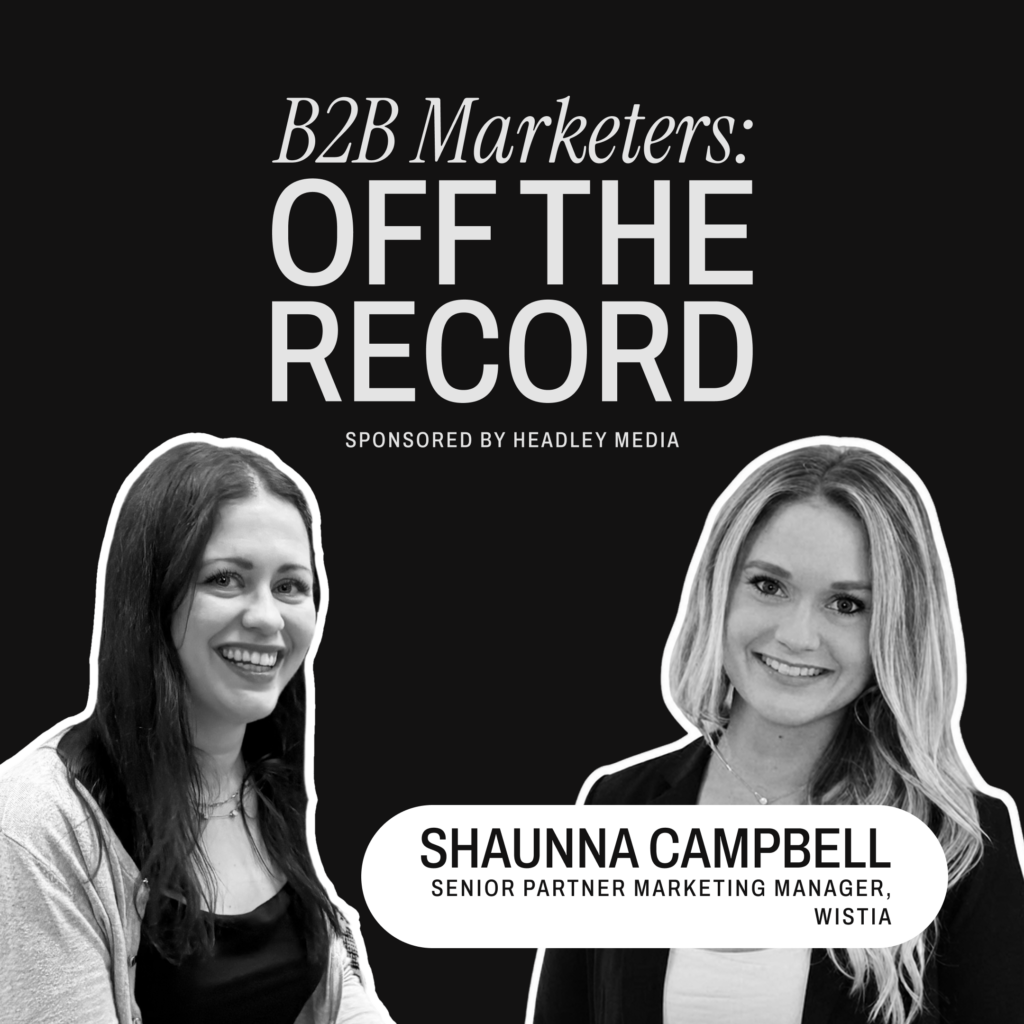
Without the space to be creative, marketing just becomes consistent but repetitive.
— Shaunna Campbell
The conversation covers the evolution of marketing measurement, the transition from PR to marketing, the role of human behavior, adaptability in marketing strategy, leveraging creator partnerships, the importance of employee advocacy, humanizing B2B marketing, and instant gratification.
The conversation also delves into the importance of experimentation in marketing, and the evolution of marketing strategies over time. It emphasizes the need for marketing to be more experimental and less fearful of failure, especially in the current climate of uncertainty.
Takeaways
Chapters



Chloe Addis (00:42)
Welcome to B2B marketers off the record. I’m delighted to be joined today by Shaunna Campbell, who is the Senior Partner Marketing Manager at Wistia. Welcome Shaunna. Would you like to give yourself a bit of an introduction?
Shaunna Campbell (00:57)
Sure, thank you for having me. So my name is Shaunna Campbell. I’ve been in the B2B marketing space for about 10 years now. I really started in content marketing and went into product marketing and now I am in partnership marketing. So I’ve seen kind of the span and it’s really been interesting to see how AI has really taken over. So excited to chat with you today.
Chloe Addis (01:19)
Absolutely. Yeah, I loved that. And that’s one of the reasons why I thought you’d be great on the podcast because you’ve got this kind of huge experience with primarily content which is fantastic. So yeah, let’s get into it. So we like to kick off the podcast with a bit of a light question, which is tell me you’ve been in B2B marketing for many years without telling me.
Shaunna Campbell (01:41)
Ooh, that’s a tricky one. I would say that we’ve seen the different when we have a different love-hate relationship with attribution models. I think
Chloe Addis (01:52)
and
Shaunna Campbell (01:53)
we’ve seen them grow over time. I remember back in the day when vanity URLs came up and it was one
Chloe Addis (01:58)
Mm-hmm.
Shaunna Campbell (01:58)
of those things where if you gave a vanity URL all you could
track is the clicks and then now you can track like the whole string of everyone’s experience throughout your website.
Chloe Addis (02:06)
Yeah.
Shaunna Campbell (02:07)
So yeah, I think that’s that’s my biggest thing and is love seeing the measurement change over time.
Chloe Addis (02:12)
Yeah, I love that too. And like, I think for a period of time, it was like all you could get like quite rightly, as you said, it’s like, here’s the vanity metrics. And then there was like this shift away, like everyone calling them vanity metrics. Like you can’t, why would you report on that? And then you turn back to it because you’re like, well, there’s not other things, like, you know, in the lack of, with the lack of something else to replace it, that’s kind of an indication. And
It’s just the interpretation, isn’t it? Having a marketer to explain the result to you, I think, is the most important thing in that.
Shaunna Campbell (02:46)
Yeah, and I think the new ways that we’ve come out with to attribute things, I I worked in luxury marketing for a little while and we did a lot of print work. And
Chloe Addis (02:54)
Okay.
Shaunna Campbell (02:55)
print, of course, you can’t really measure it other than distribution. So I know
Chloe Addis (02:59)
Yeah.
Shaunna Campbell (02:59)
QR codes, that makes it so much more easier. We use a lot of vanity URLs there. So it’s interesting to see now the things that we can measure more effectively too.
Chloe Addis (03:09)
Yeah, absolutely. And there’s so much we could talk about attribution all day. So, Tell me how did you get into marketing in the first place?
Shaunna Campbell (03:19)
Yeah,
so I actually started in public relations. I loved writing and storytelling. I dabbled in like being an English major back in college and that was just not for me. so I really loved PR. I thought it was super interesting. But then as I got into it, you know, speaking of attribution,
I realized that I’m a huge data geek and public relations was a little bit trickier to measure. So
Chloe Addis (03:44)
you
Shaunna Campbell (03:44)
I felt like marketing was that really good sweet spot where you get the storytelling aspect, you get the measurement, but you also get to really understand people and how they behave. So I thought that was super interesting.
Chloe Addis (03:56)
Yeah, there’s always like an underlying interest in human behaviour, I think, with marketing and you’re kind of, there’s always like, oh, a lot of people, oh, I fell into it through this or they were doing something that was like slightly adjacent, but there is, there’s kind of like that trend and the interest. And like you said, there’s all sorts, isn’t there? All sorts of roles that can cater for the more data minded people such as yourself.
Shaunna Campbell (04:22)
It gives you a lot of chances to be creative too. And just the way you write things, the people that you target, the different targeting techniques, even just the way you change buttons, different colors, like it’s super interesting to dig into.
Chloe Addis (04:35)
Yeah, 100%. That’s like every day we get to kind of try. So it’s like core part of being a marketer, isn’t it? That you get to trial and test pretty
Shaunna Campbell (04:42)
Yeah.
Chloe Addis (04:43)
much everything anytime you want.
Shaunna Campbell (04:46)
For sure. It’s the best part.
Chloe Addis (04:49)
So what’s one belief about B2B marketing that you’ve changed your mind on in the last 12 months?
Shaunna Campbell (04:56)
Yeah, so I used to think, and I see this a lot on a lot of people’s LinkedIn posts, that consistency was the most important thing. but now with the era of AI, I really think adaptability matters much more. So
Chloe Addis (05:09)
Mm-hmm.
Shaunna Campbell (05:10)
as we know, you know, AI is changing by our behavior and there’s so many new channels that are popping up. I think the best marketers today are really the ones that don’t really have the most perfect plans, but they’re really the ones that can notice things that are changing and really adjust.
quickly. Because you know, like the best marketing strategy today is the one that’s really allowed to change.
Chloe Addis (05:32)
Yeah, I think you’re completely right on There was loads of posts, certainly there always used to be. And I don’t know if that’s to do with the LinkedIn algorithm or something to do with the consistency. And of course, the ultimate goal is consistent output, isn’t it? A consistent
Shaunna Campbell (05:52)
Yeah.
Chloe Addis (05:53)
ROI and proving that marketing works and ultimately coming back to that revenue function.
but
Shaunna Campbell (05:59)
Mm-hmm.
Chloe Addis (06:01)
The story of marketing.
Shaunna Campbell (06:03)
Yeah.
Chloe Addis (06:03)
but you know, it’s, I think you’re absolutely right. Like these days it’s, it’s hard to be able to tell what is, what marketing is going to be like in the next 12 months, two years, you know, you can’t really put a pin in what that’s going to be like in kind of predicting the future. So, yeah, definitely being adaptable.
Trying new things, again, to your previous point, it’s kind of being able to get in the weeds, be creative and use things and see what works. Constant testing at the moment.
Shaunna Campbell (06:35)
Yeah, and I think giving everyone the flexibility to experiment, I think that’s
Chloe Addis (06:40)
Mm-hmm.
Shaunna Campbell (06:40)
super important too, because marketing is, to your point, like experimentation. Like we really need that
Chloe Addis (06:44)
Yeah.
Shaunna Campbell (06:45)
flexibility and the creativity to be able to do those things when they come up and make changes.
Chloe Addis (06:51)
Yeah,
absolutely. You mentioned there about the kind of the way that buyers are behaving now that that’s kind of like, that’s really shifted. So what, how could you kind of describe their attitudes more and what are you seeing from B2B buyers?
Shaunna Campbell (07:09)
Yeah,
I think that people are doing far more research before they’re ever talking to sales. So of course we have so much content out there. We have videos and demo videos and different resources. and I think that the amount of information out there is really making, you know, potential customers much more informed.
Chloe Addis (07:30)
Yeah.
Shaunna Campbell (07:30)
but the on the other side of that, I think that it’s causing a lot of decision fatigue. So that’s really making people not really know what to trust or what to rely on. So I think that we’re really going back to our roots and really relying on people. So, you know, or reviews
Chloe Addis (07:45)
Right.
Shaunna Campbell (07:45)
or recommendations from others, from colleagues, from friends. and I think, you know, as marketers, what that really means is we really need to leverage more employee content and like customer stories and communities and creator partnerships because ultimately
people want proof. You know,
Chloe Addis (08:02)
Yeah.
Shaunna Campbell (08:02)
AI has made it even easier to make generic or fake content out there. So really having that authentic experience has really made it much more valuable.
Chloe Addis (08:12)
Yeah, it is a really, a really difficult one, isn’t it? And I think a lot of people are saying, you know, similar to what you’ve just said is that, you know, it’s, there’s this like, so much content that people aren’t sifting through it. They’re just looking at it and going, you know, what, that’s just, that’s too much. And they might be using AI to try and discern, but there’s only so far you can trust it. Isn’t that there’s some things and then that give you kind of a pointer in the right direction. But like you said, that process is.
becoming longer, like the research says there’s so much more that they’re doing kind of behind the scenes. And if you can be offering something different that has that credibility, and you you’re building trust in some way. You mentioned kind of employee branding and, and, and helpful kind of touch points in that way. What else? You kind of also mentioned partnership branding, which is, know, your, your wheelhouse. What’s, what kind of things would you say?
could help in terms of a partnership campaign to stand out from the crowd.
Shaunna Campbell (09:16)
Yeah, I think the creator partnerships is huge right now. I don’t know if you saw but LinkedIn is now launching creator partnership capabilities too. So
they’re kind of see
Chloe Addis (09:24)
Right.
Shaunna Campbell (09:25)
doing what
Instagram had done years ago and now they’re bringing it on.
Chloe Addis (09:29)
Mm-hmm.
Shaunna Campbell (09:29)
so I really see that being an important part of strategies because these creators already have these large audiences. They’re already super trusted. So wherever you can kind of leverage and put your brand in front of your audience, because they’re already there. So really
Chloe Addis (09:43)
Mm-hmm.
Shaunna Campbell (09:44)
leveraging those channels would be really, really helpful and kind of leveraging the trust that they already have with their audience and putting your brand there.
Chloe Addis (09:50)
Yeah, absolutely. Again, it’s using the channels that you have available, isn’t it, with kind of different strategies and getting in front of people.
Shaunna Campbell (09:58)
Yeah, because if
you think about it too, like your brand channel is great, but it’s like a polished version of yourself out there in the world. And now like with AI, like everything can be polished. So what people are
Chloe Addis (10:08)
Mm.
Shaunna Campbell (10:09)
really looking for is that like authentic experience and those authentic people
Chloe Addis (10:12)
Yeah.
Shaunna Campbell (10:13)
that are a little less unpolished, like they’re real humans out there.
Chloe Addis (10:17)
Yeah, 100%. I think there’s just such a difference, isn’t there? Everyone knows that that’s like highly curated and like, yeah, like said, polished for different kind of levels of consumption. So it makes a lot of sense. So what’s a strategic bet that you think more marketing leaders will need to make over the next couple of years?
Shaunna Campbell (10:42)
Well, I think you plugged this a little bit, but I definitely think employee advocacy is huge
Chloe Addis (10:47)
Mm-hmm.
Shaunna Campbell (10:48)
right now. So we’ve actually seen it in our own content. we’ve compared like the same posts from our brand to like ones that we have from employee advocacy programs and the employees out
you
know, outperform all of our branded content every single time because they are real people. and I think for companies, especially B2B companies that are so known to be inside the box and to, you know, go by the book and have all these best practices, I think we’re gonna have to really be a little bit more comfortable in letting people be the face of our brand and like kind of releasing some of that control that we have around it. you know, by giving our employees kind of the tools and the training and, you know, the support that
They need to go out and be the face of your brand because it’s really gonna gain a lot of credibility in the audience. And this has been something that I’ve seen across the board. Even like ed tech companies that don’t have these huge marketing teams are starting to do it. So it’s been super effective, especially across LinkedIn when you see employees go out there and talk about their brand.
Chloe Addis (11:49)
Yeah, it’s one of those things that’s almost, it’s a difficult launch, isn’t it? Like, you know, there’s a lot of work to, you know, the process training, as you mentioned, that onboarding and letting that happen. But then, you know, the results from it kind of will speak for themselves. And like you said, just on some of the metrics that we can measure the interaction and just kind of those real
real life relationships, which is again, what we’re talking about a lot in response to AI. just, makes it all come together. And I think a lot of people are, aware of that and becoming sort of wise to it and thinking, right, we need to have a strategy here, but it’s the implementation that’s quite difficult. because those are not necessarily going to be.
the marketing people who know what we’re trying to achieve and, you know, have that kind of intrinsic knowledge of what’s going on. So it’s kind of like you said, releasing, like giving the reins to other people. But also you do want that like feedback loop and you know, there’s a lot involved in that.
Shaunna Campbell (12:57)
Yeah, and I think it’s also, you know, getting people
over
the fear of being seen. Because a lot of times
Chloe Addis (13:04)
Yeah.
Shaunna Campbell (13:04)
when they’re putting themselves out there, they’re not, yes, they’re the face of the brand, but at the same time they’re still them. And I think
Chloe Addis (13:10)
Yeah.
Shaunna Campbell (13:10)
that’s that’s scary for a lot of people. So it’s not
Chloe Addis (13:13)
Mm-hmm.
Shaunna Campbell (13:13)
only recruiting the people that may, you know, may be part of that program, but
Chloe Addis (13:17)
Yeah.
Shaunna Campbell (13:17)
also making it super easy for them and like giving them the content and or maybe managing their profiles for them. That’s what we kind of do is we have a bunch of people that we manage them for them. And that
Chloe Addis (13:27)
Yeah.
Shaunna Campbell (13:28)
kind of reduces a lot of the fear behind it because you know they don’t really
have to touch it, they don’t have to worry about it. And someone’s just like posting on their behalf.
Chloe Addis (13:36)
Yeah, it’s like, where’s the line, the approval line and like, you know, yeah, all of that. And I think at the end of the day, it’s just such a human thought, isn’t it? Before putting yourself out there online, you’re thinking, God, just, you know, there’s that barrier that’s like, I just want people to like me. I just want, you know, people to relate to me. And actually, if you think about the people that you’re consuming, that you’re following,
You’re not really giving it the second thought of, I wonder if they were nervous or, you know, or
Shaunna Campbell (14:06)
Yeah.
Chloe Addis (14:07)
like, you you’re not really sort of judging them in that capacity because they are talking about business and, know, whatever they’re talking about marketing most of the time. But they’re sort of like, you’re not judging them as to, they a nice person? You’re listening to what they’re saying, which is kind of like, you know, take the focus away, even though it is you, take the focus away from you.
and just focus on what you’re talking about. And I think that sometimes can help.
Shaunna Campbell (14:35)
Yeah, and I think the people that resonate the most with different audiences are the ones that are showing up like themselves. And I know the word authenticity
Chloe Addis (14:41)
Yeah.
Shaunna Campbell (14:43)
is always thrown around everywhere. And I’m not gonna lie, I don’t love it when people talk about it, but I think it just really
Chloe Addis (14:48)
Yeah.
Shaunna Campbell (14:49)
means like writing the way you talk, you know, sharing your perspective, like things that you would talk about with your friends, sharing that more in public versus just going to AI and asking them what you should talk about.
Chloe Addis (15:01)
Yeah, yeah, because again, it’s you’re just going to get the generic set. You’re trying to be different, but
Shaunna Campbell (15:06)
Mm-hmm.
Chloe Addis (15:07)
then you’re relying on AI to give you the same kind of generic information everyone else is talking about. So
Shaunna Campbell (15:12)
Yeah. And it’s giving everybody else.
Chloe Addis (15:17)
that’s a really good point. So here we’re kind of talking about things that people should be doing or should be looking at. But what is something that you think the teams are doing currently?
or still doing as kind of like the legacy stuff that you think they should no longer be doing.
Shaunna Campbell (15:35)
Yeah, I think especially in B2B, we’re always trying to sound so professional and so put together and so rigid. But
Chloe Addis (15:44)
Mm-hmm.
Shaunna Campbell (15:44)
I think that sometimes we all forget that like, yeah, businesses are buying our products, but there’s people behind those businesses. Those
Chloe Addis (15:51)
Yeah.
Shaunna Campbell (15:52)
are the people that are buying our products. So, you know, we layer in so much process and best practices and and you know, talking what we were just saying about like being so polished.
Chloe Addis (16:01)
Mm-hmm.
Shaunna Campbell (16:01)
But I think the companies that stand out today are the ones that act a lot more human and they’re willing to be creative in their marketing and show up as more authentic versions of themselves versus just, you know, standing behind a brand and having everything be so polished. I don’t know if you saw recently HubSpot was running a campaign with Kyle Cook from Summerhouse.
Chloe Addis (16:25)
okay, no I didn’t catch it.
Shaunna Campbell (16:26)
Yeah.
So it it’s funny when we all saw it, we thought it was so crazy because it’s so culturally relevant and it is not something that you would see from a B2B brand. So it’s
Chloe Addis (16:37)
Yeah.
Shaunna Campbell (16:37)
just like super relevant to everything that everyone’s always talking about in the news and Summerhouse. It’s huge. so I thought that was just such a great example of a B2B brand like breaking the mold a little bit and being
Chloe Addis (16:48)
Yeah.
Shaunna Campbell (16:48)
a little bit outside the box, not being super polished, you know, really capitalizing on trends that are going on right now.
Chloe Addis (16:54)
Mm-hmm.
Shaunna Campbell (16:55)
And I think that we just really need to stop s trying to sound so professional and really just try to focus on sounding human.
Chloe Addis (17:02)
Yeah, is the bigger players, I suppose, in B2B that are maybe using kind of celebrity in their advertising and things like that a lot more. I assume it will be a trend that is only going to gather momentum because of the success of previous campaigns.
it is interesting. think the whole, that whole concept is take something, you know, almost from the consumer world, but applying it to B2B. I think there’s this kind
Shaunna Campbell (17:33)
Mm-hmm.
Chloe Addis (17:33)
of movement that is the old thinking was that B2B
has to stay in its lane and has to be like you said very polished and very like, you know, you can’t, you can’t have personality so much, you know, it’s that it’s that kind of like boring if you like templated stuff. But then we’re all living in this, like hyper modern world with like, so much thrown at us all of the time, so many messages, so much communication, and we want like that instant gratification. Actually, your post I was reading earlier today was like,
I want the dopamine hit out of that content.
Shaunna Campbell (18:14)
Yeah.
Chloe Addis (18:14)
Don’t make me kind of scroll through it to get to the actual information or like the reason why I’m going to follow you is because I get it immediately or like you’ve told me something and I’m going to carry that with me. That’s the human connection, isn’t it? I think that makes so much
Shaunna Campbell (18:30)
Yeah.
Chloe Addis (18:31)
sense.
Shaunna Campbell (18:31)
And I think just getting to the point a lot of times is is super helpful and we try to bury the lead or tell the story, but the the lead gets buried.
Chloe Addis (18:40)
Yeah, yeah, we’re so keen, like you said, we’re so keen on the metrics that we’re like, okay, well, we give them a little bit and then ask them to do something else or click through or do this
Shaunna Campbell (18:49)
Mm-hmm.
Chloe Addis (18:50)
next point before they actually get to what they need to get to. But actually, the reverse is true in most of kind of what they’re seeing and what they’re interacting with it throughout their lives. It’s sort of there’s such a blurred boundary now with technology and
Shaunna Campbell (19:05)
Yeah.
Chloe Addis (19:06)
everything that everyone’s exposed to.
Shaunna Campbell (19:09)
And I’m wondering if that’s also something that’s changed over the years, like going from
Chloe Addis (19:13)
and
Shaunna Campbell (19:13)
like long form marketing to like really shortening it, because we’re we’re in the era of needing instant gratification, like Amazon
Chloe Addis (19:20)
Yeah.
Shaunna Campbell (19:20)
Prime and it’s two-day shipping. Like we constantly need what we want right away. And I’m I’m
Chloe Addis (19:26)
Yeah.
Shaunna Campbell (19:26)
wondering if like that’s ch also changed marketing in the way that we do things. Like people just want you to get to the point. They don’t want to read a really long thing.
Chloe Addis (19:33)
Yeah. I was saying this to my colleague the other day. Like I always watch like reels and stories and stuff on 2X speed. is like, know, cause you’re like, okay, come on, come on. Like I understand that you’ve got to tell the story because that’s like the hook and you know, that that’s marketing. But at the same time, you’re like, what happened at the end? I just want to know what happened at the end. So I think we need like, yeah, the ability to skip ahead is.
is definitely underrated at the moment.
Shaunna Campbell (20:05)
Yeah.
Or you get to the end and you don’t actually get the conclusion and you have to go to the next one. I’m like, no. No.
Chloe Addis (20:10)
yeah.
Yeah, no reason, but you’re going down like the rabbit hole of like, of content and you’ve followed it like a, like a sheep.
Shaunna Campbell (20:21)
Yeah.
Chloe Addis (20:23)
Okay. So what type of investment should marketing leaders protect right now, even if budgets are tightened, which, you know, they have been across the board in some cases.
Shaunna Campbell (20:36)
Yeah, I would say especially in
The time that we’re in, we really need to protect experimentation. So I
Chloe Addis (20:43)
Mm-hmm.
Shaunna Campbell (20:43)
always like having a percent of my budget or my time really set aside for testing and testing new things that may come up. especially you see this a lot on social media when like different trends pop up. Like you need to have the ability to jump on those at when they’re timely and relevant. some people often call it a slush fund. I’ve heard that a few times, and it’s just basically like a dedicated budget for things that may pop up or things that you want to.
test and learn.
Chloe Addis (21:10)
Yeah.
Shaunna Campbell (21:10)
and it’s really just there to chase the weird ideas that you may come up with that you want to
you know, dig into. so in
Chloe Addis (21:16)
Mm-hmm.
Shaunna Campbell (21:17)
my world it’s really like unexpected partnerships. You know, people come out of the woodwork and we’re like, wow, this could be really, really cool. Or maybe
Chloe Addis (21:23)
Yeah.
Shaunna Campbell (21:24)
new formats. I feel like channels are changing daily. There’s new things that pop up all the time that you might want to try or maybe you hear something from a customer that you’re like, I r I really want to jump on that.
Chloe Addis (21:34)
Mm.
Shaunna Campbell (21:35)
so I think without like the space to be creative, then marketing just becomes cons consistent but repetitive.
Chloe Addis (21:43)
Yes.
Shaunna Campbell (21:43)
So we really want to be able to kind of jump on the next trend and like explore new things and really just like leave room to chase that weird thing.
Chloe Addis (21:52)
Yeah, that must be so key as part of partnership marketing as well. As you kind of mentioned, there’s so many players involved that how could you predict? Obviously, we all run to a plan, but there
Shaunna Campbell (22:06)
Yeah.
Chloe Addis (22:07)
does need to be the wiggle room because how could you predict what somebody might bring to you in one of those meetings that you’re then going to go, oh, that’s a great idea. Let’s all kind of jump on that. But you need the budget behind it or, you know,
Shaunna Campbell (22:21)
Yeah.
Chloe Addis (22:22)
that kind of the ability to work with partners like that.
Shaunna Campbell (22:26)
Yeah, I think marketing is a bit unpredictable. So we need to really be able to we we love plans. I’m like a huge proponent of planning and organization. But even
Chloe Addis (22:37)
Yeah.
Shaunna Campbell (22:37)
like the best laid plans, we need a little bit of flexibility. That way we can kind of chase things.
Chloe Addis (22:42)
Yeah,
100%. So what is one thing that you wish you could change about marketing if you could?
Shaunna Campbell (22:50)
Ooh,
I would love to remove kind of the fear behind marketing. So I think like we we talked about it earlier with you know people posting and being afraid of being seen. But I think kind
Chloe Addis (23:02)
Mm-hmm.
Shaunna Campbell (23:02)
of like
the fear of failing, the fear of posting, the fear of like trying something new. I think
Chloe Addis (23:07)
Yeah.
Shaunna Campbell (23:07)
we add so many layers of approval in marketing and we all have our own perspectives on like what will work, what won’t work. but I think marketing should really be, you know, more of the most experimental functions in a company. but
Chloe Addis (23:21)
Mm-hmm.
Shaunna Campbell (23:22)
I feel like we
Often make it more of the safest function.
I actually saw this other day on a podcast. The product leader from Snap was on, and he was talking
Chloe Addis (23:32)
Okay.
Shaunna Campbell (23:33)
about when he has a new employee come into Snap. On their first day, they’re required to do a pitch to the whole company for like something. And like 99% of the pitches on the first day fail. But they do it purposely to make people fail on their first day. So then they’re not worried about failing later on.
on. So
Chloe Addis (23:53)
Okay.
Shaunna Campbell (23:54)
it’s so interesting to see because they’re like, okay, you have to do presentation and fail on your first day. And it basically incorporates this whole perspective that like you’re able to pitch ideas and you know experiment and do all these things because most ideas actually fail. You know, it’s really that 1% of ideas that are good ideas, but I think we need to have more of the bad ones to get to the good ones.
Chloe Addis (24:16)
Yeah, of course. It’s like a constant learning, isn’t it? That’s really interesting. I mean, you know, as a, as a marketer, most of what we’re trying to do is like, as we’ve mentioned around psychology and kind of real world connections and emotions and, know, kind of the basics of, what emotion you’re trying to tap into, what you’re trying to kind of unlock with your audience or like gain common ground in. And fear is, is a really central.
part, isn’t it? It’s really part of like one of those is like the, you know, of loss, fear of not being involved and well, fear of missing out, I suppose, but not fear of like, of the doing like you that’s not what you want
Shaunna Campbell (25:00)
Yeah.
Chloe Addis (25:01)
from your side. You want to be in those conversations and be out there. That’s really interesting.
Shaunna Campbell (25:06)
It’s interesting
too because I feel like in marketing we try to predict people’s reactions.
Chloe Addis (25:11)
Yeah.
Shaunna Campbell (25:12)
And everyone’s gonna have a different reaction. Some people may hate your marketing campaign, some people may love it. So it’s it’s really interesting because like we’re so afraid of like having a bad reaction when really it’s gonna be skewed, depending on who you’re talking to.
Chloe Addis (25:24)
Yeah, it just, it obviously it means a lot to you as the marketer, but from the other person’s perspective, it really doesn’t mean that much. Like if they
Shaunna Campbell (25:32)
Yeah.
Chloe Addis (25:33)
didn’t like something or they thought, that’s, you know, a boring ad or something, they’re going to scroll past it. And that’s the end that there’s just no more thought behind it. Like it’s not going to change anything. That was a bad idea. You can, you can optimize it next time. Like it will be okay.
Shaunna Campbell (25:49)
Yeah.
Yeah, and I I see like a really outrageous marketing and like the B2C world, but B2B I feel like we’re we’re in a very safe box.
Chloe Addis (25:59)
Yeah,
yeah, I think so. Yeah, definitely. Like you said, the kind of layers of approval, we intrinsically know what we’re doing, don’t we? So that
Shaunna Campbell (26:07)
No.
Chloe Addis (26:08)
like we won’t, we won’t step outside the box unless, unless that fear is gone for us.
We’re coming on to kind of the final pieces, which is like, you know, who should we have on and the questions from next guest. But that’s just reminded me about the questions that we’ve had so far. And kind of we’ve had we’ve had some around AI, which we’ve not spoken about too much. But one of them was about how you’re using AI within your teams to create efficiencies.
So I was just interested to know as kind of like a very content focused and obviously you’re talking about kind of like the people and that element of it. Just to kind of bring it back and ask you a question that’s a little bit off the record, I suppose.
Shaunna Campbell (26:54)
Yeah, I’ve I’ve gone through a bit of a process with AI and I think a lot of us have.
Chloe Addis (26:59)
Mm.
Shaunna Campbell (27:00)
you know, when you start with AI, a lot of people use it for content creation and like they really leverage it for brainstorming, things like that. I feel like it’s a lot like riding a bike. You kind of have to like use your training wheels before you go further. so
Chloe Addis (27:12)
That’s true.
Shaunna Campbell (27:13)
that’s kind of where I started is like digging in and using it for brainstorming. But now I’ve gotten into the automation side of AI and it has definitely changed things for me.
Chloe Addis (27:23)
Okay.
Shaunna Campbell (27:24)
So what I’ve been working on lately is I use it for two core things. one of it being measurement, especially in partnerships. Partnerships is really hard to measure.
Chloe Addis (27:33)
Mm.
Shaunna Campbell (27:33)
Because we have so many different sources of data. You know, we have like our internal data and our revenue and all of that. Then we have like our partner data and like how we merge the gap between those two things. so I’ve been using it to build different dashboards, specifically in Claude. So that’s been super helpful for me is like working through attribution models and figuring out like how to best measure that and put it in like a pretty dashboard to report
Chloe Addis (27:56)
Yeah.
Shaunna Campbell (27:56)
on all of our great campaigns.
Chloe Addis (27:58)
Mm-hmm.
Shaunna Campbell (27:59)
but then like we talked about both have interest in psychology, the psychologists.
Me really, I like to use it for like human behavior and like figuring out how I can be more productive and effective in my day. so I have used AI. I I most recently I did talk about this on LinkedIn about my horror story with AI. I used it to
Ultimately, I wanted to create like a master project status sheet that had like all of my things together. Ultimately, I came in one day and I was like, I have a Asana I have all my meeting notes and action items, I have my Gmail. I was overwhelmed. And I’m a pretty organized person, but I was like, I don’t know what to do with all of this. So what I did is I linked Claude to my granola, which is like I have AI meeting notes through granola,
Chloe Addis (28:46)
Yep.
Shaunna Campbell (28:47)
my Asana my Gmail, my Google Drive, and I basically linked
It all together and I had it create me like this master dashboard of like all the things that I had to do, which I was like, I was pretty proud of myself, not gonna lie. Like I’m I was super
Chloe Addis (28:59)
Yeah.
Shaunna Campbell (29:01)
excited about it because I’m like, ooh, look at me. Like I’m so organized. and then as I dug into it, I went away for a three-day weekend and I came back and Claude had actually
gone in and created new asana tasks for every single thing on my dashboard. so every
Chloe Addis (29:19)
no.
Shaunna Campbell (29:21)
spam email I got wasn’t asana task. Every thing
that someone may have mentioned like in a meeting wasn’t asana task. Even things that were like assigned to other people in Asana were my Asana tasks. So it just went
Chloe Addis (29:34)
no.
Shaunna Campbell (29:36)
Crazy. I had I just went to into Claude and I was like, please stop. Please stop the flood. so I’ve
Chloe Addis (29:41)
no.
Shaunna Campbell (29:42)
kind of reeled that back. I still am using it for project dashboards and stuff, but I’ve had to put a lot more parameters together in order to make
Chloe Addis (29:48)
Right.
Shaunna Campbell (29:49)
that more effective. But
Chloe Addis (29:51)
Hmm.
Shaunna Campbell (29:52)
yeah, so that’s what I’ve been working on a little bit lately. It’s more like project management. I’ve also been using it to
With like all the connectors, I can analyze my time. So that’s been really cool to see. It’s
Chloe Addis (30:02)
Okay.
Shaunna Campbell (30:03)
like digging into like, okay, how many, how much of my time spent on like meetings versus doing documents versus answering emails, and then figuring out like where my time aligns with like what actually is moving the needle for work. So like
Chloe Addis (30:15)
Yeah.
Shaunna Campbell (30:16)
what categories and things like that. So I don’t know, automation in AI has really changed the game for me because you can automate so many things from like, hey, every time this happens, do this, or every time this
comes in and create a PowerPoint deck for it. So like that’s been really, really cool to see.
Chloe Addis (30:32)
Yeah,
absolutely. And you’re not just using it for, okay, I can create this document quicker.
Shaunna Campbell (30:38)
Mm-hmm.
Chloe Addis (30:39)
You’re actually saying, well, no, am I like, look at look like self reflectively.
Shaunna Campbell (30:45)
Yeah.
Chloe Addis (30:46)
Where are my gaps and what could I be doing? How could I enhance or be more efficient and spend more time in the right place? Whereas, yeah, gosh, that’s, that’s, that’s really interesting.
as long as I suppose you’re not using that time and then going through a sauna, deleting all the extra tasks.
Shaunna Campbell (31:06)
Yeah, and del my god, there’s
hut there’s still some in there that I keep finding and I’m like, where are these coming from? Please stop. Please don’t ruin my life. But yeah,
Chloe Addis (31:11)
I’m sorry.
Shaunna Campbell (31:15)
I think also we all
or I’m I’m speaking for everybody here, but have a tendency to go down AI rabbit holes. So
Chloe Addis (31:23)
Yeah.
Shaunna Campbell (31:23)
like you’re going in there to spend time, but like by the time you give Claude a task and you’re waiting for it, like you’re spending like hours building out these things. So I think we
Chloe Addis (31:32)
Yeah.
Shaunna Campbell (31:32)
also need to be make sure that, you know, we’re using it to automate our time, but we’re not spending so much time automating our time, you know? So we really
Chloe Addis (31:40)
yet.
Shaunna Campbell (31:40)
need to scale it back and make sure that we’re using it for the most effective things. Cause it’s it’s cool and it’s fun and it’s interesting and I think it’s
It’s has so much potential, but we need to use that potential wisely.
Chloe Addis (31:52)
Yeah, 100%. You can just be in the weeds, can’t you, for too long. I think that’s where I get to where a lot of the time is like, I’m spending too much time doing like the job around the job. Like I just need to get the job done now. But I’m sure
Shaunna Campbell (32:11)
Yeah.
Chloe Addis (32:11)
we’ve all been in that situation.
We’ve kind of come to the come to the end of the questions. The next two are about who you think we should maybe invite on next and who would be a great speaker to have on.
Shaunna Campbell (32:23)
Yeah,
I would love to hear Rory Sutherland. Yes, I saw him on a webinar and he was
Chloe Addis (32:28)
Wow, that’s, that’s aspirational.
Shaunna Campbell (32:31)
just seemed like such a lovely person. And I think
that he consistently reminds marketers you know, people don’t behave like spreadsheets as much as we would like them to. And he
Chloe Addis (32:42)
Yeah.
Shaunna Campbell (32:42)
just has such a real perspective on marketing.
Chloe Addis (32:44)
Yeah, he’s been banging that drum for a long, time about, like people aren’t what the finance team wants them to be. You know, they’re not going to kind of follow this linear journey because you said they would.
Shaunna Campbell (32:59)
Yeah. We have to remember
that with like with AI, like people are not robots. So we need like
Chloe Addis (33:03)
Yeah.
Shaunna Campbell (33:04)
to remember they’re humans and like they are a little bit coloring outside the lines.
Chloe Addis (33:09)
Yeah, people are fickle.
Shaunna Campbell (33:11)
Right.
Chloe Addis (33:12)
That’s amazing. I would absolutely love to have him on. And so whether it’s for Rory or another guest that we have on, what would be one question that you’d like to leave for the next person?
Shaunna Campbell (33:25)
I would ask what’s one marketing opinion that you held five years ago that you would argue against today?
Chloe Addis (33:33)
okay, that was really interesting. Do you have one that kind of came to your mind before you said that?
Shaunna Campbell (33:39)
Yeah, so I would say we’ve heard this a lot, but that you need to spend money to make money. And I would say especially
Chloe Addis (33:46)
Mm-hmm. Yeah.
Shaunna Campbell (33:48)
today, the most trusted sources are often often the unpaid ones, the people that happen organically.
Chloe Addis (33:55)
There’s definitely truths in both. I think that maybe the listeners will be like, okay, there’s truths in both sides. And I suppose it depends on what each marketer’s function is. The paid media marketer’s listening will be like, hang on.
Shaunna Campbell (34:11)
I think to a point that could be true that you do need to spend a little bit of money, but at the same time, I think people trust sources that are unpaid more than they do they are paid and
Chloe Addis (34:20)
Yeah. Yeah.
Shaunna Campbell (34:21)
trust is the currency right now.
Chloe Addis (34:23)
Yeah, I think you’re right. Certainly kind of within that short space of time, know, realistically five years isn’t a long time, but now
Shaunna Campbell (34:30)
Yeah.
Chloe Addis (34:31)
certainly with everything we know with what AI values visibility and search and certainly a lot of what we’ve spoken about today, social media, but also kind of owned media, like, yeah, first party owned media.
Shaunna Campbell (34:47)
Yeah.
Chloe Addis (34:48)
is really important for influencing all of that and yeah really important so a good answer very very good answer in fact all of your answers have been fantastic so thank you so much for joining me today can you tell people where they can find you if they’d like to
Shaunna Campbell (35:05)
Yeah, you can find me on LinkedIn. It’s LinkedIn dot com slash in slash Shaunna Campbell. So it’s spelled S H A U N N A, Campbell like Camp Bell. but yeah, I post about all things partnerships and marketing and B to B marketing and AI. I share all of my AI horror stories. So I’d love to have you there.
Chloe Addis (35:26)
Perfect, I’m sure they’ll come and find you. Alright, well Thank you very much.
Shaunna Campbell (35:31)
Yeah, thank you for having me.
In this episode of B2B Marketers: Off The Record, Chloe Addis speaks with Shaunna Campbell, Senior Partner Marketing Manager at Wistia. Drawing on a career spanning content, product and partnership marketing, Shaunna explores why adaptability is becoming more important than consistency, how AI is changing buyer behaviour and why B2B marketers need to create more space for experimentation.
A central theme of the conversation is the growing importance of human connection. As AI makes it easier to produce polished, generic content at scale, Shaunna argues that buyers are increasingly looking for trusted voices, genuine recommendations and proof from real people.
Shaunna has changed her perspective on one of marketing’s most commonly repeated principles: consistency.
While consistent output still matters, she believes adaptability has become more valuable as AI, buyer behaviour and marketing channels evolve at speed. The strongest marketers aren’t necessarily those with the most perfect plans. They’re the ones able to recognise change, react quickly and give themselves enough flexibility to experiment.
Buyers are doing significantly more research before speaking to sales. They have access to videos, demos, reviews and huge volumes of content, making them more informed before entering a conversation with a brand.
But more information isn’t necessarily making buying easier.
Shaunna believes the volume of available content is creating decision fatigue, making it harder for buyers to know what or who to trust. This is pushing people towards recommendations from colleagues, customer stories, communities, creators and employees.
For marketers, that means credibility and human proof are becoming increasingly valuable.
One of Shaunna’s biggest strategic bets is employee advocacy.
At Wistia, she has seen employee-led posts outperform branded content, demonstrating the value of putting real people at the front of a company’s marketing.
But successful employee advocacy requires brands to give up some control. Employees need training, tools, content and support, while companies need to become more comfortable allowing individuals to develop their own voices.
The goal isn’t simply to turn employees into another distribution channel. It’s to help them show up as themselves, write the way they speak and share perspectives that genuinely belong to them.
Businesses might be buying B2B products, but there are still people behind those businesses making the decisions.
Shaunna argues that B2B marketing has historically added too many layers of process, polish and professionalism. As audiences become accustomed to more personality-driven consumer content, there’s an opportunity for B2B brands to break out of that traditional mould.
That could mean responding to cultural moments, embracing creators or simply communicating in a more natural way.
Her advice is simple: focus less on sounding professional and more on sounding human.
When budgets tighten, experimentation can be one of the first things to disappear. Shaunna believes marketing leaders should actively protect it.
She likes to reserve a percentage of budget or time specifically for testing ideas that couldn’t necessarily have been predicted during annual planning.
In partnership marketing, that might be an unexpected collaboration. Elsewhere, it could mean experimenting with a new format, responding to a trend or acting on something heard directly from a customer.
Without that space, marketing risks becoming consistent but repetitive.
If Shaunna could change one thing about marketing, it would be removing some of the fear surrounding it.
Fear of posting, fear of trying something different and fear of campaigns failing can lead teams to add layers of approval that make marketing safer at exactly the time it needs to become more experimental.
Not every idea will work, and Shaunna argues that marketers need more freedom to pursue the bad ideas in order to eventually find the great ones.
Shaunna’s own use of AI has evolved significantly. She started by using it for brainstorming and content creation, but now sees much greater potential in automation, measurement and productivity.
In partnership marketing, she’s using AI to bring together different sources of data and develop dashboards that make attribution easier to understand. She’s also experimented with connecting tools including meeting notes, Asana, Gmail and Google Drive to create a central view of projects and priorities.
That experimentation hasn’t been without mistakes. One AI workflow inadvertently started creating Asana tasks from almost everything it encountered, including emails, meeting comments and work assigned to other people.
The experience highlighted an important lesson: automation needs parameters, oversight and a clear purpose.
There’s also a danger of spending so much time building AI efficiencies that the efficiency itself becomes another job. Shaunna’s advice is to make sure AI is being applied where it genuinely makes work more effective.
Shaunna’s overarching argument is that as technology makes marketing easier to create and scale, human trust becomes more valuable.
Buyers increasingly have the tools to research independently, while AI can produce endless amounts of polished content. The opportunity for B2B marketers is therefore not simply to create more.
It’s to create marketing that feels credible, distinctive and human.
That means giving employees a voice, embracing creator and customer partnerships, experimenting with ideas that might fail and using AI to support human judgement rather than replace it.
As Shaunna puts it towards the end of the conversation, the sources people trust most aren’t always the ones brands have paid to put in front of them. In today’s B2B environment, trust is the currency.
Shaunna Campbell is a B2B marketer with nearly a decade of experience across product marketing, content, customer insights, and partnerships. She currently leads strategic partnerships and co-marketing at Wistia, and is known for sharing practical, no-fluff insights on AI, content strategy, and modern B2B marketing through LinkedIn, podcasts, and events.
In this conversation, Freya Ward and Paula Medeiros explore the evolving landscape of B2B marketing,…
In this episode of B2B Marketers Off the Record, Freya Ward interviews Niall Ratcliffe, CEO…
In this episode, Simon Gould shares his extensive journey in digital marketing, emphasizing the transformative…